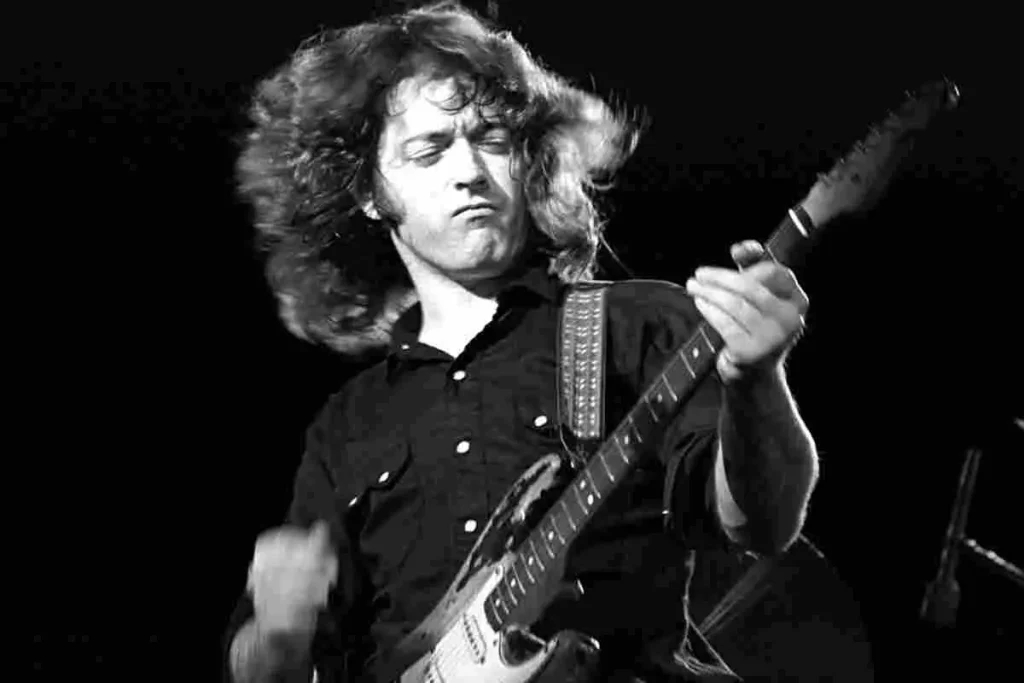
Rory Gallagher (2 March 1948 – 14 June 1995) is often described with the kind of praise that sounds polite: “tasteful,” “authentic,” “a musician’s musician.” That framing sells him short. Gallagher was a one-man correction to rock guitar’s worst habit: mistaking volume and flash for depth.
He learned the blues the hard way, by listening obsessively to radio broadcasts that treated blues as a cousin of jazz rather than a branch of rock. Then he built a style that was neither museum-piece purism nor blues-rock cliché. If you love the blues but get bored by the “learn five licks, bend like B.B., call it soul” approach, Gallagher is your antidote.
The quotes that explain everything: radio, curiosity, and the “primitive” spark
In a Chris Heim interview, Gallagher describes a childhood without a record player and a musical education assembled from late-night signals: BBC jazz programs, AFN jazz nights, and whatever else he could catch. He recalls hearing Lead Belly first, then Muddy Waters on a jazz broadcast, and feeling like the “raw blues” hit a deeper level than rock and roll.
“Even though I was a rock ’n’ roll fan, hearing the raw blues was like listening to music on a much deeper kind of level.”
– Rory Gallagher, interview with Chris Heim
That “deeper level” is not a mystical claim. It is a practical listening skill: the ability to hear rhythm guitar as the engine, not the wallpaper; to hear microtiming, touch, and dynamics as the story; and to hear older country-blues vocab as a living language, not a history lesson.
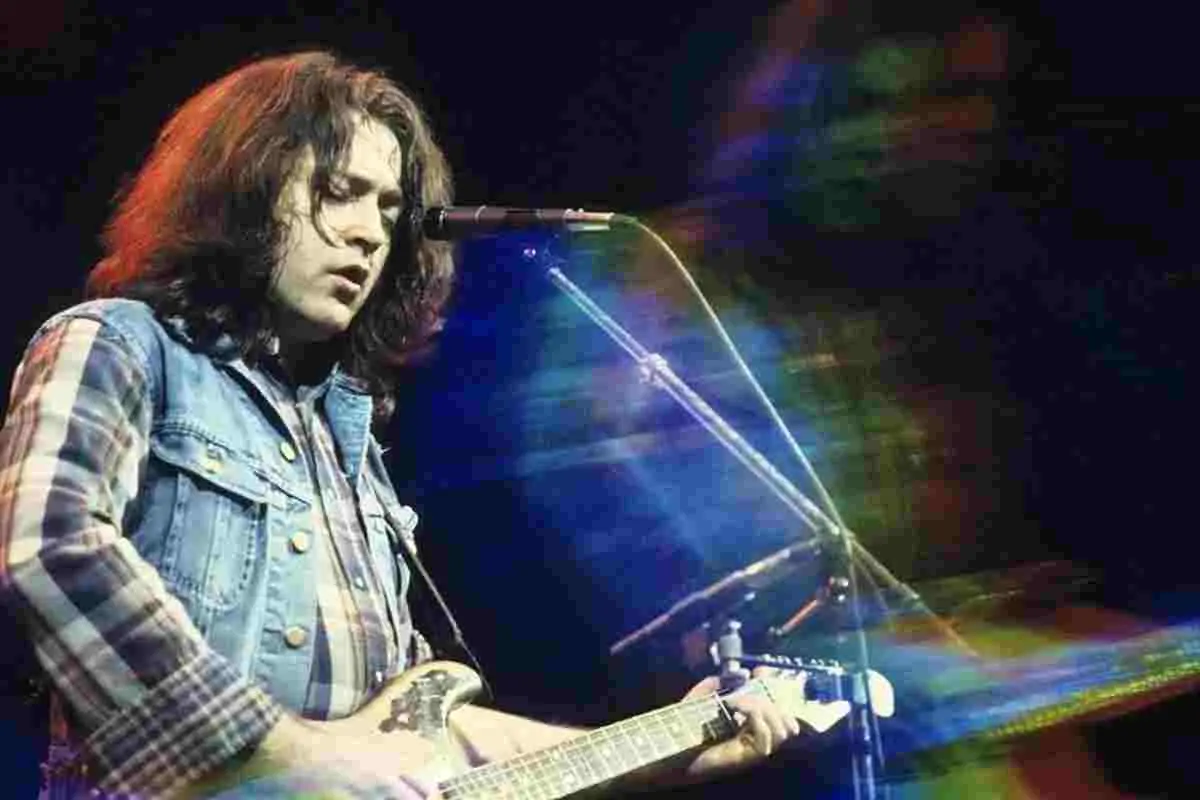
Gallagher was also blunt about a common trap for young guitarists: believing the blues begins and ends with a handful of electric giants. His point was not disrespect. It was that the blues has a long, messy borderland where country blues turns into electric blues, and the most revealing guitar ideas often live right on that seam.
“They don’t delve back into the country blues or the borderline where country blues turned into electric country blues.”
– Rory Gallagher, interview with Chris Heim
Why Gallagher’s blues education is a rebuke to today’s “content” culture
Gallagher’s origin story is inconvenient in the modern era, where players can binge tutorials, isolated tracks, and “ultimate tone” presets. He had limitation instead of choice: a radio dial, imperfect reception, and the need to memorize what he heard. The result is a style built on internalized rhythm and phrasing rather than copied shapes.
His official site and archival releases underline how central live performance was to his identity: relentless gigging, constant refinement, and a refusal to let the songs get comfortable. Gallagher’s guitar playing sounds like that lifestyle: urgent, slightly dangerous, and allergic to autopilot.
The blues wasn’t a costume for him, it was a work ethic
Many blues-rock players treat blues as a “vibe” layered on top of rock: slow minor pentatonics, a few big bends, and a moody face. Gallagher treated blues as a discipline of feel and form. That is why his best moments often happen when he is not soloing at all.
Here is the uncomfortable claim: if your rhythm playing is weak, your blues playing is not “raw.” It is unfinished. Gallagher’s interviews make clear he was obsessed with “open chord playing, rhythm and figures,” the stuff that holds a band together when the solos stop.
Gallagher’s “primitive” side, translated into actionable listening
- Listen for the right hand. Gallagher’s attack changes bar-to-bar, not just chorus-to-chorus.
- Listen for the bass relationship. His riffs often lock with the bass in a way that feels closer to older blues forms than to arena rock.
- Listen for the chord vocabulary. You will hear open strings, droning notes, and chord fragments that keep the harmony breathing.
If you want a clean map of his recorded work, a cataloged archive of documented releases and artifacts can be a useful reference point for sorting facts from fan myth.
Tasteful? No. He played like the rent was due
Gallagher’s tone is often described as “natural” or “unprocessed.” The truth is more interesting: it is earned. His sound comes from touch, volume discipline, and the willingness to let ugly frequencies exist when the song needs them.
That is why his battered Stratocaster became a symbol. His best-documented live era remains a reminder that the instrument was a tool used nightly, not a collectible preserved in plastic.
A quick “Gallagher mindset” tone checklist (no gear worship required)
| What you hear | What it usually means in practice |
|---|---|
| Notes pop, then decay fast | Firm pick attack, controlled muting, and letting the amp speak naturally |
| Dirty but not fizzy overdrive | Moderate gain, strong midrange focus, and volume-knob riding |
| Rhythm parts feel “alive” | Dynamic strumming, small timing pushes/pulls, and chord voicings with open strings |
| Solos sound like sentences | Motifs, call-and-response phrasing, and leaving space instead of filling bars |
The Irish Tour ’74 effect: why his live reputation won the argument
Some artists build legend through scarcity. Gallagher did it through proof. The live album and film era around Irish Tour ’74 remains a key reference for fans because it captures him in his element: working the room, stretching songs, and making blues-rock feel like something happening right now, not a reenactment.
Rolling Stone’s inclusion of the Irish Tour ’74 40th anniversary edition among notable reissues speaks to how enduring that document is for understanding his live power.
Gallagher vs. the “Three Kings” trap (and how to escape it)
Gallagher’s critique of blues education still lands because it is so common to build a blues identity from a small set of electric touchstones. Those artists are essential, but the danger is turning the blues into a narrow, standardized dialect: same box, same bend, same turnaround, same phrasing.
His remedy was not snobbery. It was curiosity. Go backwards. Learn the “borderline” styles where the electric language is still forming. You will discover different rhythmic priorities, different chord shapes, and a wider emotional range than the modern blues-rock default.
Practical “dig deeper” moves (in Gallagher’s spirit)
- Rebuild your blues rhythm from scratch. Spend a week playing only two-note chord fragments and alternating bass patterns.
- Limit your bends. Replace big bends with slides, hammer-ons, double-stops, and rhythmic motifs.
- Chase the borderlands. Look for recordings where acoustic sensibility collides with early electric grit.
Why he is still underrated: he refused the celebrity bargain
Gallagher is famous, but not famous enough for how good he was. Part of that is aesthetic: he did not package himself as a glamorous guitar god. Another part is strategic: he prioritized touring and musicianship over mythology-building publicity.
Even mainstream guitar canon nods to him, but often as a sidebar rather than a headline. Mainstream retrospectives and canon lists confirm the respect while also hinting at how often he gets filed under “connoisseur pick” instead of “household name.”
What to play if you want to learn something real (not just copy a tone)
The point is not to imitate Gallagher’s exact licks. It is to steal his priorities: rhythm first, dynamic control, and a wider blues vocabulary than the usual electric shortlist. Use his recordings as a mirror that shows what your hands are actually doing.
Three study approaches that work
- Transcribe rhythm, not solos. Write down a verse groove and make it feel good at three tempos.
- Practice “radio listening.” Put on a track once, then try to play along without rewinding. Force memory and instinct.
- Record your dynamics. Play the same chorus three times: whisper, normal, and loud, without changing tempo.
If you need a compact biography baseline and key career landmarks, a compact biography baseline and career landmarks is serviceable for dates and discography scaffolding, as long as you treat it as a starting point rather than a final authority.
The deeper point: the blues is bigger than guitar heroism
Gallagher’s radio-blues education is a reminder that the blues was not designed to be a guitar Olympics event. It is a song form, a rhythmic language, and a human voice translated into strings. His genius was that he could be ferocious without turning the music into a stunt.
A lot of profiles lean into this exact paradox: a blues-rock hero widely revered by musicians, yet easy for casual listeners to miss unless someone points the way.
Conclusion: Rory’s lesson is still uncomfortable, which is why it still matters
Gallagher’s comments about radio, Lead Belly, Muddy Waters, and the neglected “borderline” blues are not nostalgia. They are a challenge: stop treating the blues as a narrow electric style and start treating it as a deep musical continuum.
Play fewer “signature licks.” Learn better rhythm. Listen harder. And if the music feels a little raw and exposed, you are finally getting close to what Rory Gallagher meant.