
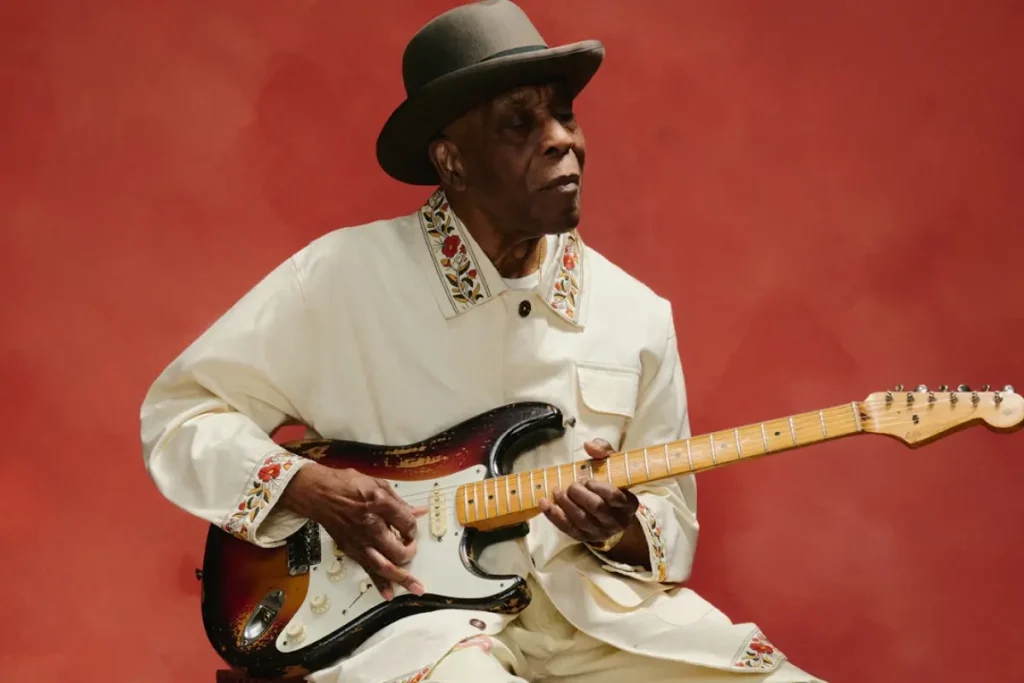
Buddy Guy has never asked for polite applause. In a Rick Landers interview, he lays out a philosophy that is blunt, almost confrontational: he does not want you to say you loved the show. He wants you to show it – in your face, your body, your attention, your reaction. That attitude is more than stage banter. It is a blueprint for what the blues has always demanded: proof of feeling.
“If somebody tell you they love you, they could be lying, but if somebody shows you they love you, you can’t lie about that.”
Buddy Guy, recalling his mother, in an interview with Rick Landers
This is where Buddy’s greatness lives. Not just in bends and volume, but in a lifelong obsession with the audience as a lie detector. The blues, in his hands, is not nostalgia. It is a stress test: for the song, for the performer, and for the listener.
Why this quote hits harder than a guitar solo
Buddy’s story turns on a simple, devastating fact: his mother never got to see him play. That absence becomes his standard. If he cannot play for her, he plays as if she is in every room, taking the measure of whether he meant what he sang.
The line about love being proven, not spoken, is not a cute saying. It is a performance ethic. You can fake “I’m having fun” onstage. You cannot fake sweat, focus, and the kind of risk that makes a song feel like it might fall apart. Buddy builds his show around that risk.
The blues as a lie detector
Buddy Guy’s whole point is that the blues exposes you. It exposes the singer who cannot inhabit the lyric, the guitarist who hides behind licks, and the audience member who wants the idea of the blues without the discomfort of it.
His method is almost scientific. He watches faces. If the spotlight blinds him, he asks for it to be taken off so he can see people. That detail is telling: many stars love distance and haze. Buddy wants eye contact, because eye contact is accountability.
PBS’s portrait of Buddy as a living, forward-driving blues force frames him as an artist who carried the tradition forward while still making it personal and immediate, not museum music. That “immediate” part is exactly what he is describing: if he cannot read you, he cannot complete the circuit.
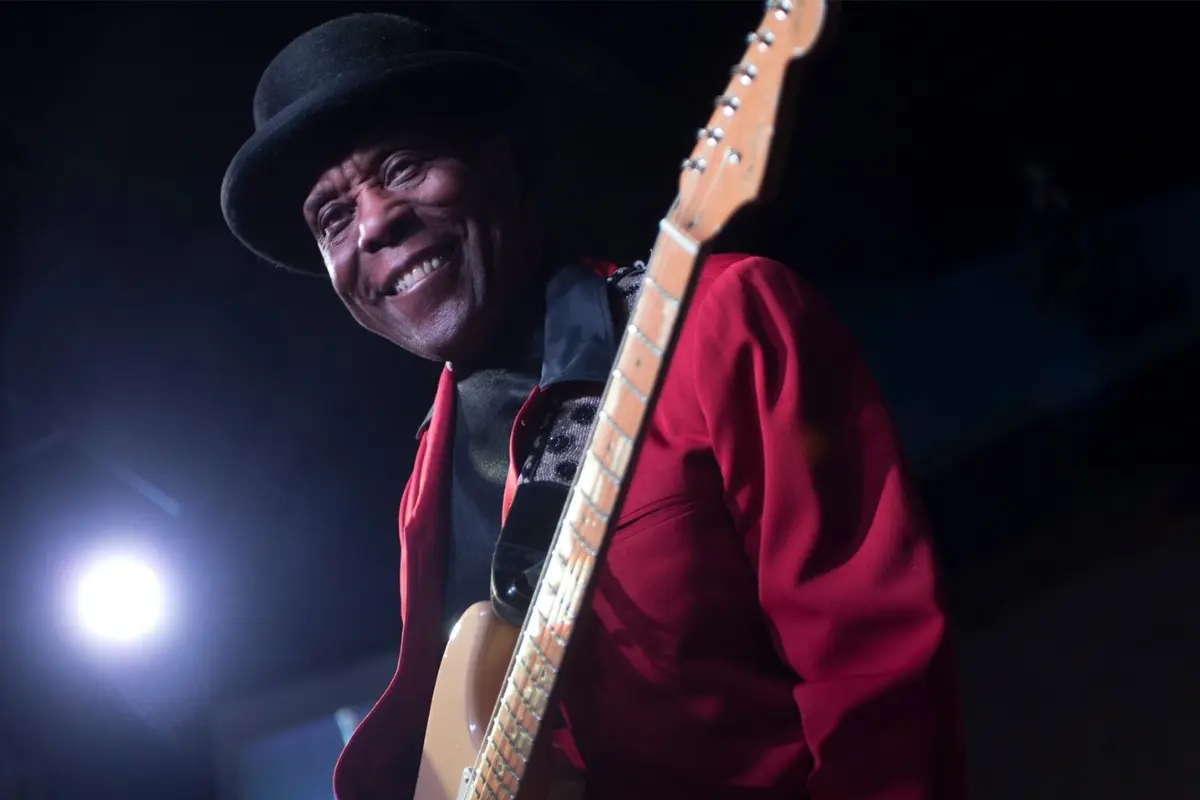
Edgy claim: Buddy Guy doesn’t “entertain” – he interrogates
Here is the provocative truth many fans miss. Buddy Guy’s most famous live move is not a signature riff. It is his refusal to let you sit back and consume the show like a product. In his interview, he all but says: I’m after you.
That is not metaphor. It is a mission statement.
In an era when classic acts can coast on greatest-hits autopilot, Buddy’s posture is almost aggressive. He is not there to be validated. He is there to give “every damn thing” he has, whether you smile or not, and make sure you know it.
Where that intensity comes from: roots, migration, and Chicago electricity
Buddy Guy was born in Lettsworth, Louisiana, and became one of the key architects of Chicago’s modern electric blues, a style shaped by migration, urban clubs, and louder instruments. The blues is full of artists who refined a sound. Buddy weaponized it.
Chicago electric blues is often described as Delta feeling plugged into city current: sharper attack, bigger bands, and an edge built for crowded rooms. That environment rewards players who can cut through noise and distraction, and Buddy learned to do exactly that.
Buddy’s long arc through the Chicago scene and beyond is outlined in biographical summaries of his career chronology and major recordings.
“Take the spotlight off me”: a masterclass in live communication
It is worth pausing on that spotlight moment, because it is practical advice for performers. Buddy is describing a common stage problem: lighting that flatters the show but kills connection. If you cannot see the crowd, you cannot adjust your pacing, dynamics, or emotional temperature.
What Buddy is really doing (and what you can steal)
- He monitors attention. Faces tell him whether the room is with him.
- He prefers feedback to fantasy. If the crowd is bored, he wants to know now.
- He builds trust through effort. Even skeptics recognize authenticity when someone empties the tank.
This is the blues version of a brutally honest soundcheck. Not for gear – for humanity.
Show, don’t tell: Buddy Guy’s authenticity checklist
Buddy’s quote can be translated into a working checklist for any blues singer or guitarist who wants to sound less like an imitation and more like a person.
| Buddy Guy principle | What it looks like onstage | Common mistake it avoids |
|---|---|---|
| Make it visible | Big dynamic swings, clear phrasing, physical commitment | Hiding behind constant volume |
| Seek real reaction | Eye contact, call-and-response, space for audience noise | Playing to the back wall |
| Earn belief | Lyrics delivered like testimony, not theater | Blues as costume |
| Risk something | Improvisation, extended endings, unplanned moments | Over-rehearsed stiffness |
Buddy’s guitar style: drama, danger, and control
Even when you strip away the legend, Buddy’s playing has a few consistent traits: vocal-like bends, sharp rhythmic punctuation, and a willingness to let a note sound “too” high, “too” strained, or “too” loud if that is what the lyric needs. The blues is not polite, and Buddy refuses to sand it down.
That approach is part of why so many rock and blues guitarists cite him as a bridge between older electric blues and the more explosive vocabulary that shaped rock guitar. His influence and long-running career are emphasized in artist bios that note how he kept working well past the era when many peers slowed down.
The awards matter, but the point is bigger than trophies
Buddy Guy has been honored in the ways institutions know how: major awards, lifetime recognition, and documentary profiles. The Blues Foundation’s Hall of Fame recognition situates him as a pillar in the genre’s official lineage.
But Buddy’s interview perspective is almost anti-award. He is not chasing a plaque. He is chasing the moment when a roomful of strangers cannot deny they felt something real.
That push-and-pull between honor and urgency is visible in the wider ecosystem of recognition too, including the Blues Music Awards program, which reflects how the community tries to formalize excellence in a music built on the moment.

If you want to understand Buddy Guy, watch the live evidence
You do not have to take anyone’s word for Buddy Guy. His whole argument is that talk is cheap. Go look at performances where he controls a crowd with nothing but phrasing and nerve, then compare that to “safe” blues sets that never change temperature.
For quick proof in bite-size form, there are live performance videos that capture his crowd-control and full-throttle delivery.
The mother line is a blues manifesto
Buddy’s mother’s advice is bigger than family wisdom. It is the blues distilled: people will say anything, but emotion has tells. The tremor in a voice, the way a note wavers and then steadies, the split-second decision to hold silence instead of filling it – those are the “shows” that cannot lie.
Smithsonian Folkways’ documentation of blues recordings and related materials illustrates how deeply the music runs through American recorded history, which makes Buddy’s insistence on liveness feel even more radical.
Likewise, the National Jukebox collection overview speaks to the preservation of early recordings, reminding us that the blues has always lived in the tension between documentation and lived experience.
Practical takeaways for players: how to “show” the blues
Want a Buddy-approved approach without copying his licks? Focus on what his quote actually demands: visible commitment and readable emotion.
For singers
- Sing to one person at a time. Pick faces, not the void.
- Let the lyric lead. If the words are bitter, do not “pretty” them up.
- Use dynamics like punctuation. Whisper, then hit. Do not cruise.
For guitarists
- Bend with intention. Hit the note like you mean it, not like you practiced it.
- Leave space. A pause can be more honest than another run.
- Play to the room. If the audience shifts, shift with them.
Conclusion: Buddy Guy’s “every damn thing” standard
The sharpest thing Buddy Guy says in that interview is not about technique. It is about integrity. He is willing to accept that you might not like what he played, but he refuses to let you doubt his effort or honesty.
That is the blues at its most uncomfortable and most necessary: not a genre that begs to be loved, but a music that dares you to watch closely and decide whether it is real.


