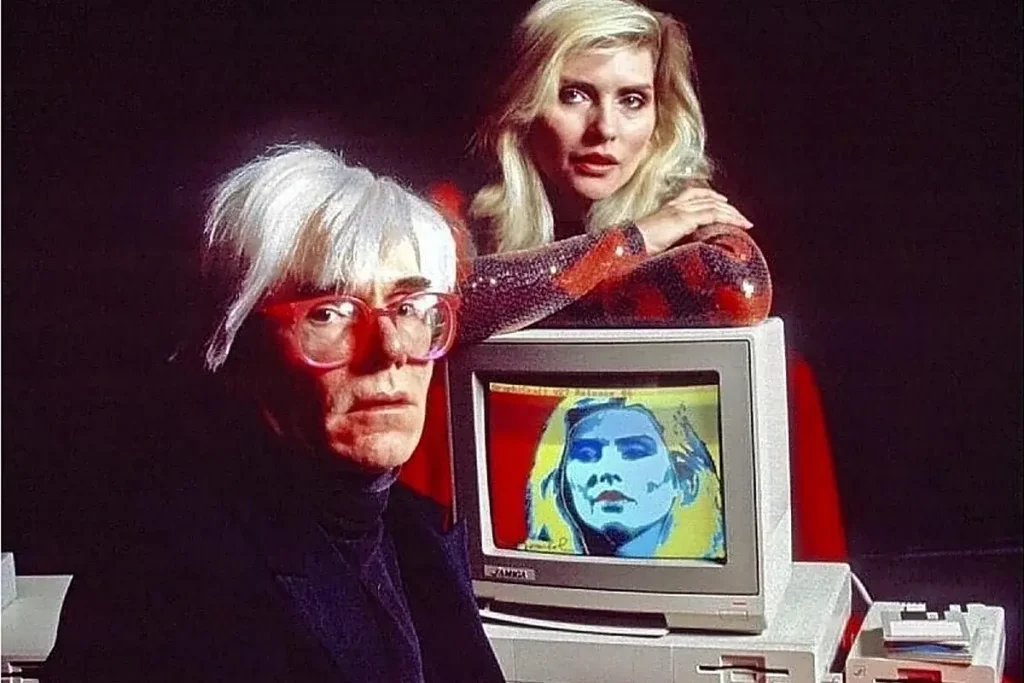
Andy Warhol making “computer art” sounds like one of those too-perfect internet legends. But in 1985, it actually happened: Warhol sat down with a Commodore Amiga and used it to create a digital portrait of Debbie Harry, the frontwoman of Blondie. The moment was part tech demo, part celebrity theater, and part sincere artistic curiosity, and it still feels eerily modern because it blurs the same boundaries we argue about today: image-making as software, fame as a medium, and art as a reproducible file.
“In the future, everyone will be world-famous for 15 minutes.” – Andy Warhol
That quote gets thrown around so much it can feel like wallpaper, but the Amiga portrait session is one of the rare times when Warhol’s prediction intersects with actual hardware and a real cultural moment. A pop artist known for silkscreened celebrity heads used an early mass-market multimedia computer to draw a pop star’s face, live, like a prototype of the influencer era.
What exactly happened in 1985?
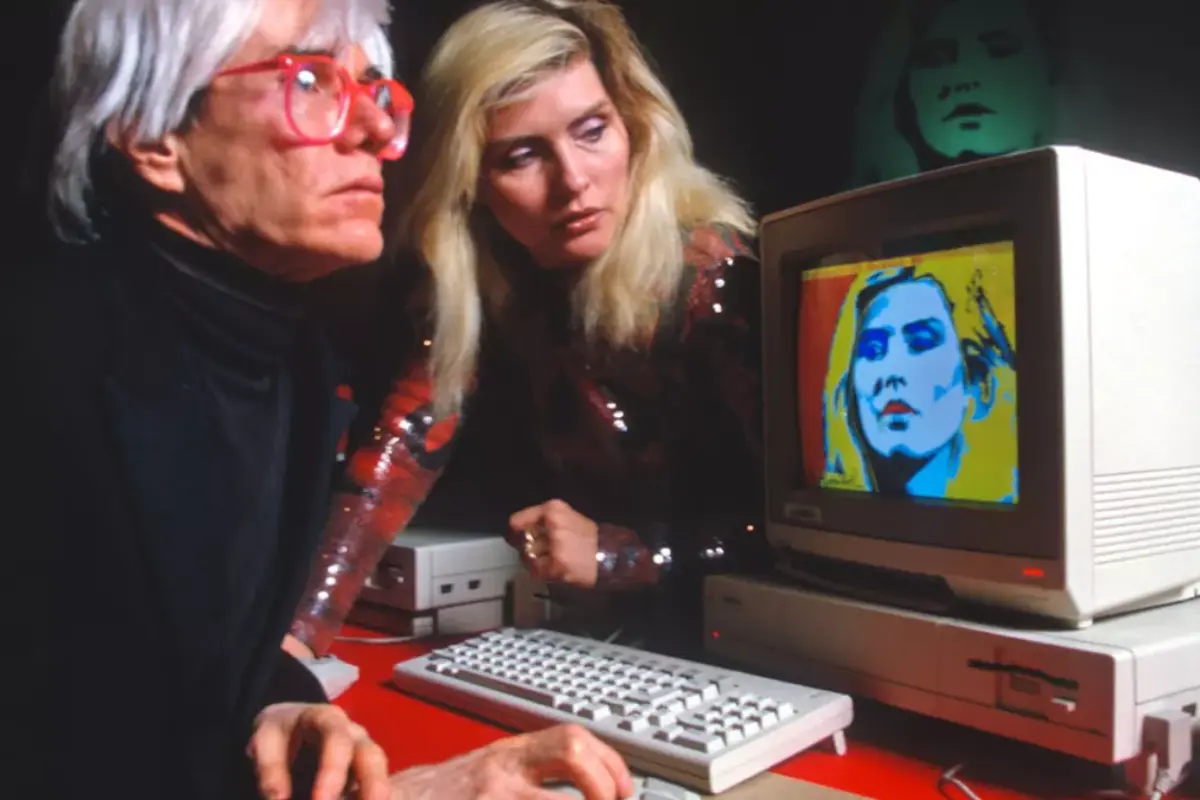
In 1985, Commodore staged a splashy launch event for the Amiga (often associated with the Amiga 1000), a computer positioned as a creative powerhouse for graphics, video, and sound rather than spreadsheets. Warhol appeared as a celebrity endorser and, during the presentation, used the Amiga to paint Debbie Harry on-screen, turning her into a digital Warhol subject in real time – an event preserved in footage of the demonstration.
The point was not that Warhol suddenly became a computer nerd. The point was that Commodore wanted the most famous art-world brand to validate its machine as a new kind of cultural tool, and Warhol was happy to test-drive any method that let him multiply an image and play with its surface. His career had always been about process as much as result, and a mouse-driven paint program is basically process turned into a performance.
Why the Amiga mattered (and why Warhol picked it, even casually)
The Amiga’s reputation rests on a simple idea: it was built for media. In the mid-1980s, that was radical. Where many personal computers treated color and sound as afterthoughts, the Amiga was designed to handle richer graphics and more sophisticated audiovisual tricks for its time. The Amiga 1000 became the flagship model associated with this launch-era hype.
Warhol didn’t need to understand every technical detail to “get” the cultural significance. If you’re an artist obsessed with mechanical reproduction, a computer is not just a tool – it’s a factory that fits on a desk. The Amiga pitch to the public was essentially: here’s a machine that makes images behave like media, not precious objects.
Debbie Harry: the perfect Warhol-era subject
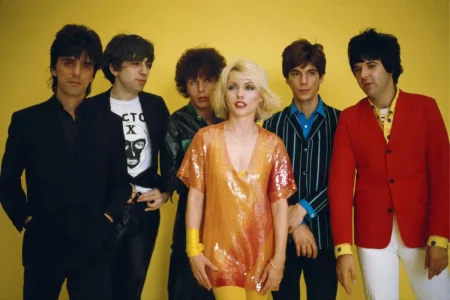
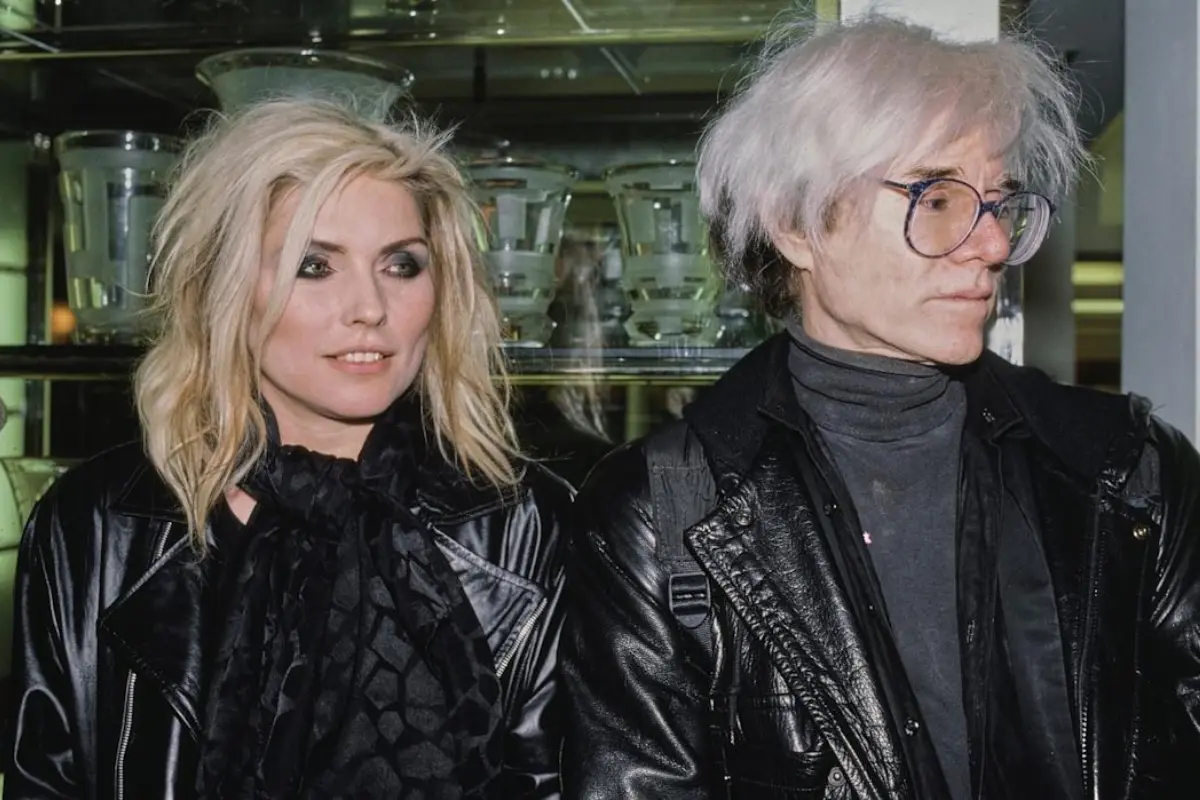
Debbie Harry was not a random model; she was celebrity with a sharp, art-aware edge. As Blondie’s face and voice, she sat at the intersection of punk attitude and pop accessibility, and she had already moved through the same downtown New York ecosystem Warhol loved to orbit. Her official site reflects the long arc of her public persona as a visual icon, not just a singer.
Warhol always understood that music and image are inseparable once the culture machine kicks in. Long before “branding” became an everyday word, Warhol treated stardom as a material you could print, tint, crop, and sell. Debbie Harry’s look – bold hair, high-contrast features, camera-ready detachment – is practically an instruction manual for pop portraiture.
The portrait itself: a pixel-era Warhol, not a silkscreen substitute
People sometimes frame the Amiga portrait as a gimmick, as if Warhol were only doing an ad. The better reading is that it was Warhol doing what he always did: using the newest reproduction technology to flatten a famous face into an image-object. The difference is the “object” is now a file-like artifact created with software, where undo/redo and tool palettes replace screens and inks.
On an Amiga paint program, the act of choosing color, filling shapes, and outlining features becomes visibly procedural. That matters because Warhol’s art is often misread as emotionally cold, when in reality it’s intensely focused on how images are made and circulated. Digital tools make that circulation feel inevitable: once an image is data, copying isn’t just easy – it’s the default.
From stage demo to recovered digital works: the bigger Amiga story
The 1985 Debbie Harry portrait session became even more interesting decades later, when researchers and conservators began recovering Warhol’s Amiga-era digital works from old floppy disks. That rediscovery is part of the broader story of digital art and how easily software-based work can slip out of view until the right tools – and attention – bring it back.
This recovery storyline matters for one reason: it turns the Amiga moment from a one-off spectacle into evidence of an actual practice. Warhol wasn’t only “posing” with a computer. He was exploring what it meant to sketch, color, and store images in a system where the medium is software-dependent and the artwork might be unreadable without the right tools.
Digital conservation is not nostalgia – it’s survival
When your art is tied to obsolete media, preserving it becomes part archaeology, part computer science. Even defining what counts as the “original” gets messy: is it the raw file, the display on a period-correct monitor, or a modern rendering of the same pixels? Museums have had to develop frameworks for how to talk about digital art as a category, because it behaves differently from canvas and ink.
That’s why Warhol’s Amiga work keeps showing up in conversations about conservation and authenticity. It isn’t only historically cute. It’s a real case study in what happens when a major artist makes work inside a technological ecosystem that quickly disappears.
Warhol’s pop logic meets 1980s computing: why this is more than a trivia fact
Warhol’s best-known celebrity portraits often feel like “mass production with attitude.” The Amiga portrait extends that logic into a world where mass production is instantaneous. In a sense, Warhol’s whole brand was a preview of digital culture: surface-first, remix-friendly, and obsessed with the feedback loop between media attention and personal identity.
Definitions of digital art tend to emphasize computation as part of the work’s creation or presentation, not just documentation. The Amiga portrait qualifies cleanly because the computer isn’t photographing an artwork – it is the instrument used to make the image, which fits how major institutions summarize Warhol’s practice and mediums.
Edgy claim (with a point): Warhol didn’t “predict the internet” – he rehearsed it
Warhol is often credited with forecasting modern fame culture, but the Amiga demo shows something sharper: he practiced a workflow that looks like today’s image-making pipeline. Capture a face, stylize it fast, flatten it into a shareable image, and let the medium do the multiplying. If you squint, it’s not far from a creator firing up an app, filtering a portrait, and posting it for reaction.
Even the public nature of the demo anticipates the performative aspect of digital creativity. It’s art as a live interface: the crowd watches the screen, not the artist’s hands, and the value comes partly from witnessing the process unfold.
A quick guide: how to “see” the Debbie Harry Amiga portrait like a music person
Know Your Instrument readers often think in sound, not pixels, so here are a few practical ways to map this story onto music culture.
1) Think of the Amiga like a new instrument, not a new canvas
Musicians understand that when a new instrument or technology arrives (electric guitar, synth, sampler), it changes the kind of art people make. The Amiga was pitched as a multimedia machine, and its creative software functioned like a new set of timbres and techniques for image-makers. A broader museum view of technology-crossing modern art practices similarly frames technology as part of the medium, not just a delivery channel.
2) The “sound” of the picture is its era
Just as gated reverb screams 1980s, early computer graphics carry a recognizable signature: limited color palettes, chunky edges, and bold fills. That aesthetic is not a failure. It’s the equivalent of a vintage synth’s constraints pushing you toward a specific kind of hook.
3) Debbie Harry’s face is the hook
Pop music thrives on hooks, and celebrity portraiture is similar. Warhol’s genius was choosing subjects whose image already behaved like a chorus: instantly recognizable, easy to repeat, and impossible to fully own because it belongs to the culture.
Fast facts table: the story at a glance
| Element | Why it matters |
|---|---|
| Andy Warhol | Pop artist whose work centered reproduction, celebrity, and media systems, as outlined in biographical overviews of his life and practice. |
| Commodore Amiga | An early personal computer associated with advanced multimedia capabilities for its time. |
| Debbie Harry | Frontwoman of Blondie and a visual icon who fit Warhol’s celebrity portrait tradition. |
| 1985 demo footage | Shows Warhol using the Amiga to draw Harry, turning the act into a public performance. |
Where the “portrait” sits in Warhol’s larger legacy
Warhol’s career is often summarized with soup cans and Marilyn, but his real subject was the media machine itself. The Debbie Harry Amiga portrait is a late-era echo of that obsession: the machine has changed from printing press logic to computing logic, but the cultural question is the same. Who controls the image? How fast can it replicate? What happens to identity when it’s reduced to a set of repeatable surfaces?
Institutions that collect and interpret Warhol now routinely present him as a figure who moved across commercial art, fine art, film, and celebrity culture. The Warhol Museum’s biographical framing reinforces how central mass media and portraiture were to his practice, and you can also see that institutional framing reflected in museum collection documentation of Warhol’s work.
Conclusion: the most Warhol thing Warhol ever did
Warhol using an Amiga to paint Debbie Harry is not just a fun footnote. It’s a compressed lesson in modern culture: celebrity as raw material, technology as collaborator, and art as a file that wants to travel. If you care about music history, it’s also a reminder that sound scenes and art scenes share the same electricity – new tools arrive, stars become symbols, and the audience watches the interface as much as the performance.
And yes: it also proves Warhol could do what today’s creators do constantly – turn a famous face into a digital object on a screen, in public, and make everyone argue about whether it “counts.” That argument, more than the pixels themselves, might be the real artwork.