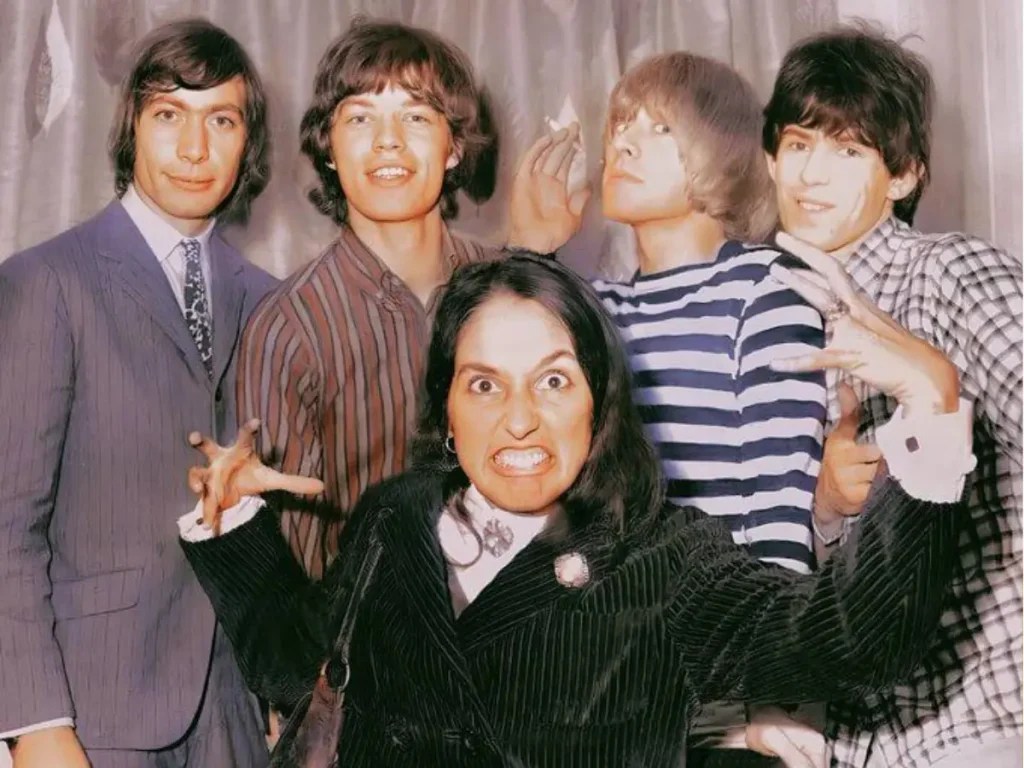
In one black-and-white photograph from 1965, the entire culture war of the decade seems to squeeze into a single meeting. Joan Baez – the pure-voiced conscience of the folk revival – stands beside Mick Jagger, frontman of the dirtiest band in Britain, backstage in Glasgow.
The date is 6 October 1965, the venue is the Odeon Theatre, and the Rolling Stones are in town for two screaming, 30-minute shows. Somewhere in that cramped backstage corridor, Baez walks into their orbit for a few minutes. It is a small encounter, but it perfectly captures the moment when protest folk and British rock stopped glaring at each other across the barricades and quietly shook hands.
The set-up: two different revolutions on one bill
The Rolling Stones in 1965: blues fanatics turned teen menace
By late 1965 the Rolling Stones had completed their evolution from scruffy club band to full-scale phenomenon. Their album Out of Our Heads had just turned them into chart royalty, mixing raw covers of American soul and blues with original hits like “The Last Time” and the explosive “(I Can’t Get No) Satisfaction.”
They were still obsessive students of American blues – Muddy Waters, Howlin’ Wolf, Slim Harpo – but they had learned how to repackage that sound for suburban teenagers from London to the American Midwest. Compared with the Beatles’ tidy charm, the Stones offered something more primal and less polite, drawing a straight, unapologetic line from Chicago bar bands to British dance halls.
The 2nd British Tour of 1965 was the moment that new identity hit full speed. Across 24 days the band blasted through 48 shows, often playing two short, deafening sets a night to packed cinemas and theatres around the UK. On 6 October they rolled into Glasgow for a pair of shows at the Odeon Theatre – a typical stop on a punishing schedule that was turning them into the most notorious live act in Britain.
Joan Baez: the inconvenient conscience of he folk boom
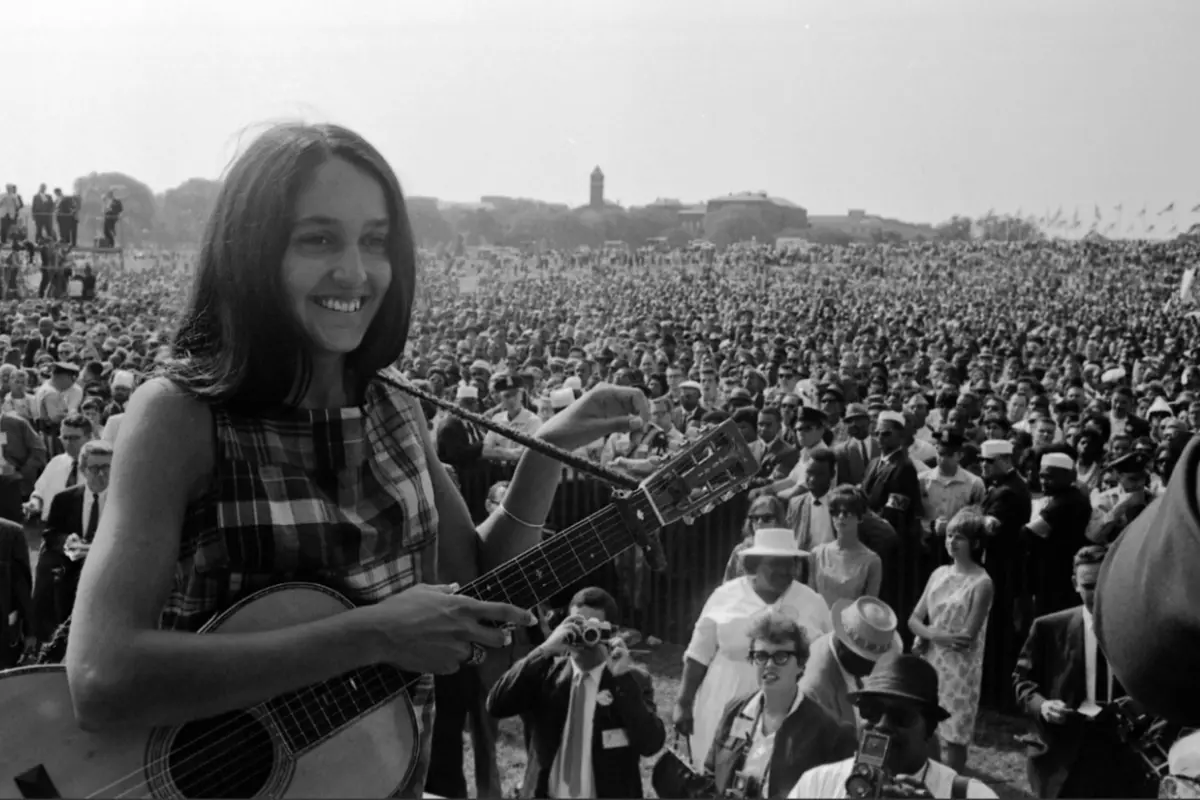
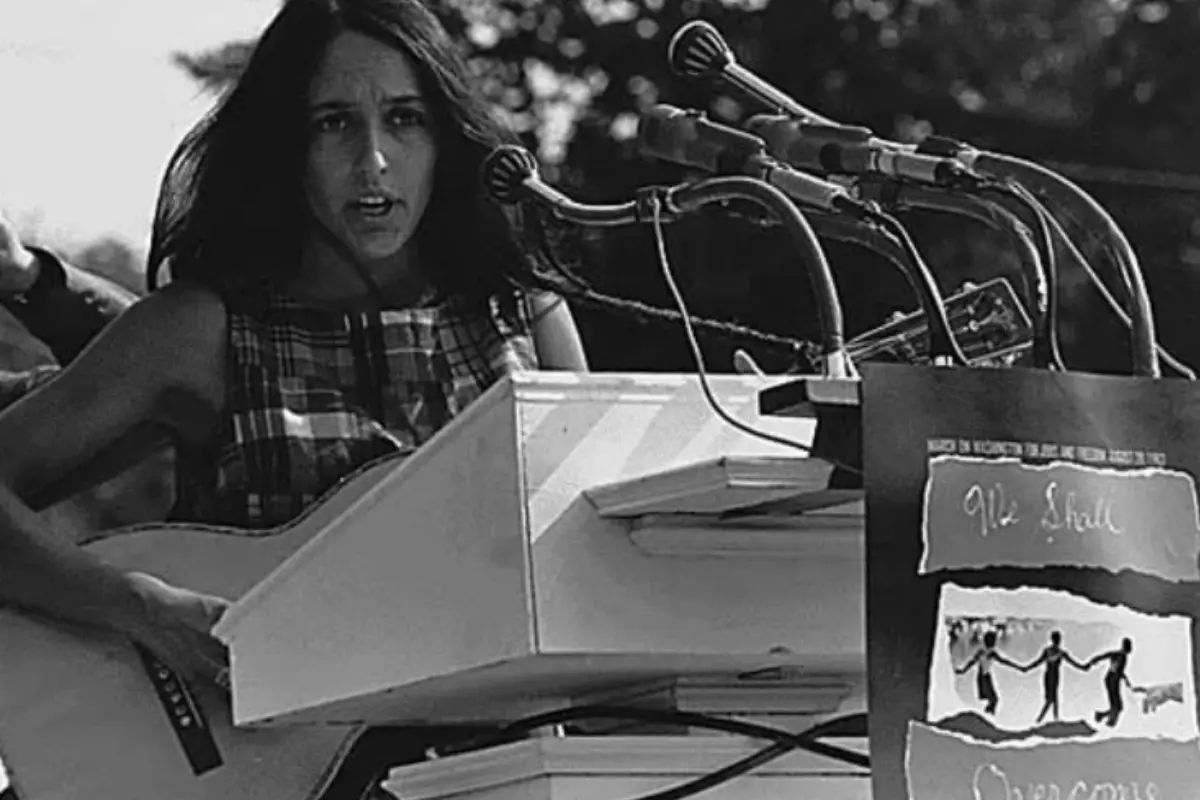
Joan Baez came into 1965 from a different angle entirely. She had already become the public face of the urban folk revival, filling halls with traditional ballads and topical songs while younger peers were still busking in coffee houses. In the folk world, Baez’s crystal soprano and classical poise carried as much weight as Jagger’s swagger did in rock.
Crucially, Baez treated music as a tool, not a diversion. She played free concerts for civil rights organizations, anti-Vietnam War rallies and humanitarian causes, refused to pay the portion of her taxes that funded the war, and served jail time for blocking an induction center during draft protests. For a generation of listeners, Baez was not entertainment so much as a moral weather vane.
So when that photograph catches her slipping into the Stones’ backstage world, it is not just a meeting of two celebrities. It is the folk movement’s most principled voice walking straight into the epicenter of British rock excess and saying, at least for a moment, “We occupy the same decade.”
6 October 1965: backstage at the Glasgow Odeon
The bare facts are simple and well-documented. On 6 October 1965 the Rolling Stones played two shows at the Odeon Theatre in Glasgow as part of their 2nd British Tour. Contemporary tour logs list the date and venue, and a Mirrorpix photograph – alongside the official tour listings – carries the caption: “Joan Baez meets Rolling Stones’ Mick Jagger in Glasgow where the Stones were playing two shows. 6th October 1965.”
The image itself is unremarkable in one sense: two young musicians in their mid-twenties, smiling, apparently mid-greeting, surrounded by the visual clutter of a typical 1960s backstage corridor. There are no guitars being smashed, no cops dragging protesters away, no crowd shots of fainting fans. It looks like what it was – a brief, friendly collision between two very different careers caught in the same hurricane.
Yet context gives the frame its charge. Outside, Glaswegian teenagers are queuing to see the Stones sprint through a set built on amplified American rhythm and blues. Inside, a woman whose voice has led civil rights marches and antiwar vigils is chatting with the singer who has just turned sexual frustration into a three-minute global anthem. The picture is polite; the implications are not.
Folk purity vs rock decadence – or a lazy myth?
Ever since the 1960s, commentators have loved to set Baez and the Stones up as moral opposites. One Washington Post columnist later contrasted Mick Jagger’s own shrugging description of rock songs as mostly about “cars, food and girls” with Baez’s catalogue of peace, justice and freedom, arguing that his social contribution was tiny next to hers. It is a brutal comparison, and not entirely unfair.
But the Glasgow meeting complicates that easy morality play. The Stones may have sold rebellion in tight trousers rather than manifestos, yet their sound depended on the same African American musical tradition that underpinned much of the urban folk revival. At the same time, Baez’s presence backstage tells you that she was not interested in living inside a purist bubble where electric guitars were automatically the enemy.
On the rock side of the curtain, the Stones were already edging toward something more sophisticated than bar-band blues. Out of Our Heads blended Marvin Gaye and Sam Cooke covers with originals that pulled in country, English folk textures and a sharper, more cynical lyrical voice – most famously in “Satisfaction,” whose sneer at consumer culture would later be read as proto-punk.
On the folk side, Baez was standing at a crossroads of her own. The urban revival that had carried her to fame was mutating fast: Bob Dylan had just detonated Newport by plugging in, folk-rock bands were forming by the week, and the idea that acoustic purity equaled political virtue was starting to look shaky. The fact that Baez could drop by a Stones show without the sky falling suggested that the real musicians were less dogmatic than their self-appointed gatekeepers.
From snapshot to sound: how the story continued
If the Glasgow meeting feels symbolic, that is because the next few years completed the arc it hints at. As the late 1960s wore on, the line between folk and rock grew blurrier, and the supposedly separate camps began raiding one another’s songbooks with abandon.
Baez herself eventually stepped over the imaginary border in a way that would have horrified the strictest folk purists of 1963. In 1970 she recorded the Rolling Stones ballad “No Expectations” on her Nashville-cut album One Day at a Time, turning a late-60s slide-guitar lament into a country-tinged meditation in her own voice.
That choice was not an accident or a novelty. It was Baez acknowledging that some of the deepest emotional writing of the era was happening on rock records – and that a song born on a Stones album could carry as much poetic weight as anything from the coffeehouse era. In its way, the cover completes a circle that began with a polite meeting in a Glasgow hallway.
Meanwhile, the Stones were inching closer to the kind of gravitas Baez had embodied from the start. After Out of Our Heads, albums like Beggars Banquet and Let It Bleed pushed further into American roots music while tackling violence, apocalypse and moral exhaustion alongside the usual sex and swagger. The band never became a protest outfit, but the adolescent snarl of 1965 deepened into something darker and more adult.
Hearing the collision: what to play after you see the photo
If you want to “hear” what that Glasgow moment represents, you do not need a bootleg from the Odeon. You just need a short playlist that lets Baez and the Stones argue, flirt and overlap in your speakers.
| Artist | Recording | Year | Why it matters |
|---|---|---|---|
| Joan Baez | Farewell, Angelina (album) | 1965 | Baez at peak folk power, wrapping Dylan-era songwriting in a voice that still sounds like the era’s moral conscience. |
| The Rolling Stones | Out of Our Heads (UK or US) | 1965 | The record the Glasgow tour was effectively selling – raw R&B colliding with the new arrogance of “Satisfaction.” |
| The Rolling Stones | “No Expectations” | 1968 | A slow, country-blues ballad that strips away bravado and reveals the vulnerable core Baez later found so worth covering. |
| Joan Baez | “No Expectations” (One Day at a Time) | 1970 | Baez taking a Stones song and making it her own, proof that the supposed walls between folk and rock were mostly in critics’ heads. |
| Various | Live clips from Newport and early Stones TV spots | 1963–1965 | Watch the body language: you can almost see folk’s earnestness and rock’s chaos drawing from the same deep well. |
One stolen moment, two revolutions
No one seriously claims that a few minutes backstage in Glasgow changed the course of music history. The Stones would have filled arenas and Baez would have marched on regardless. But that quiet encounter, frozen by a newspaper photographer, gives the lie to the idea that the 1960s were neatly divided into “serious” and “trashy” music camps.
In that photograph you see two revolutions crossing paths without drama: the folk singer who believed songs could change laws, and the rock singer who proved that volume and attitude could shake whole societies even when the lyrics were about less noble things. For a brief moment in October 1965, they shared a hallway, a conversation, and a frame – and the distance between their worlds suddenly did not look so large.