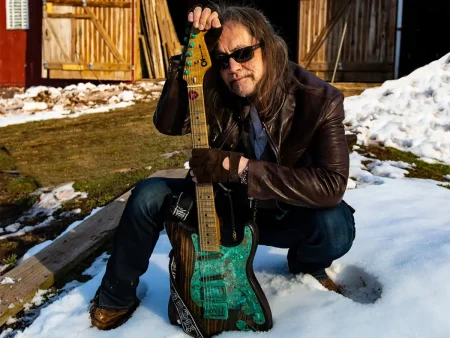
Zakk Wylde is the rare rock figure who feels like a comic-book character and still plays like a disciplined craftsman. The hair, beard, vests, and biker swagger are loud, sure – but the real “larger than life” part is the right hand, the vibrato, and the way his pinch harmonics jump out like they’re trying to start a bar fight.
And yes, the origin story is unexpectedly wholesome: before he became Ozzy Osbourne’s most imposing guitarist, Wylde was chasing a different kind of stadium dream. He’s spoken about wanting to be a professional baseball player before taking up guitar as a teenager, which makes his later career feel even more like a hard left turn into destiny on his official site.
The late start that didn’t matter
Wylde didn’t grow up as a child prodigy with a guitar glued to his hands. By many accounts, he started playing around age 14, then progressed with the kind of single-minded intensity that becomes a theme in his story on his official site.
That “late start” is a useful myth-buster for readers who think it’s too late to get dangerous on an instrument. The bigger truth is that rock guitar rewards obsession, consistency, and touch – and Wylde built his identity around those three things.
Baseball mindset, metal execution
Think about why the baseball detail matters. A kid aiming for pro sports already understands practice, repetition, and competing with yourself. Swap batting cages for metronomes and you get the engine behind a player whose riffs sound like they’re trying to bench-press the drum kit.
Wylde’s “athlete” mentality also explains how he survived the most unforgiving gig in hard rock: stepping into Ozzy’s orbit, where fans compare you to Randy Rhoads and Jake E. Lee before you’ve even finished tuning.
Getting the Ozzy gig: talent, timing, and nerve
Wylde joined Ozzy Osbourne in the late 1980s and quickly became a defining voice in Ozzy’s post-Rhoads era, contributing to records and tours that leaned heavier and more aggressive than much of Ozzy’s early solo work via the Ozzy Osbourne official site.
Ozzy’s band has always been a high-pressure lab for guitar heroes: you’re expected to honor the catalog while staking your claim. Wylde’s solution was blunt and effective: turn the gain up, tighten the rhythm attack, and make the guitar “sing” with a wide, vocal vibrato that could carry a stadium hook.

No Rest for the Wicked and the sound of a new era
No Rest for the Wicked is often framed as the moment Wylde’s identity hit the public at full volume: thick, muscular rhythms; screaming harmonics; and solos that feel like a blues player got strapped to a rocket. The broader point is that Wylde helped shift Ozzy into a more modern, punishing metal guitar language without losing the sing-along drama that makes Ozzy, Ozzy, as reflected in a Zakk Wylde artist profile.
If Randy was elegance and danger, and Jake was precision and bite, Wylde was brute force with a gospel choir in his vibrato. It wasn’t subtle, and that was the point.
Pinch harmonics: Wylde’s calling card (and why it works)
Plenty of players can squeal a pinch harmonic. Wylde made it punctuation – like exclamation marks in the middle of riffs. He didn’t just add harmonics to solos; he baked them into the rhythm language so the riff itself becomes a lead instrument.
“Practice makes perfect. Get your fundamentals together.” – Zakk Wylde (as quoted in the Black Label Society universe)
That quote is almost boring, which is why it’s revealing. The theatrics are real, but the method is brutally simple: fundamentals, repetition, and control. His harmonics aren’t random squeals – they’re placed where a singer would put a shout, where a drummer would hit a crash, where a crowd would raise a fist.
How to get closer to the “squeal” (without copying)
- Pick attack first: A hard, consistent downstroke gives the harmonic something to grab.
- Thumb placement: Lightly graze the string with the thumb edge immediately after the pick hits.
- High gain, but not chaos: Too much gain hides sloppy technique; Wylde’s sound is saturated but defined.
- Vibrato discipline: Wide vibrato is only impressive when it’s controlled and in tune.
If you’re a player reading this: Wylde’s trick isn’t “magic gear”. It’s committing to a physical style and practicing it until it’s automatic.
The bullseye Les Paul: branding that became mythology
The bullseye Les Paul look is so tied to Wylde that it’s basically a logo at this point. In a genre that loves visual symbols (Eddie’s stripes, Dime’s lightning, Slash’s top hat), Wylde’s bullseye reads like a warning label: this is going to be loud, direct, and unapologetic.
It also fits his musical philosophy: aim for impact. No floating ambiance. No tasteful fading into the mix. His guitar parts often feel like they’re supposed to sit front-and-center, dominating the song rather than decorating it.
Black Label Society: where the riffs got meaner and the choruses got bigger
If the Ozzy years made Wylde famous, Black Label Society (BLS) made him undeniable as a frontman, songwriter, and brand-builder. BLS is where his riff DNA fused into a consistent aesthetic: thick grooves, bluesy grit, metal bite, and choruses designed for beer-soaked group vocals.
The band’s official home frames BLS as more than a project – it’s presented like a fraternity of volume: tours, releases, and a long-running identity that fans buy into as a culture, not just a playlist, on the official Black Label Society site.
The “Southern flair” debate (and why it’s valid)
Some listeners call BLS “Southern metal” or “Southern hard rock,” others argue that label belongs elsewhere. The reality is simpler: Wylde borrows the swagger and pentatonic grit that Southern rock made famous, then runs it through a modern high-gain metal rig. Whether you call it Southern or not, the feel is there: big downbeats, blues bones, and riffs that swing even when they’re crushing.
Ozzy-era heaviness vs. Zakk-as-a-universe
Wylde’s Ozzy work is the proving ground; BLS is the empire. The key difference is responsibility. In Ozzy’s band, the guitar has to serve the “Prince of Darkness” story. In BLS, Wylde gets to build his own mythology: biker sermons, brotherhood language, and riffs that feel like engines.
That’s also why some fans say Wylde isn’t “just a guitarist.” He’s a complete hard-rock archetype: vocalist, writer, bandleader, and relentless road dog.
Gear and tone: the ingredients that keep showing up
Wylde’s tone is often described as saturated, mid-forward, and aggressive – with enough clarity that fast pentatonic runs don’t dissolve into fuzz. While his exact rig shifts over time, a few “anchor points” are consistent across credible gear profiles: hot pickups, loud amps, and pedals set for punch rather than subtlety.
Common components (the stuff players actually copy)
| Element | Why it matters in the Wylde-style sound |
|---|---|
| High-output humbuckers | Keep single-note lines thick and push the front of the amp hard. |
| Overdrive/boost | Tightens the low end so fast riffs stay percussive. |
| Chorus (sparingly) | Adds sheen and width for clean parts and certain leads. |
| Strong vibrato and pick attack | The “secret sauce” is touch: the hands do more than the knobs. |
For a more practical view of how fans approximate his sound, a breakdown of Wylde-ish amp settings highlights the emphasis on mids, gain structure, and tightness rather than scooped, fizzy distortion.
Signature gear exists for a reason
Wylde has long-running associations with specific gear brands and signature products, reflecting how central tone is to his identity. Zakk Wylde’s signature Jim Dunlop line is one example of how his playing style translated into mass-market tools for fans chasing that same aggressive feel.
The persona: beard, tattoos, leather – and a surprisingly disciplined core
Wylde’s aesthetic has always been maximal: the beard, the tattoos, the “battle vest” vibe. But the most interesting contrast is that behind the visual chaos is a player who talks like a coach. His interviews and endorsements repeatedly circle back to fundamentals and work ethic, not mystical inspiration.
That’s why he connects with older rock and metal listeners: he’s not pretending to be delicate. He’s selling a lifestyle of commitment, and the music backs it up.

Not just Ozzy and BLS: the wider legacy
Wylde’s influence is measurable in the thousands of players who learned pinch harmonics, wide vibrato, and pentatonic “speed bursts” because they heard him do it with Ozzy. He’s also one of the few modern metal guitar stars whose phrasing is still unmistakably rooted in classic rock vocabulary.
He’s remained visible through collaborations, constant touring, and headline-worthy moves in the broader metal world, including high-profile live roles that keep his name in the conversation among multiple generations of fans in scenes that overlap with bands like Pantera.
Brewing, branding, and the business of being Zakk Wylde
Wylde’s brand extends beyond records and tours, including ventures that lean into his Viking-biker mythology. Valhalla Beer presents the project as part of the broader Wylde universe, reinforcing that his persona is not an accident – it’s a curated, consistent identity.
This matters for musicians reading the room: in a world where guitar heroes used to be sold by radio alone, Wylde shows how a distinct image, voice, and community can keep a career durable even as the industry changes.
What guitarists should steal from Zakk (and what to leave behind)
Steal this
- Rhythm first: His leads work because the riffs hit like a second drummer.
- Vibrato as a signature: It’s the most personal technique on guitar, and he made it unmistakable.
- Intentional showmanship: Every squeal and pose has a musical purpose: impact.
- Consistency: He built a sound and defended it for decades.
Maybe leave this behind
- Over-saturation: Copying the gain level without the technique can turn your tone into mush.
- Endless squeals: Pinch harmonics are seasoning, not the meal, unless you can phrase them like Wylde does.
- Image without substance: The beard doesn’t write the riffs.
Quick timeline: the “why he matters” highlights
For a concise overview of key milestones – early life, Ozzy era, Black Label Society, and other projects – a reference biography of his career milestones compiles the broad strokes in one place.
Conclusion: the baseball dream that turned into a guitar empire
Zakk Wylde’s story is satisfying because it’s not a fairy tale about effortless genius. It’s a story about pivoting hard, practicing harder, and turning a set of techniques – pinch harmonics, vibrato, riff discipline – into a personal language.
He didn’t just help Ozzy sound heavier. He proved that a guitarist can be both a hired gun and a self-made universe – and that sometimes the kid who wanted to go pro in baseball ends up swinging a Les Paul like a Louisville Slugger.