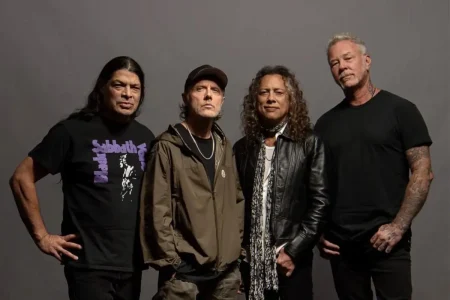
For many fans, the “classic” Metallica image is Hetfield grimacing at the mic and Ulrich flailing behind the kit. Look closer today and the real engine of the live show is often the duo flanking them: Kirk Hammett and Robert Trujillo. One is the Bay Area kid who replaced a future Megadeth icon; the other is the skate-punk bassist who walked into a million-dollar job.
Together they turned from “the new guys” into the glue that holds the world’s biggest metal band together. Their story is part friendship, part survival manual, and part lesson in how musicians quietly reshape a giant machine from the inside.
Kirk Hammett: the shy thrasher who became Metallica’s lead voice
By early 1983 Metallica were hungry, volatile and about to implode. Dave Mustaine was out, the band had hauled itself to New York to cut its debut, and they needed a new lead guitarist fast. They plucked Kirk Hammett from Bay Area peers Exodus; within weeks he was in the studio tracking what became Kill ‘Em All.
The phone call that changed his life could not have been less glamorous. Hammett has recalled sitting on the toilet on April Fool’s Day when Metallica’s camp rang to invite him to audition. He thought it was a prank until a cassette of their songs arrived in the mail, and Exodus singer Paul Baloff was so furious at losing him that he poured a beer over Kirk’s head.Hammett has recalled sitting on the toilet on April Fool’s Day when Metallica’s camp rang to invite him to audition. He thought it was a prank until a cassette of their songs arrived in the mail, and Exodus singer Paul Baloff was so furious at losing him that he poured a beer over Kirk’s head.
Hammett was never just a hired gun reading Mustaine’s parts. By the time of Ride the Lightning he was co-writing riffs and even naming songs. He suggested the title “Ride the Lightning” after a line in Stephen King’s The Stand, and the leap in the band’s harmony and lead work reflected the intense lessons he was taking from Joe Satriani at the time.
Those early records set his template: solos that were as hooky as the choruses, modal runs that pushed thrash out of blues-box comfort zones, and a willingness to let things get slightly out of control. The famous wah pedal obsession came later; at his peak he walked a knife edge between melody and chaos that made songs like “Fade to Black” and “Master of Puppets” feel cinematic rather than just fast.

What Hammett really brought to Metallica
- A melodic lead voice that could carry songs when Hetfield dropped to rhythm.
- A horror-nerd imagination that fit the band’s darker lyrical turn.
- Bay Area thrash credibility without Mustaine’s self-destruct button.
Hammett’s importance is easy to miss because he rarely writes lyrics or gives bombastic speeches. But from Ride the Lightning through the Black Album and into the modern era, his lead work is the color in Metallica’s sound. Strip it away and you are left with great riffs, but far less personality.
Robert Trujillo: the groove merchant with the million-dollar welcome
Two decades later, Metallica were in a very different crisis. Bassist Jason Newsted was gone, Hetfield was fresh out of rehab, and the band looked one bad argument away from implosion. Into this walked Robert Trujillo, a Santa Monica native whose resume ran from Suicidal Tendencies and funk-metal project Infectious Grooves to Ozzy Osbourne and Jerry Cantrell, blending hardcore attack with deep-pocket groove.
The world saw his tryout in the documentary Some Kind of Monster: Trujillo jamming through classic songs while the band sized him up. He has since admitted he rolled into his 2003 audition with the worst hangover of his life after drinking with Lars until 5 a.m., then spent two days playing under that fog – and still “annihilated the competition.” At the end of months of auditions he was offered the job, plus a cool million-dollar advance as a “welcome to the family.”
That kind of money would have wrecked plenty of players. Trujillo did the opposite. He went home, locked himself away with tablature books and live recordings, and crammed two decades of Metallica history plus a full album of fresh St. Anger material into his brain. Later he summed up his role in simple terms: he wanted to bring “peace, harmony and groove” to a band that had plenty of riffs but badly needed stability.He wanted to bring “peace, harmony and groove” to a band that had plenty of riffs but badly needed stability.
Unlike his pick-wielding predecessor, Trujillo mostly plays with his fingers, hammering chords and percussive accents that make songs like “Sad But True” and “Moth Into Flame” hit harder live. He is also, quietly, the longest-serving bassist in Metallica’s history, outlasting both Cliff Burton and Jason Newsted in tenure.
The indispensable outsiders
Both men stepped into mythic shadows. Hammett had to follow the guy who would go on to front Megadeth; Trujillo inherited a chair haunted by Burton’s legend and fans’ attachment to Newsted. Yet over time they stopped being “replacements” and became the sonic bookends of the band’s classic lineup.
| Member | Joined Metallica | Replaced | Key impact |
|---|---|---|---|
| Kirk Hammett | 1983 | Dave Mustaine | Defined Metallica’s lead guitar language and melodic identity. |
| Robert Trujillo | 2003 | Jason Newsted | Restored groove, morale and low-end power in the 21st century. |
Hammett: melodic chaos on tap
Hammett’s great strength is that he treats lead guitar like a singer, not a sport. Even when he is shredding at warp speed there is usually a vocal shape to his lines, a sense of call-and-response with Hetfield’s rhythm. That is why his solos on “One” or “The Unforgiven” lodge in listeners’ memories as strongly as any chorus.
Yes, the internet loves to roast him for leaning on the wah pedal and for some spotty nights on recent tours. But the same risky, improvisational streak that produces the occasional train wreck is exactly what keeps 40-year-old songs feeling dangerous instead of museum-grade.
Trujillo: groove as a weapon
Trujillo came from bands where the bass was not an afterthought but a lead instrument, and he smuggled that mentality into Metallica. Listen to modern live mixes and you can finally feel the bass shoving the guitars forward rather than just following them. His backing vocals and percussive fills give weight to choruses that might otherwise feel overly familiar.
More subtly, his presence seems to have calmed the band’s rhythm-section politics. The infamous bass-free mix of …And Justice for All would be unthinkable now; Trujillo has earned equal billing in the groove, and Metallica’s latter-day records sound heavier for it.
Kirk & Rob: the joyful frontline
Onstage, Hammett and Trujillo function almost like Metallica’s good-cop squad. While Hetfield carries the psychological weight of the lyrics and Ulrich steers the ship, Kirk and Rob roam the stage, clown with fans, and turn a stadium show into something that occasionally feels like a bar gig with obscenely good players.
Surfing, sanity and shared headspace
Their connection is not just musical. Trujillo has talked about how he and Hammett are both obsessive surfers, grabbing boards and heading for the ocean whenever the tour schedule leaves a gap. He describes Hammett as a yoga-practicing, surf-addicted bandmate, and notes that the two of them hit the waves together whenever they can.He describes Hammett as a yoga-practicing, surf-addicted bandmate, and notes that the two of them hit the waves together whenever they can.
For a band that once nearly collapsed under its own success, that kind of shared, offstage ritual matters. It keeps two key members grounded in something that is not merch numbers or setlists, and it forges a friendship that shows up in the way they trust each other musically.

WorldWired doodles: weaponized busking
The clearest public glimpse of their chemistry came on the WorldWired tour. Every night Hammett and Trujillo were given a duet slot. At first they tried deep-cut Metallica songs, but crowds kept waiting for Hetfield to appear, so the moment felt like a prelude instead of its own event. Trujillo recalls they pivoted by playing city-specific covers, from “Le Freak” to local rock staples like “Radar Love” in Amsterdam, turning half a million-seat stadiums into drunken singalongs.
In the 72 Seasons sessions Hammett described how wild those duets became: jazz, country, Eastern European folk, French and Dutch pop, you name it. The two of them would sometimes choose a complex song in a foreign language, woodshed it 30 times in a hotel room, then keep rehearsing right up until showtime so they could play it convincingly and “from the heart” in front of 80,000 people.Hammett described how wild those duets became: jazz, country, Eastern European folk, French and Dutch pop, you name it.
This is not just a cute sideshow. It reveals two veteran players who are still curious, still slightly terrified by new challenges, and still willing to risk failure in public for the sake of connection. That attitude bleeds back into Metallica proper.
The Wedding Band: joy outside the Metallica machine
When they are not carrying Metallica’s flag, Hammett and Trujillo blow off steam with their covers project The Wedding Band. In 2019 they led an all-star lineup through a riotous club set in Ontario, ripping through everything from Black Sabbath and Motörhead to Kool & the Gang’s “Jungle Boogie” and Chic-style funk.
For two guys used to pyro, giant screens and drum risers, playing sweaty, low-ceiling shows for a few hundred people is a reset button. It keeps their ears tuned to groove and dynamics rather than production cues, and it reinforces the simple fact that underneath the brand name “Metallica” they are still just working musicians who love loud guitars and weird covers.
Why their partnership matters
Strip Metallica down to song credits and corporate decisions and you could think it is a two-man operation. In reality, the band that still fills stadiums depends heavily on a lead guitarist who quietly rewrote the language of thrash and a bassist who walked into chaos and responded by locking the groove down.
For listeners who grew up on 70s rock or early 80s metal and drifted away when the haircuts got shorter and the records got slicker, it is worth revisiting modern Metallica with musician ears. Hear the way Hammett still searches for new angles inside old solos, and how Trujillo drags songs like “Seek & Destroy” into the present with sheer low-end authority.
Metallica might still be Hetfield and Ulrich’s kingdom on paper. But out on the stage and in the rehearsal room, it is often Kirk Hammett and Robert Trujillo – surfing together, jamming obscure pop tunes and turning risk into groove – who keep that kingdom feeling alive instead of embalmed.