
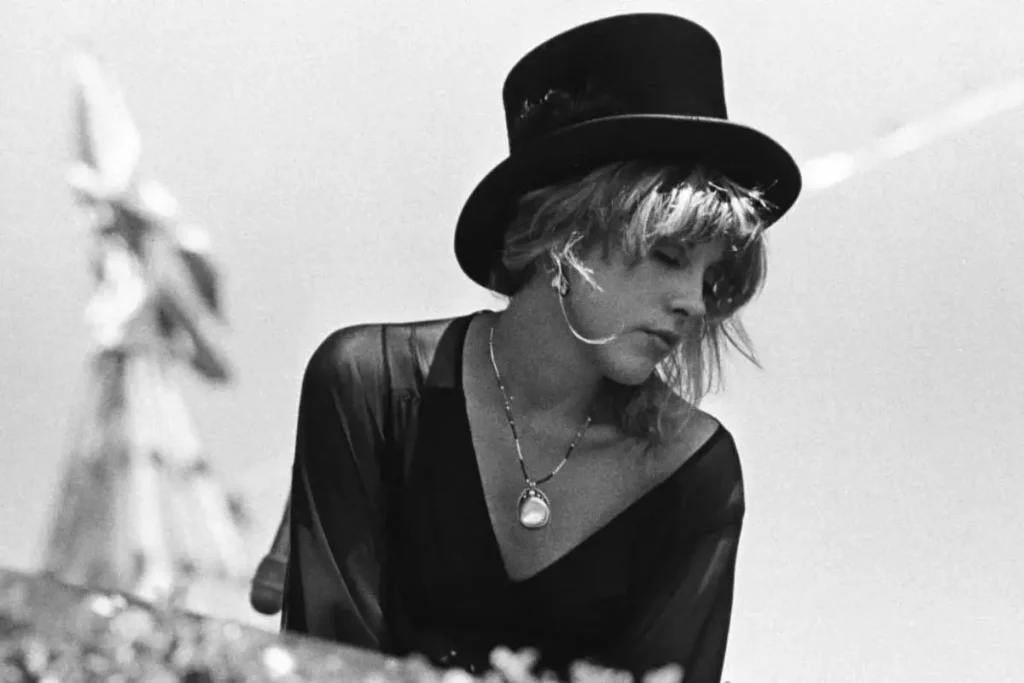
Before Stevie Nicks was rock’s resident sorceress, she was a broke songwriter in Los Angeles, waiting tables and cleaning houses to keep the lights on. Out of that grind came a song about a woman who might be a ghost, a witch, a goddess or all three, and it changed her life – and Fleetwood Mac’s future.
“Rhiannon” is more than a mid-70s radio staple. It is the moment Nicks fused paperback occult fiction, ancient Welsh mythology and raw relationship drama into a four-minute spell that still has not worn off.
A paperback, a piano and a ten-minute spell
In the early 1970s, Stevie Nicks and Lindsey Buckingham were struggling in LA after their Buckingham Nicks album flopped. She paid the rent by waiting tables and cleaning producer Keith Olsen’s house while the two of them chased songs at night, long before Fleetwood Mac came calling.
At a friend’s place, Nicks picked up a cheap fantasy paperback called Triad by Mary Bartlet Leader. The novel’s story of a woman possessed by a spirit named Rhiannon grabbed her so hard that she went home, sat at the piano and, by her own account, wrote most of “Rhiannon” in about ten minutes.
That first version was just Nicks, a piano and a cassette recorder in a cramped Marina del Rey apartment. The bones of the song were already there: minor-key verses, a chorus built on a simple plea – “will you ever win?” – and a character who felt powerful, haunted and utterly beyond anyone’s control.
From ghost story to Welsh goddess
When Nicks wrote “Rhiannon” in 1973, she thought she was simply inventing a celestial, otherworldly woman based on that novel. Years later she told Mojo that only in 1978 did she discover the medieval Welsh tales of the Mabinogion, and realize that Rhiannon was actually a mythological queen, not a witch at all.
That coincidence turned into an obsession. A fan later mailed Nicks a bundle of paperbacks, including Evangeline Walton’s retellings of the Mabinogion; Nicks said she was so transfixed that she bought the rights and began planning an entire Rhiannon project, imagining it as a movie, stage work or even a ballet, and spinning off related songs like “Angel,” “Stay Away” and “Maker of Birds.”
So the song that began as a gothic ghost-possession story quietly grafted itself onto a much older myth. You can hear that double exposure in the lyrics: this Rhiannon is both a modern, damaged woman and something ancient that blows in on the wind and refuses to be owned.
Turning a piano incantation into rock radio
When Nicks and Buckingham finally joined Fleetwood Mac at the end of 1974, she brought “Rhiannon” with her. The band cut it at Sound City in early 1975 for their self-titled “white album,” then issued it the next year as a single under the slightly desperate title “Rhiannon (Will You Ever Win).”
On record, the song is lean and focused: Mick Fleetwood’s toms roll like distant thunder, John McVie locks into a steady pulse, Buckingham’s fingerpicked guitar line snakes around Christine McVie’s bell-like Rhodes, and Nicks rides over the top with a vocal that starts conversational and ends as a ragged invocation. The single reached No. 11 on the US Billboard Hot 100, later hit No. 46 in the UK on reissue, and eventually landed at No. 488 on Rolling Stone’s list of the 500 Greatest Songs of All Time.
For a band that had never quite broken through in America, that mattered. Suddenly the weird, mid-tempo tune about a maybe-witch was not just album deep cut material; it was the track that made millions of listeners learn how to say “Rhiannon.”

Live “exorcisms” and the birth of the Stevie Nicks myth
Onstage, “Rhiannon” stopped being a tidy four-minute rock song and turned into a ritual. Nicks would often introduce it as “a song about an old Welsh witch,” then stretch it past six minutes, whirling in chiffon and top hat while the band hammered the outro and she screamed the closing refrain like a woman being dragged between worlds.
Drummer Mick Fleetwood later said that her performance of “Rhiannon” in those years was “like an exorcism,” and he was not exaggerating.[S5] Those nights cemented the public image that followed Nicks for decades: the “white witch” figure whose shawls, boots and wild-eyed delivery made femininity in rock look dangerous rather than decorative.
That image was deliberate, and it worked. A male singer howling about spirits might have sounded cartoonish; Nicks made it feel like a challenge, as if she were daring a very male rock world to decide whether it was afraid of her or in love with her.
How one song dragged Fleetwood Mac back to the top
Fleetwood Mac’s 1975 album did not explode out of the gate. It debuted at No. 183 on the Billboard 200 and spent more than a year clawing up the chart– an unprecedented slow-burn climb at the time.
Singles told the story. “Over My Head” became the band’s first US Top 20 hit, but it was “Rhiannon (Will You Ever Win)” that pushed deeper, debuting on the Hot 100 in March 1976 and grinding its way to No. 11 over an 18-week run, with a later UK reissue finally nudging into their Top 50. By the time “Say You Love Me” matched that No. 11 peak, the album had quietly turned from risky reboot into blockbuster.
Inside the band, of course, the wheels were already wobbling. Nicks and Buckingham’s romance was unraveling, and that breakup – alongside the McVies’ divorce and Mick Fleetwood’s marital collapse – would drive the emotional carnage of Rumours. As Know Your Instrument has explored, their love affair and its fallout powered a string of classics like “Dreams,” “Go Your Own Way” and “Silver Springs,” turning Fleetwood Mac into rock’s most compelling soap opera.
“Rhiannon” sits right at the pivot point: the song written in their tiny shared apartment that ended up financing the very fame and chaos that blew that relationship apart.
From FM staple to cross-generational spell
Unlike many 70s hits, “Rhiannon” never really left the culture. It stayed in Fleetwood Mac’s setlists for decades and became a rite of passage for female singers who wanted to test themselves against Nicks’ wild-eyed intensity.
In 2010, Nicks walked onstage at the Grammys to duet on “Rhiannon” with Taylor Swift, the biggest young star in pop-country at the time. The performance was ragged enough to spark think-pieces about pitch.
Critics have increasingly treated “Rhiannon” as the moment Nicks stepped into her full powers. Pitchfork’s career-spanning survey of her work frames the song as her breakout and the origin story of the pagan goddess persona she would refine on tracks like “Gold Dust Woman” and “Sisters of the Moon,” praising the way she sings as if toggling between human lover and mythic being.
Even the band’s own story keeps circling back to it. A recent book, Fleetwood Mac: All the Songs, devotes space to how “Rhiannon” grew out of that Mary Bartlet Leader novel and how much Nicks feared releasing it as a single, worried that her favorite song would flop – only to watch it become one of her defining statements and a cornerstone of her witchy stage persona.
Influence: making “witchy” women in rock inevitable
“Rhiannon” also helped redraw what a rock frontwoman could be. Long before words like “art-pop” or “witchy folk” were marketing terms, Nicks was mixing occult imagery, romantic turmoil and theatricality in a way that made space for others.
Florence Welch of Florence + the Machine has explicitly put Nicks in a pantheon with Kate Bush and Siouxsie Sioux, calling them her icons and framing herself as carrying on their tradition of dramatic, fiercely individual female performers rather than polished industry products. Listen to “Rhiannon,” then to something like “Rabbit Heart” or “Shake It Out,” and the lineage is hard to miss.
The song’s DNA runs through country, goth, indie and pop: any time you hear a woman onstage in flowing black, singing about storms, spirits or unnamed forces that might ruin you, there is at least a little Rhiannon in the room.
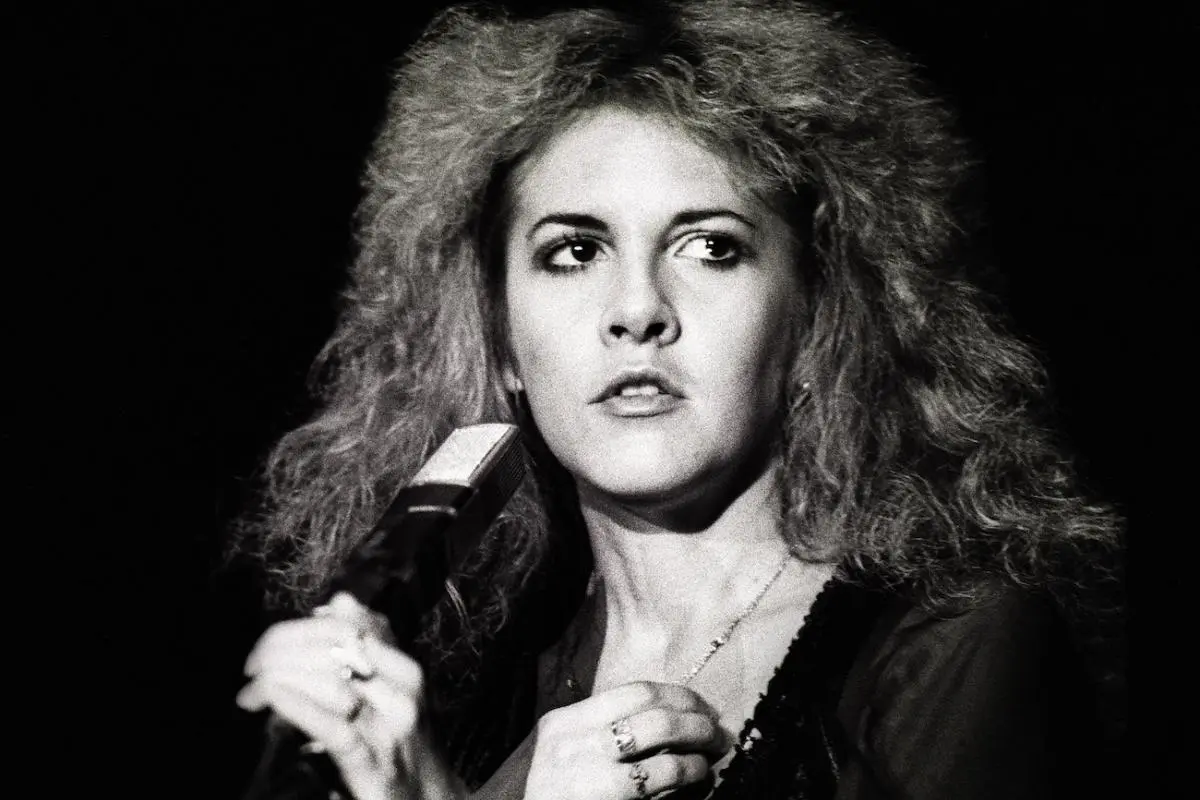
Why “Rhiannon” still feels dangerous
Part of what keeps “Rhiannon” unsettling is that the song never tells you who is really in control. The narrator sounds half-in love, half-terrified, and by the final chorus it is not clear whether the real danger is the woman in the song or the man still trying to “win” her.
That ambiguity was radical in the mid-70s and still feels sharp today. Instead of making the mysterious woman a villain to be defeated, Nicks made her the center of gravity and invited the rest of us to decide whether we were going to fear her, desire her, or let her blow past like weather.
Fifty years on, “Rhiannon” is not just a classic rock track. It is a small, elegant act of rebellion: a song in which the witch never apologizes, never explains herself and never, ever stops the wind.


