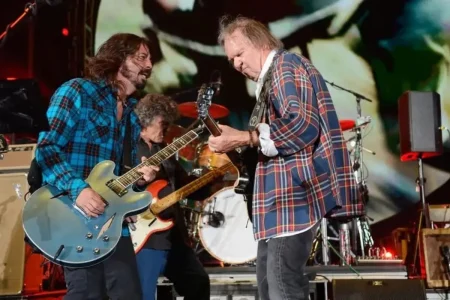
Neil Young has never been shy about trashing modern listening habits. In his view, MP3s give you maybe “5 percent” of the master, new vinyl is just CDs on wax, and what passes for rock & roll now is polite, Perry Como music in ripped jeans.
If you grew up with big wooden speakers, thick LP jackets and late night FM, that probably hits a nerve. So how much of Young’s rant is grumpy nostalgia, and how much is a brutally accurate read on how we actually hear music today?
Neil Young’s war on “5 percent” sound
Young started going public about sound quality in the early 2010s, arguing that lossy files like MP3 contain only a tiny slice of the information in his studio masters and that we now have “the worst sound we’ve ever had.” He was not attacking the songs, but the medium itself.
On a basic level he is right. A typical MP3 or low tier stream throws away huge amounts of data to shrink file sizes, especially in the high frequencies and low level detail where the codec thinks you will not notice. That is convenient on a phone, but it is nowhere near what left the mixing desk.
What 5 percent actually means
High resolution audio is usually defined as lossless digital audio mastered from better than CD quality sources, with bit depth and sample rate beyond 16-bit/44.1 kHz. Industry bodies describe it as a format that can reproduce the full spectrum of sound from those higher quality masters, not a magic ticket to “analog heaven.”
Where Young pushes things is in implying that standard formats are almost worthless. In truth, a properly encoded CD-quality or lossless file already covers the audible range extremely well, and controlled tests show that moving beyond that gives a subtle improvement, not a religious experience.

Does hi-res really sound better?
A large meta-analysis for the Audio Engineering Society looked at 18 studies and more than 12,000 listening trials comparing standard audio to better than CD-quality formats. Listeners could tell them apart more often than chance, especially when trained, but the effect was modest rather than explosive.
At the same time, technically minded engineers have pointed out that ultra extreme formats like 24-bit/192 kHz mostly waste storage and bandwidth without offering real world gains, and in some cases can even be slightly worse than standard 16/44.1 if badly implemented. In other words, resolution matters, but past a certain point the obsession becomes more about status than sound.
Pono, passion and the real problem
Young’s Pono player was his attempt to fix all this, promising studio quality hi-res files in a dedicated device instead of “digital crap.” It paired a high quality digital to analog converter with lossless, better-than-CD downloads in FLAC format sold as hi‑res music.
The irony is that Pono was arguably solving the wrong problem. The bigger villain in how modern records sound is not just file format, but mastering choices: hard limiting, crushed dynamics and the loudness war that makes everything hit “10” all the time. A brickwalled master will sound flat and fatiguing whether you ship it as MP3, CD or 192 kHz FLAC.
| Format | Typical quality | Real world result |
|---|---|---|
| Low bitrate stream (96-128 kbps) | Heavy data loss, smeared highs | Fine on phones, harsh on good speakers |
| High quality lossy (256-320 kbps) | Much closer to CD | Transparent for many casual listeners |
| CD-quality lossless (16-bit/44.1 kHz) | Full audible spectrum | Good enough for almost any system |
| Hi-res lossless (24-bit/96+ kHz) | More headroom, finer detail | Small but real benefit in ideal conditions |
“CDs on vinyl”: is new wax just a fashion statement?
In a widely quoted interview, Young warned that many buyers of new vinyl are really spinning “CD masters on vinyl,” calling large parts of the vinyl revival “nothing but a fashion statement.” The target was not vinyl as a format, but record companies cashing in by pressing digital masters onto wax.
He is not making this up. Writers who looked into the issue found that while plenty of electronic and indie releases are mastered specifically for vinyl, much of the booming reissue market simply takes existing digital remasters and runs them to lacquer. Young’s criticism of the vinyl revival points directly at that practice. You get the artwork and the ritual, but not some hidden analog gold.
Even the coveted sticker “mastered from the original analog tapes” can be marketing mush. In the current hybrid workflow it might mean a true all-analog chain, or it might mean the tapes were transferred to high resolution digital, tweaked in a workstation, then sent to the cutting lathe. Behind that phrase lies a whole range of possible signal chains. Some audiophile labels were forced to spell this out only after fans discovered digital steps hiding inside supposedly pure analog series.
Add to that the sheer economics. Vinyl has definitely roared back, even outselling CDs in recent industry reports, but physical formats still represent a small slice of revenue compared with streaming’s overwhelming share. For major labels, that makes most vinyl product as much lifestyle object as sonic upgrade, which is exactly what Young is attacking.
That said, a digital source does not automatically ruin a record. A well mastered LP from a good 24-bit file can sound more natural than a smashed, loudness war CD of the same album. Young is right to mock “fashion” vinyl, but wrong to assume that every digital step is poison.
Punk, Perry Como and the death of rock & roll
Young’s harshest line is not about formats at all. In a 1990s guitar interview he argued that punk and rock were really the same thing, that what now gets billed as “rock and roll” is actually pop product, an imitation that bears the same relation to real rock as Perry Como does to Little Richard. That interview lays out his view of “real” rock.
He later boiled it down even further: remember watching Perry Como on TV in a cashmere sweater while real rock & roll was exploding somewhere else? That, he said, is what rock itself was becoming – your parents’ music. Today, mainstream “rock” radio often sounds like exactly that: comfort food for middle aged ears, more about brand partnerships than danger.
Interestingly, data lines up with his instinct that something special happened in his era. A study highlighted by Know Your Instrument found that songs from roughly 1960 to 1999 form a “golden age” that younger listeners still recognize and remember far more than hits from the 2000s onward. The classic rock and soul catalog has outlived countless newer trends.
So when Young says real rock & roll is “gone,” he is really talking about the mainstream. The outlaw spirit still shows up in small clubs, noisy Bandcamp releases, extreme metal, underground hip hop and weird bedroom pop. But it rarely lives in the places the industry now labels “rock.” On that point, a lot of older listeners quietly agree with him.

How to actually hear more than 5 percent today
Strip away the hyperbole and Young is pointing at a real problem: we have more music than ever, and we often hear it in the most degraded, background way possible. The good news is that you do not need a triangular Pono player or a second mortgage to fix that.
Start with the basics. In your streaming apps, set quality to “high” or “lossless” instead of the default. Ditch the laptop speakers and phone mono drivers and use a modest DAC, an old receiver and a pair of decent passive speakers, or good wired headphones. The upgrade from “5 percent” to “good enough” happens very fast once the playback chain is not junk.
If you buy vinyl, treat it like a format, not a religion. Research specific pressings, look up the mastering engineer, and be skeptical of vague hype stickers. A clean, well pressed record from a good digital master will beat a noisy, off-center “all analog” hipster reissue every time.
Most of all, chase the spirit Young cares about rather than the gear he sells. Turn off shuffle, listen to whole albums, and go find bands that make you feel the way your first rock records did, whether they are playing fuzzed out guitars, samplers or synths. The industry may be happy to feed you 5 percent, but you do not have to listen like a 5 percent consumer.
Neil Young is exaggerating, as he always has, but that does not mean he is wrong. If his rants get you to demand better masters, better playback and braver music, then the old curmudgeon is still doing the job rock & roll was invented for.