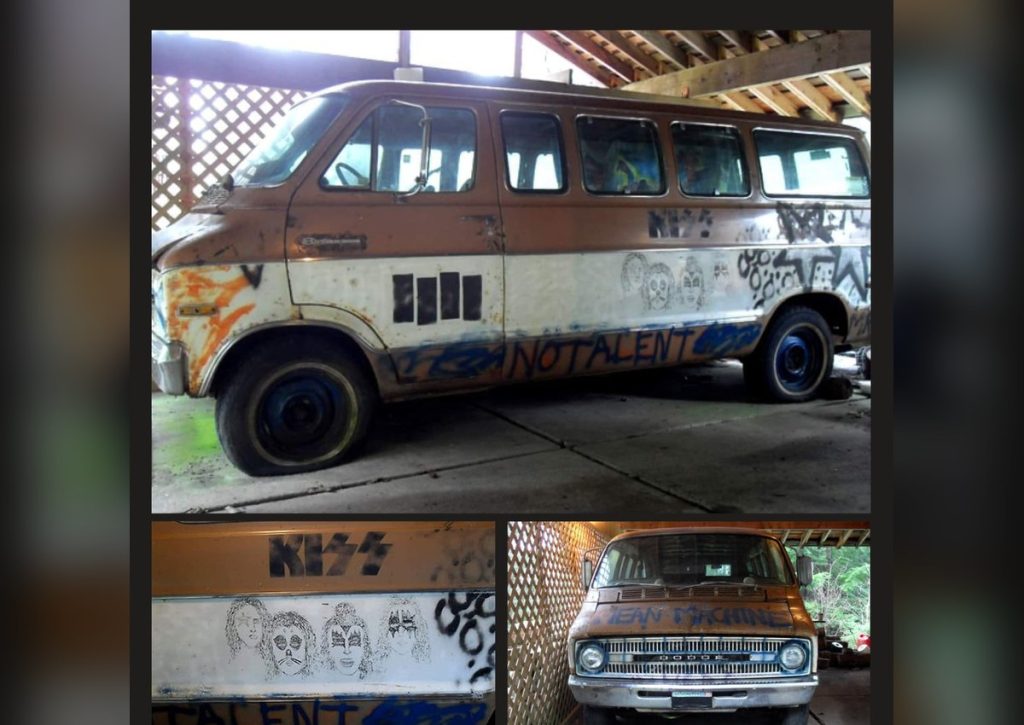
Rock history’s most famous piece of fan art is drawn on the side of a 1972 Dodge Sportsman Royal van in marker pen. The four painted faces of KISS — copied loosely from the debut-album cover, logo hovering above them — were inked onto the Melvins’ touring van by a teenage roadie from Aberdeen, Washington who wanted, more than anything in the world, to be useful to the band. His name was Kurt Cobain, and the markers were reportedly shoplifted.
Aberdeen’s one open door
To understand the mural you have to understand what the Melvins were to Aberdeen in the mid-1980s: the only evidence that escape existed. The logging town offered rain, unemployment and taverns; Buzz Osborne’s band — heavy, weird, utterly uninterested in permission — was a functioning counterexample. Teenage Cobain attached himself to their orbit with the devotion of a convert. He hauled gear, absorbed record recommendations from Osborne like scripture, auditioned unsuccessfully, and rode along in the van — the Melvan, as it became known — with the men who were teaching him, mostly by example, that a nobody from Grays Harbor could make records.
The mural was his tribute and, in a sense, his membership application: a kid paying for his seat in the only vehicle in town going anywhere, with the currency he had — draftsmanship and nerve.
The scene in one machine
The Melvan’s passenger manifest reads today like a founding document. Cobain and Krist Novoselic rode in it; so did Osborne, Dale Crover and Matt Lukin, plus Greg Hokanson, who drummed in Cobain’s first, gloriously named band, Fecal Matter. Crover would drum on Nirvana’s earliest recordings; Novoselic would co-found the band that changed everything; Osborne would make the introduction that completed the classic lineup, pointing Cobain toward a drummer named Dave Grohl.
Nor was the association always wholesome. Osborne has told the story of the night teenage Cobain got arrested for graffiti — the pair rounding a corner into a wall of police, Kurt caught marker-handed. The kid decorating vans and alley walls with equal enthusiasm was the same kid; Aberdeen just kept giving him surfaces.
The van years were also Cobain’s real education. Osborne functioned as Aberdeen’s one-man alternative library, passing the younger kid the records that rewired him — the hardcore and post-punk that crashed into his KISS-and-Beatles foundations and produced, eventually, the Nirvana synthesis. Riding shotgun in the Melvan meant hours of that curriculum at highway volume, plus the more practical syllabus: watching a genuinely uncompromising band load in, get stiffed, break down, and keep going. Every unglamorous lesson about being in a working band, Cobain learned in that Dodge before he ever had a band worth the name.
And the geography deserves its footnote. The Melvins came out of Montesano, Cobain out of Aberdeen — logging towns two hours from Seattle, a world away from the city that would later brand the movement. Grunge’s origin story is usually told in Seattle clubs; its actual embryo rode around Grays Harbor County in a van with KISS on the side.
From in-joke to artefact
The van’s afterlife has been a running commentary on what Cobain’s memory is worth. It surfaced on eBay in 2012, drawing headlines and no shortage of scepticism. By 2025 the plan had turned surgical: sections of the Melvan — Cobain’s mural among them — cut from the vehicle and auctioned at a music-memorabilia sale, a fate that predictably split fans between preservation and desecration.
Osborne himself has viewed the whole memorabilia carnival with characteristic dryness over the years — the Melvins kept touring in better vehicles while their old Dodge became a relic worth more than the band’s early careers combined. However one feels about the saw, the economics say something real. A marker drawing by an unknown teenager, on a band’s rusting Dodge, became museum-grade material because of what the teenager did next — and because the drawing captures him before: a fan, copying his heroes’ faces, years from being anyone’s hero himself.
What the mural actually documents
Strip the auction noise away and the Melvan mural is one of the most honest artefacts grunge left behind. The movement’s mythology runs on authenticity — but before authenticity, there was apprenticeship. Cobain learned bands by loving them fannishly: KISS’s cartoon theatre, then the Melvins’ sludge, then the punk and Beatles collisions he’d fuse into Nirvana. The mural sits at the exact junction: mainstream spectacle rendered in stolen Sharpie for an underground band’s van, by a kid who belonged wholly to both worlds — a mixture the Seattle explosion would monetise beyond anyone’s imagining.
And it documents the debt. Cobain said versions of it his whole short life: without Buzz Osborne and the Melvins, no Nirvana. The van carried the proof in marker pen — a thank-you note disguised as a KISS mural, drawn by the most consequential roadie in rock history, back when driving the Melvins to a gig was the biggest job he could imagine getting.