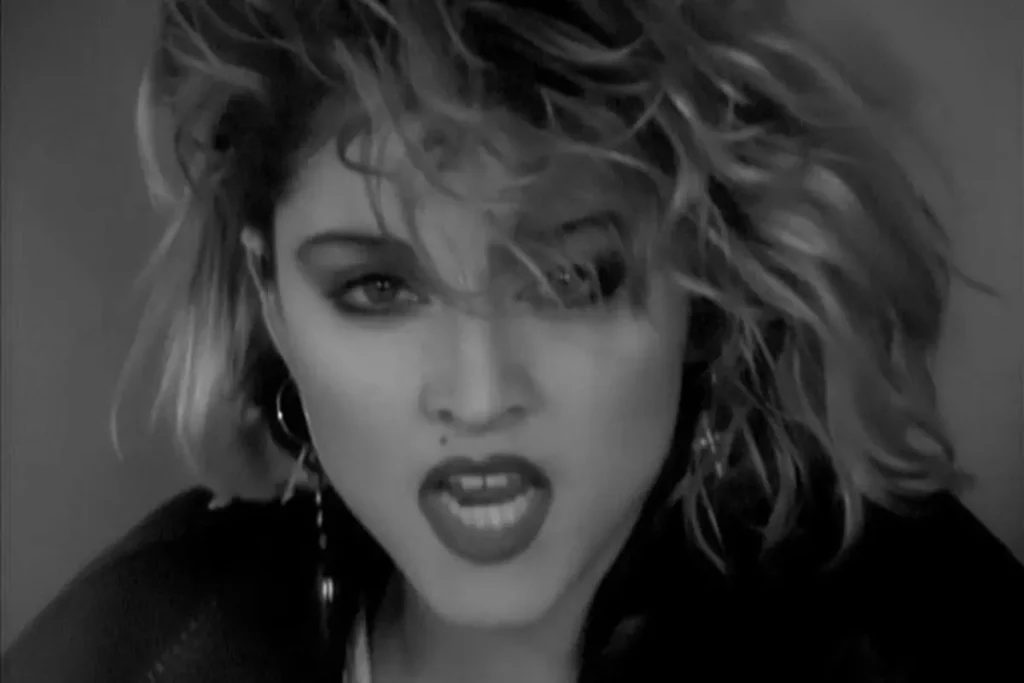
Before Madonna was a global headline machine, she was a hungry New York club kid with a voice that cut through the mix and a laser-focused sense of what pop could be. “Borderline” is where that ambition stops being potential and starts becoming proof. It is not her loudest statement, but it might be her most important early one: a song that fused downtown dance energy with radio-friendly melody and a video that pushed racial and class optics into MTV’s living room without asking permission.
Where “Borderline” sits in the Madonna origin story
“Borderline” arrived as the fifth single from Madonna (often called Madonna: The First Album), the 1983 debut that captured her club roots while packaging her for mass consumption. The record already had momentum, but “Borderline” is the track that widened the lane from dance floors to pop airwaves by sounding romantic, restless, and radio-ready at the same time. Its UK chart performance reflects that gradual expansion, peaking at No. 2 on the Official Singles Chart.
The song is credited to Madonna and Reggie Lucas, the album’s producer who helped steer her early material toward a tight, synth-pop frame. The track’s official credits and release details are broadly documented, but the deeper story is how it feels like a bridge: between post-disco downtown cool and Top 40 sweetness, between punk-ish attitude and pristine hooks.
Writing it: romance, control, and the art of sounding fearless
“Borderline” is, on paper, a pleading love song. In practice, it is a negotiation. Madonna’s narrator wants commitment, but she refuses to grovel; she pushes, she tests, she draws the line. That tension is the engine of the lyric, and it is one of the earliest examples of her signature theme: vulnerability as a form of dominance.
In the 1980s pop landscape, women were often written as either innocent or tragic. “Borderline” smuggles in a third option: a woman who is emotionally exposed but strategically clear-eyed. The title itself is a dare, not a diary entry. If you do not choose her, she will choose herself.
A quick musical snapshot (for musicians and curious listeners)
If you sit at a keyboard with the sheet music, you can see why it plays so well across formats: it is built on simple, singable shapes with enough harmonic movement to keep the chorus lifting. Published arrangements commonly list it in D minor, a key that helps the song feel urgent even when the groove is bright.

Recording and production: the club DNA that radio couldn’t resist
The production of “Borderline” is a masterclass in early-80s economy. The drum programming is crisp and danceable, the synth layers are clean but not sterile, and the bassline does the heavy emotional work by constantly pulling forward. It is pop that understands the body, which is a very New York way to write for radio.
What makes it stand out on the debut is its balance. Some early Madonna tracks lean harder into post-disco or minimal synth, but “Borderline” hits the sweet spot: enough groove to keep DJs interested and enough melodic clarity to hook mainstream listeners. If you want to understand how she became a crossover superstar, this is the blueprint in three and a half minutes.
The “edgy” claim that holds up: it is a Trojan horse record
Here is the provocative truth: “Borderline” sounds harmless until you pay attention. The attitude in the vocal, the refusal to be dismissed, and the way the track centers female desire without punishment is quietly radical for its era. It is not shock-pop. It is confidence-pop, and that is sometimes more subversive because it slips past the gatekeepers.
The video: why MTV-era storytelling mattered so much
Even people who only casually know Madonna’s early catalog often remember the video. “Borderline” presents a romance between Madonna and a Latino man while also showing her being pulled toward a glossy, art-world version of herself, complete with an older photographer shaping her image. It is a narrative about love, race, and the commodification of a young woman’s persona, told in a style that is playful on the surface and loaded underneath.
You can still watch the official “Borderline” clip and feel how modern the casting and framing were for mainstream pop video at the time. It is not a documentary, but it is not neutral either: it places interracial desire on-screen as ordinary, not as a punchline or a lesson.
“I wanted it to be about a girl who falls in love with a Hispanic boy.” Mary Lambert, director of the “Borderline” video
Director Mary Lambert would go on to become a crucial visual architect of Madonna’s early image, and “Borderline” is one of the first times you see the full concept: Madonna as a character who understands the camera and understands the politics of being seen. The video’s fashion, street energy, and flirtation with art-world manipulation helped define the MTV pop grammar that later artists would copy for decades.
Chart breakthrough: the moment she stopped being “promising”
Commercially, “Borderline” mattered because it turned momentum into inevitability. It became Madonna’s first top 10 hit on the US Billboard Hot 100, peaking at No. 10, which is the kind of milestone that changes how labels spend money and how radio programmers take calls. That performance is widely summarized in reputable discographies and historical chart resources.
In the UK, it went even further, peaking at No. 2. That is a reminder that Madonna’s early rise was not only an American story; she was already building an international profile before the cultural shockwave of “Like a Virgin” turned her into a global phenomenon.
Why “Borderline” endures: legacy in sound, image, and songwriting power
“Borderline” has a specific kind of longevity: it still sounds like pop, not like an artifact. Part of that is the disciplined production, but a bigger part is the emotional architecture. The track captures a feeling people do not outgrow: being right on the edge of getting what you want, and deciding what you will tolerate if you do not.
Impact on pop vocals: the “talk-singing” attitude before it was a default
Madonna’s vocal here is not about belting. It is about phrasing, insistence, and personality. You can draw a line from this kind of delivery to later pop stars who sell songs with texture and timing rather than raw power. It is one of the reasons “Borderline” still works in playlists next to much newer records.
Impact on pop visuals: narrative videos as brand strategy
MTV rewarded strong stories and strong styling, and Madonna learned the lesson early: pop is not just what you sing, it is what you signal. “Borderline” makes the camera part of the plot, which foreshadows her later work where fame itself becomes a character in the song’s universe.
Listening guide: what to focus on when you replay it
To hear why “Borderline” was a pivot point, listen like a producer and like a fan. The best pop records are both engineering and emotion. This one is an early example of Madonna doing both at once.
- Intro groove: the beat is clean, but it swings just enough to feel human.
- Pre-chorus tension: the arrangement subtly lifts before the hook, like a held breath.
- Chorus melody: simple, unforgettable, and designed for mass sing-along.
- Vocal attitude: she sounds like she is smiling and warning you at the same time.
Gear talk (without the myth-making): how to recreate the vibe
You do not need a museum of vintage synths to get close to the “Borderline” feel. You need the right roles in the arrangement: tight drum-machine style hits, a bouncing bass part that drives the song, and bright synth stabs that leave space for the vocal. Early-80s pop often sounds huge because it is actually sparse, with each element given room to be iconic.
| Element | What it does in “Borderline” | Modern way to approximate it |
|---|---|---|
| Drums | Locks the dance pulse, stays crisp for radio | Any drum-machine plugin + gated reverb flavor (light) |
| Bass | Creates forward motion and emotional urgency | Simple synth bass patch with short decay and steady velocity |
| Synth hooks | Provides sparkle without crowding the vocal | Bright poly-synth chords + mono lead doubles |
| Vocal | Sells the story with phrasing, not power | Close mic, modest compression, short plate reverb |
Conclusion: the quiet revolution inside a catchy single
“Borderline” is not the Madonna song that screams for attention. It is the one that proves she could build a pop hit that was dance-smart, emotionally sharp, and visually literate, all before the larger controversies that would later define her public mythology. If you want the moment where Madonna stops being a cool club export and starts becoming a pop system, “Borderline” is the switch flipping.
And that is the real legacy: a song that sounds like pure pleasure, but operates like strategy.