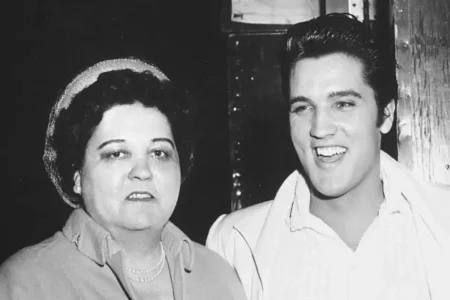
Mac Davis wasn’t trying to write poetry when he described Elvis Presley. He was reporting weather.
“He was the most beautiful man you ever saw,” Davis said, still sounding almost breathless years later. When Elvis walked into a room, the story goes, the air didn’t just shift – it behaved like a crowd at the start of a riot: attention snapped, people leaned in, and normal conversation suddenly felt irrelevant.
This article takes Davis’s wide-eyed testimony seriously, not as fandom, but as a clue. What if Elvis’s so-called “presence” was a real, repeatable combination of voice, timing, style, and social electricity that modern performers still chase – and rarely catch?
Mac Davis: why his Elvis stories matter
Davis wasn’t a random superfan. He was a working songwriter and entertainer who understood show business from the inside, and he moved through the same industry rooms Elvis did.
In Davis’s own origin story, he arrived in Nashville young, hungry, and deeply musical – the kind of person who would clock stagecraft and charisma like a mechanic listening to an engine. That background matters when he talks about Elvis as if he’s describing a force of nature.
After Davis died in 2020, major outlets described him as a prolific writer whose songs were recorded by Elvis and other stars. That summary is a reminder that Davis’s connection to Presley wasn’t imaginary or distant.
The “shockwave effect”: what people mean by Elvis’s presence
Every era has stars, but not every star creates silence just by existing. Elvis did, and the record of eyewitness language about him is unusually physical: “electric,” “glow,” “stopped the room,” “you had to see it.”
Presence is often dismissed as “charisma,” which is a lazy word that explains nothing. In performance terms, presence is closer to control: control of attention, pacing, emotion, and expectation.
Elvis’s presence also fed off scale. When mass media turned him into a national obsession, it didn’t dilute the magic; it amplified it by making every appearance feel like history arriving in real time. A basic biography sketch of his early recordings and TV breakthroughs shows how quickly that national fixation formed once his early recordings and TV appearances hit.
How Elvis built that room-changing aura (it wasn’t accidental)
1) The voice: pretty, dangerous, and emotionally specific
Elvis could move from a tender croon to a gritty shout without sounding like he changed costumes. That flexibility meant he could flirt with you in one line and warn you in the next – a powerful emotional whiplash for live audiences.
Critically, he didn’t sing like a “neutral” pop vocalist. He sang like someone who believed the lyric applied to him personally, which makes listeners feel like it applies to them, too.
2) The body language: rhythm you could see
Elvis’s early stage movement is often reduced to the punchline version (“the hips”), but the real point is that his body kept time like an instrument. He performed rhythm with his full frame, and the audience reacted like they were being played.
That visual rhythm was a kind of permission slip for the crowd: you can feel this music in your body, not just your head. For a mid-century audience trained to behave politely, that was provocative by design.
3) The look: not just handsome – symbolic
When Davis calls Elvis “the most beautiful man you ever saw,” he’s not only talking cheekbones. Elvis’s styling blended Southern toughness, gospel polish, Hollywood glamour, and youthful danger into one package.
In other words, Elvis’s “beauty” was also a billboard for a new kind of American masculinity: softer than the 1950s stereotype, yet more openly sexual than mainstream culture wanted to admit.

The women in the audience: desire as the engine of the show
Davis joked about the crowd reactions, famously describing women whose smiles were practically welded on. It’s funny because it’s true, but it’s also revealing: Elvis concerts were not only music events – they were public desire events.
And that desire wasn’t merely hormonal. Elvis’s performances let many women experience a loud, collective, unapologetic form of wanting. In conservative settings, that is socially explosive.
If you want an uncomfortable thought: Elvis didn’t just sing to audiences. He gave them permission to behave differently than the culture told them they should.
The comeback proof: 1968 and the return of “dangerous” Elvis
One of the best arguments that “presence” was real is that Elvis could lose momentum in his career and still snap back with terrifying force when the format was right.
The 1968 television special (often called the “comeback special”) is widely remembered for putting him back in a rawer, more immediate performance frame. It’s not just nostalgia; it’s a demonstration of how well he functioned in the ’68 Comeback Special when the camera and the room were close enough to capture the heat.
That special also underlines a key point: Elvis didn’t need spectacle to be compelling. Sometimes the less production he had, the more powerful he felt.
Mac Davis and “In the Ghetto”: the songwriter watching the phenomenon
Davis’s connection to Elvis wasn’t just social; it was musical. “In the Ghetto,” credited to Mac Davis and Billy Strange, became one of Elvis’s most culturally resonant late-1960s recordings.
The song’s success is a reminder that Elvis’s presence wasn’t limited to sexuality or flash. He could project empathy and seriousness, and the public would follow him there – something not every pop idol can pull off. The release details and songwriting credits for “In the Ghetto” underscore that reach.
For a songwriter, seeing a superstar elevate your work is validating. For Davis, it likely sharpened the sense that Elvis wasn’t simply a good singer – he was a carrier wave who could broadcast a song’s emotion at national scale.
Was Elvis a “phenomenon” or a product? The edgy argument: both
There’s a long-running fight over Elvis’s legacy: was he a unique talent, or was he an industry creation riding Black musical innovation? The honest answer is that the system and the man fed each other.
Elvis came up in a region where gospel, blues, and country overlapped, and his sound reflected that mixture. The argument that he absorbed and popularized styles rooted in Black American music is part of serious accounts of rock and roll’s history.
But “product” alone doesn’t explain why so many eyewitnesses describe him in near-mystical terms. Plenty of heavily marketed artists never create that room-changing hush. Elvis’s gift was that he could be packaged and still feel dangerous, spontaneous, and personal.
A practical breakdown: what today’s performers can steal from Elvis
You can’t copy Elvis, and trying is usually embarrassing. But you can copy the mechanics behind the myth.
| Elvis ingredient | What it did | How to apply it now |
|---|---|---|
| Dynamic vocal tone | Made songs feel like scenes, not tracks | Practice switching intensity within one verse without losing pitch |
| Visible rhythm | Turned the body into part of the groove | Rehearse movement patterns that reinforce the beat, not distract from it |
| Silence and pacing | Created tension the audience couldn’t ignore | Build in pauses, spoken lines, or dynamic drops to reset attention |
| Myth-friendly styling | Made him instantly readable from the back row | Choose one or two signature visual anchors (hair, jacket, mic technique) |
How the legend survives: evidence in the “afterlife” of Elvis
If Elvis were merely a mid-century fad, his orbit would have collapsed long ago. Yet his story keeps regenerating in books, films, reissues, and constant public debate.
One reason is that his career is narratively perfect: meteoric rise, cultural backlash, reinvention attempts, and an early death that freezes the image in amber. Even a simple reference overview of his impact and breadth of work emphasizes the scale of his influence across recordings, film, and live performance.
Another reason is that Elvis represents a hinge point in American entertainment, when youth culture seized the microphone and refused to give it back.

So what was that “glow” Mac Davis felt?
Maybe it was beauty. Maybe it was fame. Maybe it was the way Elvis could make a lyric sound like a confession and a threat at the same time.
But Davis’s breathless phrasing suggests something else: that Elvis made people feel the world was about to change, and for the duration of the song, it actually did.
“He was the most beautiful man you ever saw.”
Mac Davis
That line isn’t just about Elvis’s face. It’s about a once-in-a-generation performer whose presence could rearrange a room, then leave everyone inside it permanently recalibrated.
Conclusion: Elvis wasn’t just an entertainer – he was a live event
Mac Davis’s memories are valuable because they cut through trivia and land on the core truth: Elvis’s power wasn’t only in songs or stats. It was in the immediate, bodily experience of being near him, watching him, and feeling your own reactions get louder than your logic.
In a world full of content, that’s still the rarest skill of all: the ability to make nothing else matter for three minutes.