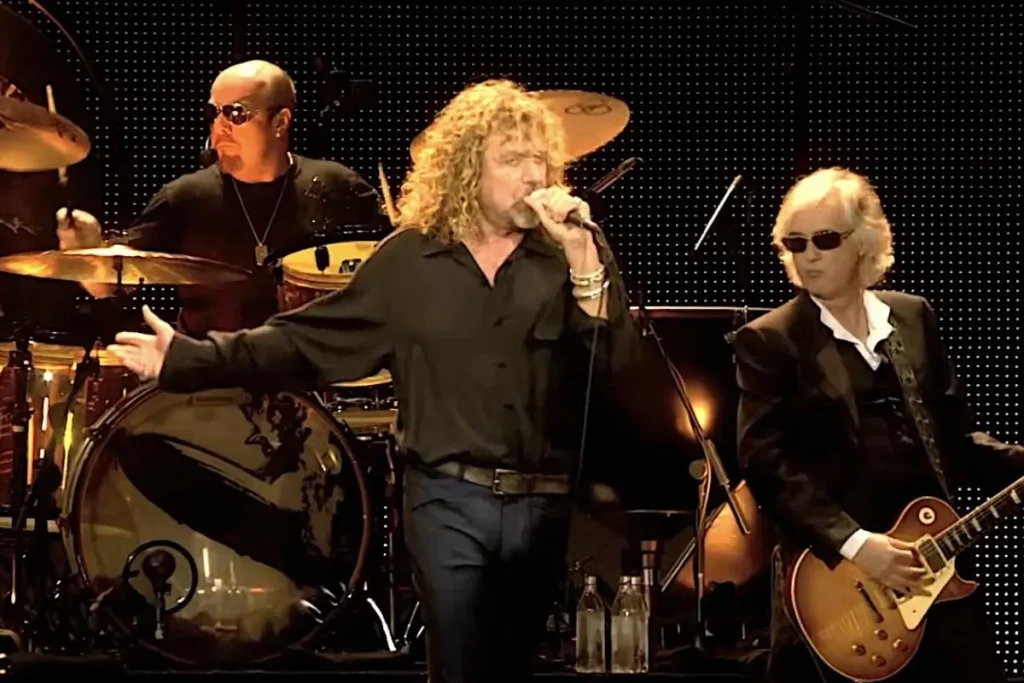
Led Zeppelin’s live reputation isn’t just “loud for rock” loud. It’s “the PA is fighting the backline and losing” loud. Fans still trade stories about walls of Marshall heads, interminable solos, and versions of songs stretched until time got wobbly.
And then there’s the nuclear headline: a 1969 performance of “Heartbreaker” allegedly hitting 130 decibels, a level often described as enough to cause immediate hearing damage. It’s a deliciously menacing claim, the kind that flatters the mythology of a band built on excess.
But did Zeppelin really hit 130 dB, and if they did, what does that number even mean? Let’s separate physics from folklore, and then talk about the part that actually matters: what extreme concert volume does to human hearing, why classic rock chased it, and how to enjoy power without paying for it with tinnitus.
The 130 dB “Heartbreaker” claim: plausible, provable, or publicity fuel?
First: there’s no universally accepted, official “Zeppelin hit 130 dB during ‘Heartbreaker’ in 1969” measurement record that’s easy to verify in public archives. That matters because decibel claims are incredibly sensitive to where and how you measure.
Sound pressure level (SPL) readings depend on distance from the speakers, room acoustics, weighting (A-weighted vs C-weighted), time averaging (fast/slow), and the meter’s calibration. Even honest engineers can produce very different numbers at the same show.
So treat “130 dB” like a mythic headline until you see measurement context. Still, the claim is not automatically impossible. It’s just the kind of number that gets repeated because it sounds like danger, and danger sounds like rock and roll.
What 130 dB would imply in real life
As a benchmark, many hearing-health authorities warn that very loud sounds can damage hearing quickly, and the risk rises sharply as sound levels increase.
At 130 dB SPL, you’re in the neighborhood of pain threshold territory for many people, and it’s well beyond occupational safety exposure limits for unprotected ears – exactly why OSHA’s occupational noise guidance treats high noise levels as a serious hazard.
So if a meter really captured ~130 dB at a Zeppelin show, it likely wasn’t “average audience level everywhere.” It would more plausibly be a peak reading near the PA stacks or close to the backline in a reflective space.
Decibels: why the number is both meaningful and easy to abuse
The decibel (dB) is a logarithmic unit, not a linear one. A small change in dB can represent a big change in acoustic energy and perceived loudness. In practical terms: the jump from “very loud” to “dangerously loud” can happen faster than your instincts realize.
The term “decibel” traces back to telecommunications measurement traditions, where relative levels mattered more than absolute ones.
To make decibels less abstract, many public-facing references compare dB levels to familiar environments and machines. Even if you debate the exact numbers, the comparisons help clarify the order of magnitude you’re dealing with.

Quick SPL reality check (and why concert peaks fool people)
| SPL range | How it feels | What it can mean at a rock show |
|---|---|---|
| 90-100 dB | Exciting, intense, “this is a concert” | Common in many venues; still risky for long exposure |
| 105-115 dB | Chest-hitting, shouting to communicate | High-energy rock levels; hearing protection strongly advised |
| 120-130 dB | Painful for many, disorienting | More likely as peaks near stacks, sidefills, or reflective hotspots |
That last row is where the Zeppelin legend lives. The band’s stage volume could be ferocious, and in the late 60s the “science of live sound” was still being invented at full speed in front of paying customers.
Why Led Zeppelin were so loud (beyond bravado)
It’s tempting to say Zeppelin were loud because they were macho. That’s not wrong, but it’s incomplete. Their volume also came from practical constraints of the era: primitive PA systems by modern standards, limited monitor technology, and the need to fill large rooms with clarity.
Early large-scale rock reinforcement often struggled to project vocals and drums cleanly over roaring guitar amps. Bands compensated by turning up the backline, which forced the PA to push harder, which created a feedback loop of volume escalation.
Marshall amplification became iconic in this arms race, and the company’s broader identity is closely tied to loud rock gear, including its work around stage-volume instruments and brands.
Extended songs + high SPL = “loudness exposure” as a lifestyle
Led Zeppelin weren’t just loud, they were loud for a long time. Their live sets often featured extended improvisations, medleys, and elastic arrangements. That’s crucial because hearing risk is not only about intensity, but also duration.
NIOSH explains that recommended exposure limits drop as dB rises; the louder it gets, the less time you can safely spend in it.
“Heartbreaker” as a volume weapon
“Heartbreaker” is built for impact: a riff that’s basically a battering ram, a drum part that hits like industrial machinery, and that famous unaccompanied guitar solo section that invites players to go bigger every night. The studio version is already aggressive; live, it becomes an excuse to test the ceiling.
The song’s history and canonical release details are well documented in standard references about “Heartbreaker”, even if the decibel folklore around it is not.
Here’s a provocative but defensible take: the “130 dB Heartbreaker” story persists because it expresses a truth about Zeppelin, even if the number is fuzzy. They normalized the idea that rock should feel physically dangerous, and that sensation often gets translated into a single scary measurement.
The bodily cost: what “deafening” actually does to you
Hearing damage from noise exposure is typically about injury to the delicate hair cells and structures of the inner ear. Once damaged, those sensory cells do not reliably regenerate in humans, which is why prevention is the whole game.
Medical and public-health organizations consistently warn that loud noise can cause permanent hearing loss and that risk increases with higher levels and longer exposures.
Many people also meet tinnitus, the ringing or buzzing perception that can follow loud sound exposure. It can be temporary or persistent, and it’s common enough to be treated as a major public health issue.
“Loud noise can damage your hearing, and once it’s damaged, it can’t be fixed.”
NIDCD (National Institute on Deafness and Other Communication Disorders)
“Immediate hearing damage” at 130 dB: how literal is that?
“Immediate” is a slippery word. Some exposures can cause acoustic trauma quickly, but individuals vary, and real-world shows have peaks and lulls. What’s not slippery is that very high SPLs dramatically increase the odds of a threshold shift (temporary or permanent), especially when repeated.
WHO frames hearing loss as a massive global health issue and emphasizes prevention as a key lever.
Why the loudness myth matters: it shapes how fans behave
The danger of the Zeppelin legend isn’t that it exaggerates a number. The danger is that it romanticizes hearing injury as the “price of admission” for authenticity. It tells fans that pain is a badge.
Classic rock audiences often include listeners who grew up before hearing protection was normalized at concerts. Many are now dealing with the long tail of those decisions: difficulty understanding speech in noise, persistent ringing, and fatigue from listening effort.
If you love loud music, you don’t have to love damage. You can keep the thrill and drop the self-harm.
How to enjoy loud concerts without sacrificing your ears
This is the practical section, because mythology is fun but tinnitus is not. The goal is not to “make it quiet.” The goal is to keep your exposure within safer bounds while preserving the live experience.

1) Wear earplugs that don’t ruin the mix
High-fidelity musician earplugs can reduce level more evenly across frequencies than foam plugs, so cymbals don’t turn into fizzy dust and vocals don’t vanish. Even basic plugs are better than nothing, but fit and consistency matter.
For everyday guidance, ASHA recommends hearing protection and sensible exposure habits in loud environments.
2) Use distance like a volume knob
Decibels drop with distance from the source (especially in open air), though reflections and room modes can create nasty hotspots indoors. If you’re standing near the speaker stacks, you are choosing the most dangerous seat in the house.
If you want “big” without “brutal,” move back, off-axis, or behind the main arrays. Your ears will still feel the show, but your cochlea won’t take the full punch.
3) Take listening breaks like you take smoke breaks
Your ears benefit from recovery time. Step into the lobby, the bar, or outside between sets. It doesn’t make you less of a fan; it makes you more likely to still be a fan in 20 years.
In the same spirit, public health guidance on safe listening emphasizes that reducing exposure time matters more as levels rise.
4) If you’re a musician: stop equating tone with suffering
Some of the most iconic rock sounds came from loud amps pushed into saturation, but modern rigs, reactive load boxes, and monitoring can get you there at saner stage levels. The macho idea that “real tone requires permanent damage” is outdated.
Also: if your band rehearses loud, you’re not “getting tight.” You’re just practicing hearing loss together.
So…were Zeppelin really that loud?
Led Zeppelin were undeniably among the loudest, most physically overwhelming rock acts of their era, and the cultural memory of their volume is earned. But the specific “130 dB in 1969” claim should be treated as unverified without measurement context, not as a settled fact.
And here’s the twist: you don’t need the number to be true for the warning to be true. Whether it was 110, 120, or a spike at 130 near a stack, the takeaway is the same: rock can be glorious and still injure you.
Enjoy the power. Respect the physics. Protect your hearing so you can keep enjoying the power.
Related listening homework: next time you play “Heartbreaker,” turn it up for fun, then put in earplugs and turn it up again. If the plugs are good, the riff still hits. The difference is that your ears won’t be the casualty.