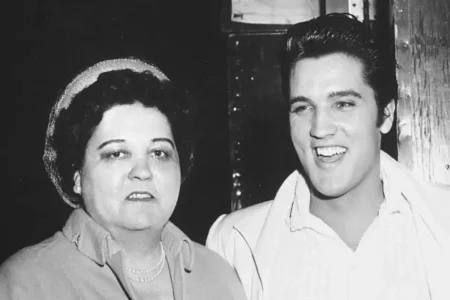
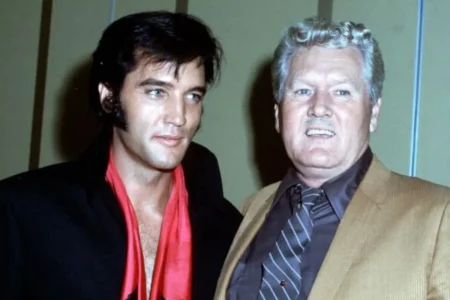
Elvis Presley is treated like a lightning strike: sudden, loud, and impossible to trace. But lightning needs weather, and in the Presley story the weather has a name: Gladys Love Presley (born Gladys Love Smith). She was not famous in her lifetime, yet her decisions, anxieties, and fierce devotion helped build the emotional engine that powered Elvis’s voice, stage persona, and lifelong need for approval.
This is an article about a woman often reduced to “Elvis’s mother”, which is a convenient way to avoid saying the messier truth: she was the main character in his private life. She was also a working-class Southern woman navigating poverty, church culture, family pressure, and the scrutiny that came with her son becoming a public obsession.
Quick facts (and why they matter)
| Fact | What it tells us |
|---|---|
| Born April 25, 1912, Pontotoc County, Mississippi | Rural roots shaped her values: family loyalty, church, and survival. |
| Parents: Robert Lee Smith and Octavia Luvenia (Mansell) Smith | Genealogy matters because the Presley myth machine often rewrites basics. |
| Married Vernon Presley, June 17, 1933 (Pontotoc County) | Young marriage in the Depression era often meant instability and grit. |
| Gave birth to twins, January 8, 1935: Jesse Garon (stillborn) and Elvis Aaron | Elvis grew up as “the surviving twin”, a psychological shadow in many bios. |
| Died August 14, 1958, Memphis, age 46 | The loss became a turning point in Elvis’s adult life and habits. |
Pontotoc County beginnings: a hard place that makes hard people
Gladys’s Mississippi childhood sits inside a broader story of early-20th-century rural life: limited money, limited healthcare, and social expectations that weighed heavily on women. If you want to understand her, drop the Hollywood lighting and picture mud, church benches, and long stretches of worry.
One reason researchers lean on records and cemetery data is that family storytelling can drift over decades. A public memorial record like the birth and death details listed for Gladys Presley offers a widely referenced snapshot that many genealogists cross-check against other documents.
Marriage to Vernon: love, pressure, and the economics of survival
Gladys married Vernon Presley in 1933, and their early years were defined by the same thing that shaped millions of American couples: the Great Depression. There was romance, but there was also math. When money is scarce, every decision becomes emotional because it can become catastrophic.
If you are trying to verify family structure and dates, a consolidated timeline of Gladys Presley’s life details can be useful as a pointer to public-record-style facts, while still reminding you to double-check with primary documents when possible.
The twin tragedy: Jesse Garon and the ghost in the room
On January 8, 1935, Gladys delivered twin boys. Jesse Garon was stillborn, and Elvis Aaron survived. Biographies disagree on how often the family spoke about Jesse, but the fact of the stillbirth is consistent across mainstream references, including historical summaries tied to Elvis’s earliest years in Tupelo.
It is tempting to over-psychoanalyze the “surviving twin” narrative, but it is not fluff to say that this kind of loss can change a household’s emotional temperature. Overprotection is not always a personality trait. Sometimes it is grief with a daily schedule.
Church music and the sound of safety
Gladys is frequently described as deeply religious, and Elvis’s early music diet included church singing, gospel quartets, and the emotional release that comes with spiritual music. That matters for musicians because it explains why Elvis could move between sacred intensity and secular swagger without sounding fake.
The Elvis Presley Birthplace in Tupelo, a key historical site tied to his early life, frames the family’s early environment and helps situate how a poor Mississippi household could still be rich in music and community.
Mother and manager (before managers): how Gladys shaped Elvis’s behavior
There is a provocative claim worth making: long before Colonel Parker negotiated a contract, Gladys trained Elvis to read a room. She taught him how to be polite when people stared, how to perform “good boy” respectability, and how to cope with the social hunger of adults who wanted a piece of him.
That kind of training creates a performer who can be both magnetic and anxious. It also helps explain why Elvis’s public confidence sometimes masked private dependence. The cultural documentation of Elvis Presley in a national recording archive is a reminder that the “Elvis phenomenon” became a matter of national cultural documentation, not just entertainment.

1950s fame: when the spotlight turns into a weapon
Once Elvis hit, Gladys went from being a private citizen to being a target for gossip and judgment. In the 1950s, people did not just critique the music. They critiqued the mother. If Elvis’s hips offended them, they often decided she must have “let it happen”.
This is where the edgy reality comes in: American moral panic has always loved a scapegoat, and mothers are convenient. The more Elvis became a symbol of youth culture, the more Gladys became, unfairly, a symbol of whatever older America feared it was losing.
Health, stress, and what “hepatitis” can mean in mid-century America
Gladys died in 1958 at 46, and many popular accounts cite hepatitis as part of the medical story. Without reproducing rumors, it is fair to say that hepatitis is a family of conditions with different transmission routes and outcomes, and the label alone does not tell you the whole narrative of how someone got sick or why they deteriorated.
Mid-century healthcare could be blunt: fewer treatment options, less nuanced public understanding, and more stigma around anything connected to the liver or alcohol. Add the stress of sudden wealth, constant attention, and family strain, and you get a pressure cooker, not a mystery.
Elvis’s grief: the moment the legend cracks
Gladys’s death is often described as a point where Elvis’s personal stability shifted. That is not just fan lore. Even if we avoid speculative diagnoses, it is reasonable to recognize that losing the person who anchored his identity would have consequences for his choices, relationships, and coping mechanisms.
“I hope I haven’t taken up too much of your time.”
– Elvis Presley (a line often cited as emblematic of his politeness and need to please)
Whether or not you accept every psychological theory attached to Elvis, one idea holds up: his relationship with Gladys was not a footnote. It was the emotional blueprint. Remove it, and the later story gets darker fast.
Verifying the paper trail: why serious fans should care
Because Gladys lived outside the spotlight, the most responsible way to talk about her is to respect documents. If you are building a family timeline, you eventually run into birth certificates, marriage records, death certificates, and census entries. Understanding how to request or interpret those records is part of telling the truth instead of repeating the loudest myth.
The basics of how vital records are created and where they are held help researchers avoid dead ends and misinformation.
The National Archives also provides guidance on census research, which matters because census entries can confirm residence, household structure, and occupations, even when family stories disagree.
If you need a certified Tennessee death certificate for historical research or family documentation, the Tennessee Department of Health outlines the process and access rules.
For broader context on historical preservation and why certain sites connected to Elvis’s early life are protected, the National Register of Historic Places framework helps explain how communities decide what counts as cultural history.
Myths worth retiring (and what to say instead)
Myth 1: “Gladys was just a stage mom.”
Better take: Gladys was protective in a world that punished poor families for failing and punished famous families for existing. Protection can look like control when the stakes are existential.
Myth 2: “Elvis’s talent appeared from nowhere.”
Better take: talent needs a container. Gladys helped build that container through church, community, and constant emotional reinforcement, even if she could not have imagined the scale of what was coming.
Myth 3: “Her death only matters because of what it did to Elvis.”
Better take: her death matters because she was a 46-year-old woman whose life was squeezed by poverty, stress, and the brutal speed of American celebrity. The human tragedy stands on its own.
What musicians can learn from Gladys Presley
- Roots are a sound. Church music, family singing, and local culture can shape phrasing and feel as much as formal lessons.
- Performance is emotional labor. The need to please does not vanish when fame arrives; it often intensifies.
- Protect your anchor people. When one relationship carries your whole sense of safety, losing it can derail everything.
- Document your story. Myths multiply in music history. Records keep you honest.

Conclusion: the woman behind the crown
Gladys Love Presley did not invent rock and roll, but she helped invent the person who could sell it to the world. Her life shows the uncomfortable truth behind many “overnight success” stories: they are built on the unseen labor of family, faith communities, and women whose names are rarely printed on the poster.
If you want to understand Elvis as a musician, you cannot skip Gladys. She is not trivia. She is the first chapter.