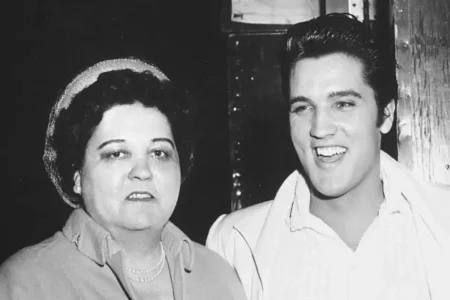
The bathroom story about Elvis Presley is true – and it has been used as a cheap joke for decades. On August 16, 1977, Elvis was found on the floor of a bathroom at Graceland after collapsing.
But the way the story gets repeated often turns a human tragedy into a punchline. If you actually follow the evidence, the bathroom detail is not “the scandal” – it is the final scene of a long medical decline shaped by exhaustion, chronic illness, and heavy prescription drug use.
“Elvis Aaron Presley, 42, the rock star, died yesterday in Memphis.” – History.com
The “bathroom rumor” that is not a rumor
The basic facts are widely documented: Elvis died at 42, at Graceland, and he was found in a bathroom area. That is the part people whisper, snicker, or sensationalize – as if where a person collapses is a moral verdict.
Yet for anyone who has cared for an aging parent or lived with chronic illness, it is not shocking at all. Bathrooms are where people faint, strain, lose blood pressure, and crash from heart problems, medication effects, or dehydration.
Why bathrooms become medical danger zones
Straining to pass stool can trigger strong autonomic reflexes that briefly change heart rate and blood pressure. In someone already medically fragile, those swings can be risky – not because the person is “weak,” but because the body is operating at the edge of tolerance.
What the official record did (and didn’t) say
At the time, Elvis’s death was reported as a heart event, often summarized as “cardiac arrest,” which is technically what happens when the heart stops. “Cardiac arrest” is a mechanism, not the deeper why.
Later discussions leaned hard into two competing myths: either he was “murdered by drugs” in a simplistic overdose narrative, or he died of “pure heart failure” divorced from lifestyle and prescriptions. Reality is usually messier: multiple conditions plus multiple medications can combine into a perfect storm.
Why “legal prescriptions” can still be lethal
Prescription does not automatically mean safe. Opioid medications, for example, are legitimate pain treatments, but they can also cause serious side effects and risks when misused or combined with other sedating drugs.
And opioid-induced constipation is not an urban legend – it is a well-known effect that can become severe and difficult to treat, especially with long-term use.

The medical chain reaction: fatigue, polypharmacy, constipation, strain
Elvis’s late-career schedule and lifestyle get summarized as “excess,” but the practical reality is more brutal. A performer can be wealthy and still trapped inside a machine that rewards showing up even when you are unwell.
Over time, a growing medication list can create a “polypharmacy” problem: drug-on-drug interactions, cumulative sedation, worsened sleep, cognitive fog, altered breathing patterns, and gastrointestinal slowdown. Opioids, sedatives, and other central nervous system drugs can layer risks rather than simply add them.
Constipation as a serious health issue (not a punchline)
Constipation is often treated as embarrassing, but clinically it can become severe, painful, and dangerous. Major medical references list medications and reduced activity among common contributors.
When constipation becomes chronic, people may strain hard, for a long time, repeatedly. If a person also has hypertension, an enlarged or weakened heart, sleep deprivation, and heavy sedative exposure, that strain can become a trigger – not the whole cause, but the final push.
So what happened to Elvis in that bathroom?
We should be careful about narrating the last minutes of any person’s life with certainty. What credible summaries consistently indicate is that Elvis collapsed in a bathroom at Graceland and died the same day amid wider medical controversy.
From there, the best-supported explanation is not a single dramatic “gotcha,” but a convergence: cardiovascular disease risk plus years of intense prescription drug use and declining overall health.
Autopsy-era debate and the long shadow of secrecy
Part of why the bathroom detail became tabloid fuel is that Elvis’s health story arrived through leaks, summaries, and later reporting rather than a transparent medical narrative. That vacuum invited conspiracy theories, from “he faked it” to “it was a cover-up,” because humans hate ambiguity.
But the idea that multiple drugs were in his system at death is not controversial in serious reporting; it is part of the historical discussion around his medical decline.
The uncomfortable, provocative takeaway: Elvis was a warning label in rhinestones
Here is the edgy claim that holds up: Elvis did not just die “in a bathroom.” He died inside a system that normalizes medicating the human body into a work schedule it cannot survive.
If you want to be mad at something, be mad at the cultural bargain that made it easier to hand a superstar another prescription than to stop the machine and let him recover. Even now, many musicians feel pressure to perform through illness because the show is bigger than the person.
How fame can distort medical care
Fame changes how people get treated. Regular patients get told “no” all the time. Very famous patients can end up surrounded by yes-men, caretakers trying to keep the peace, and doctors who are asked to solve lifestyle problems with medication.
None of that excuses bad choices. It simply explains why “he had everything” is not the same as “he had health.”
Remembering Elvis beyond the bathroom floor
It is lazy to reduce Elvis to his final location. Elvis was a once-in-a-century cultural force whose catalog still defines rock, pop, gospel, and country crossover in a way few artists ever managed.
And because this is Know Your Instrument, it is worth saying plainly: his impact was not just celebrity. It was musicianship – phrasing, feel, vocal color, rhythmic swagger, and a band-leading instinct that made studio takes and live shows land like an event.

A quick reality check for fans and musicians
| Claim | What’s credible |
|---|---|
| “Elvis dying in the bathroom is just a rumor.” | He was found collapsed in a bathroom at Graceland. |
| “It was only drugs.” | Drug use is part of the story, but heart disease risk and overall health matter too. |
| “Constipation is just embarrassing, not serious.” | Constipation can be medication-related and become severe. |
| “Prescribed medications can’t be that dangerous.” | Opioids are effective but carry serious risks and side effects. |
What Elvis’s death teaches the rest of us
Elvis’s death is not a morality play about “rock star excess.” It is a brutally relatable story about what happens when sleep breaks, pain becomes chronic, medicine becomes routine, and the body keeps the score.
If you are a working musician, a touring veteran, or simply someone caring for your health: take constipation seriously, be skeptical of stacking sedating prescriptions, and treat rest like a non-negotiable part of performance. The bathroom detail is not the point – the point is that decline is often quiet until it isn’t.
And if you are a fan, the humane move is simple: retire the joke. Elvis’s voice still hits like electricity, and that is the legacy that deserves to be loudest.
Note: This article discusses medical possibilities in general terms and is not personal medical advice.