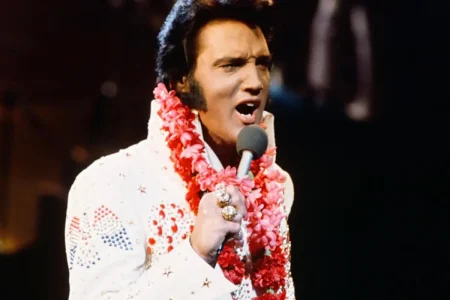
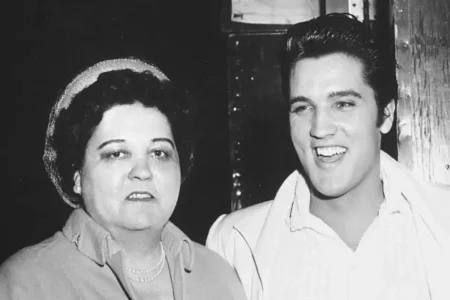
Elvis Presley is often described like a force of nature: a voice, a sneer, a swivel, a cultural before-and-after. But inside the most photographed life in America, there was a quieter story that fans still cling to because it makes the myth human: Elvis as a dad, and Lisa Marie as the child who could cut through the noise.
Lisa Marie Presley was born in 1968, the only child of Elvis and Priscilla Presley. Her presence did not stop the machinery of superstardom, but it did change the emotional weather around it. Even in the historical record, you can see the pattern: whenever Elvis is “just Elvis,” Lisa is usually nearby, either literally or in the way people around him talk about what mattered most.
The center of Elvis’s world: what we can say with confidence
Elvis’s public timeline is well documented: the Sun Records breakthrough, the Hollywood years, the ’68 Comeback Special, the Vegas era, and then the collapse of health and privacy. The often-missed detail is that Lisa Marie arrived right as the narrative started shifting from hungry young star to complicated institution. Basic biographical milestones for both Elvis and Lisa Marie are widely corroborated.
Lisa Marie Presley’s death in 2023 also brought renewed attention to how official narratives frame Elvis’s life through his family as much as his fame, which matters because it is a curated story from the estate that still protects his image. It is not the whole truth, but it signals what the Presley camp believes is central: roots, home, and the gravitational pull of family.
“The King disappeared”: a beautiful line, and why it’s hard to verify
Fans love the idea that when Elvis held Lisa, the “King” vanished and only a tender father remained. That sentiment tracks with many recollections, but exact lines are often secondhand, paraphrased, or recycled through decades of retelling. When you see an emotionally perfect quote with no clear provenance, treat it as a mood, not a document.
That said, the underlying claim is not outrageous. People close to artists often describe the same phenomenon: parenting can temporarily break the spell of performance, because children are unimpressed by celebrity and brutally honest about attention. Elvis, in particular, was famous for being hypersensitive to loyalty and affection, so a relationship that was not transactional could have felt like oxygen.

Graceland as “family space,” not just a museum
Graceland is usually discussed as a tourist destination, but it is also the physical stage where the Elvis-and-Lisa story keeps replaying. The estate’s presentation of Elvis stresses his home life and personal spaces, a subtle reminder that behind the costumes and cameras there were rooms where music was simply something you did, not something you sold.
From a music perspective, that setting matters. A house with instruments in reach, friends dropping in, and spontaneous playing is a powerful incubator for a child, even if that child eventually runs from the family shadow. It is also where the Presley story becomes uniquely American: private grief turning into public pilgrimage.
The day everything stopped: 1977 and a nine-year-old daughter
Elvis died in 1977 at age 42, and Lisa Marie was nine. The tragedy is obvious, but the deeper shock is structural: she lost not just a father, but the only person who could truly normalize her world. Reporting on Lisa Marie Presley’s final days and the Graceland legacy underscores how quickly the Elvis story became a national moment rather than a private one.
“Elvis Presley, the rock star… died today…” – The New York Times
That public scale is the poison needle for children of icons. You cannot grieve normally when the world thinks it owns the person you are grieving. And for Lisa Marie, the Elvis story did not end; it became her surname, her inheritance, and her burden.
Lisa Marie’s adult life: music as defiance, not cosplay
Lisa Marie Presley eventually released music under her own name, which was an audacious decision. The easy path would have been to monetize nostalgia, “sing like Dad,” or live as a permanent appendix to Elvis history. Instead, she leaned into a darker, modern rock-adjacent singer-songwriter lane, which many listeners heard as a refusal to be a tribute act.
Her biographical overview and career arc are summarized in mainstream reference profiles, including how her identity was shaped by being Elvis’s only child and by intense media attention.
Her voice in the story: what she said about Elvis
Lisa Marie regularly spoke about Elvis with a mix of love, protectiveness, and frustration at the mythology. A key point for fans to remember is that she did not know him as an oldies symbol; she knew him as a parent, and children remember mundane details more than headlines. A general public-facing timeline of milestones and statements can be useful for quick orientation, even if it is not primary reporting.
When you read her comments across years, one theme repeats: safety. In a life where strangers felt entitled to her family, Elvis was the one place the entitlement didn’t reach. That is why fan stories about him “tiptoeing” into her room or privately playing piano resonate, even if the specific anecdotes blur over time. They feel emotionally consistent with what celebrity children often describe: the rare calm of being alone with the parent everyone else is shouting at.
Edgy but necessary: Elvis’s decline, and the part fans avoid
Let’s be blunt: the Elvis-and-Lisa story is beautiful because it is tragic, and it is tragic because fame does not just elevate you, it isolates you. Elvis’s later years have been analyzed endlessly, but one sober takeaway is unavoidable: the “system” around him rewarded output and image maintenance, not health. The Elvis industry did not pause because he was a father.
When conversations turn to substance use, it is important not to turn real suffering into lurid gossip. But it is equally dangerous to sanitize. The FDA warns benzodiazepines carry serious risks including abuse, addiction, and dependence, especially when used improperly or combined with other depressants.
Likewise, the CDC’s overview of prescription opioids explains how dependence, overdose risk, and misuse can emerge, even when medication starts in a medical context.
Those public health facts do not “explain Elvis,” but they frame the era that consumed many performers: a time when doctor shopping and pill culture were normalized in celebrity circles, and when the people with the most access to help were sometimes the least likely to receive it in a healthy way. If you want a provocative claim, here it is: the most dangerous drug in Elvis’s orbit was not a pill, it was the demand that he never stop being Elvis.
Lisa Marie’s final chapter, and why it hit so hard
Lisa Marie Presley died in 2023 at age 54. Major outlets reported the basic facts and the immediate responses from family and the wider entertainment world, underscoring how she remained a public figure even when she tried to live privately.
Rolling Stone’s reporting went deeper into the context of her life and the pressures around Graceland and the Presley legacy, illustrating how difficult it can be to be both a person and a symbol.
Reunited at Graceland: what “resting side by side” really means
One of the most moving facts in this story is also one of the simplest: both Elvis and Lisa Marie are buried at Graceland, in the Meditation Garden. It is not metaphorical reunion; it is literal geography. The enduring Elvis catalog and legacy also reinforces how the art keeps working even after the family stops breathing.
There is a reason visitors bring notes and flowers like they are writing to someone who can still hear them. For many fans, Elvis soundtracked youth, romance, military service, rebellion, church, road trips, and heartbreak. Lisa Marie became the living thread that made the story feel present tense, not sepia-toned.

A quick myth-vs-fact table for fans
| Claim | What we can responsibly say |
|---|---|
| Elvis was “only happy” when Lisa was around | He clearly valued family, but “only” is impossible to prove and oversimplifies his life. |
| Elvis privately told a friend “she was my reason for living” | Sentiment is plausible, exact phrasing often lacks a verifiable primary source. |
| Lisa Marie kept Elvis’s spirit alive through her own music | Her career shows she made original work while inevitably carrying the Presley legacy. |
| They are buried at Graceland together | Yes, both are interred at Graceland’s Meditation Garden. |
How to listen to Elvis differently after knowing this story
If you want to hear the father-daughter subtext without inventing it, listen for vulnerability rather than biography. Elvis’s best performances often have a pleading quality beneath the polish. In other words, you do not need a cradle-side anecdote to feel the stakes in his voice.
Try this approach:
- Listen for the “soft consonants” era – when his phrasing turns intimate instead of explosive.
- Notice the gospel influence – a place where he sounded less like an icon and more like a believer.
- Compare early vs late live recordings – not to judge, but to hear the cost of carrying the brand.
Conclusion: the love story inside the legend
The Elvis and Lisa Marie story endures because it is not just about celebrity. It is about a child loving a parent who could not outrun his own myth, and a parent loving a child who briefly made the myth irrelevant. That bond did not “fix” the Presley tragedy, but it did give it meaning.
Fans will keep leaving flowers at Graceland for the same reason they keep pressing play: because some voices feel like family, and some family stories feel like songs.