Put Bob Dylan, Neil Young and Eric Clapton on the same bill and you get something more dangerous than any manufactured supergroup. You get three competing definitions of what rock music is for.
Dylan is the songwriter who treats language like high explosives. Young is the unstable conscience who might play a song for 20 minutes or walk off after two. Clapton is the virtuoso who keeps insisting he would rather be a sideman. Together, their collaborations quietly rewired classic rock, onstage and in the studio.
They did it not through one big project, but through a long chain of guest spots, benefit one-offs, covers and backstage alliances. The story is messy, political and sometimes gloriously shambolic – which is exactly why it matters.
The reluctant supergroup that never quite formed
On paper, a Dylan – Young – Clapton studio album should have happened. Labels spent the 70s and 80s chasing lesser supergroup fantasies, yet somehow this obvious one stayed a rumor fans built in their heads.
Part of the reason is temperament. Dylan hates being pinned down, Young bolts whenever things feel tidy, and Clapton has historically preferred sinking into someone else’s song rather than wrestling equals in a new band. Their collaborations tend to happen on neutral ground – benefits, tributes, festivals – where nobody has to surrender control for more than a night.
That is why the key moments are scattered: a charity in New York, a chaotic day in San Francisco, a filmed farewell in San Francisco again, and a strangely tense double bill in London decades later. Trace those nights and you start to see how deeply they shaped one another.
Dylan and Clapton: the songwriter and the guitar hero
Clapton has never been shy about raiding Dylan’s songbook, and the traffic runs deeper than a few respectful covers. He first carved Dylan into his live identity in the 70s, turning songs like “Knockin’ on Heaven’s Door” and “If I Don’t Be There by Morning” into extended blues-rock workouts that ended up on his 1983 live compilation Timepieces Vol. II: Live in the Seventies.
Those versions are not polite tributes. Clapton bends Dylan’s structures until they feel like Cream-era vehicles, complete with stretched solos and call-and-response guitar figures. It is Dylan as barroom catharsis rather than coffeehouse sermon, and it helped cement the idea that his catalog was raw material for guitar music, not a museum of folk songs.
The relationship is not just interpretive. When Dylan assembled the patchwork sessions that became his 1988 album Down in the Groove, Clapton was one of the ringers drafted in, joining a wild cast that also included Jerry Garcia and members of the Grateful Dead. The record is famously uneven, but the very fact that Dylan pulled Clapton into his studio world says plenty about who he trusted to color outside the lines with him.
Clapton’s comfort in that supporting role fits his long friendship with J. J. Cale, whose laid-back ethos and disdain for rock-star grandstanding gave Clapton a model for disappearing inside songs rather than standing on top of them. That same instinct is what makes him such a lethal foil in Dylan’s orbit – he can drop in explosive solos without demanding to own the night.
Their charity work intersects early too. At George Harrison’s Concert for Bangladesh in 1971, Dylan stepped out of semi-retirement to play a short, riveting acoustic set while Clapton, battling serious health issues, hauled himself onstage as part of the all-star band. That show effectively invented the modern rock benefit template: a revolving cast of giants backing and upstaging each other for a cause.
Dylan and Neil Young: friendly rivals, shared causes
If Clapton approaches Dylan’s songs like a craftsman, Neil Young treats Dylan more like a rival prophet. Both write in riddles, both like to sabotage expectations, and neither has much patience for nostalgia. Their collaborations tend to feel like two weather systems colliding.
One of the rawest examples is the SNACK benefit at San Francisco’s Kezar Stadium in 1975, where Bill Graham threw Dylan, Young and three members of The Band onto the same stage with barely a plan. Bootlegged recordings show them stumbling through a set that swings from Young’s “Helpless” to Dylan’s “I Want You” and “Knockin’ on Heaven’s Door,” with vocals and arrangements slipping in and out of focus. It is a mess in the best possible way – two major writers testing each other’s songs in real time.
Dylan may have accidentally given Young his most enduring stage for activism. During Live Aid in 1985, Dylan tossed off a remark about how it might be nice if some of the money helped American family farmers, a comment Willie Nelson took to heart when he founded Farm Aid with Young and John Mellencamp later that year. In other words, Dylan handed Young a cause and Young built a permanent institution around it.
Decades on, Farm Aid remains a recurring meeting point where Dylan and Young occasionally share bills in the service of something larger than career management. For all their reputations as loners, some of their most important late-career appearances happen in this explicitly communal, political context.
When they finally co-headlined Hyde Park in London, it felt less like a novelty and more like a public acknowledgment of a long, quiet kinship. Reviews noted that Young leaned into crowd-pleasing hits while Dylan deconstructed his own catalog into new, rough-hewn shapes, the two men effectively offering opposite answers to the question of what a legacy artist should do onstage.
All roads crossing: The Last Waltz, My Back Pages and beyond
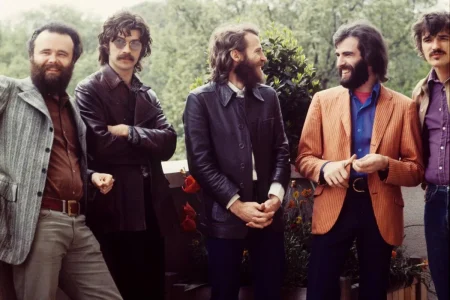
The closest we ever got to an actual Dylan – Young – Clapton “band” may have been thanksgiving night, 1976, at The Band’s farewell concert, immortalised as The Last Waltz. The film shows The Band backing an absurd roster of guests, including Dylan, Young and Clapton, all stepping into the same spotlight over the course of the evening. They do not share one tidy supergroup set, but the message is clear: these are peers, not separate universes.
That loose community resurfaces at Madison Square Garden in 1992 for Dylan’s 30th Anniversary Concert. On the now-classic performance of “My Back Pages”, Roger McGuinn, Tom Petty, Neil Young, Eric Clapton, Dylan himself and George Harrison trade verses while Clapton and Young fire off contrasting guitar solos over Booker T. & the M.G.’s. It plays like a summit meeting of different strands of 60s rock, with Dylan’s song as the shared scripture.
The wider concert gives Clapton even more room to burrow into Dylan’s writing. The official audio release features his smoldering rehearsal and performance of “Don’t Think Twice, It’s All Right,” proof that by the early 90s he could bend Dylan’s folk structures into modern blues without losing their bite. If you want to hear a guitar hero submit completely to another writer’s material and still sound like himself, start there.
Clapton, for his part, has spent years formalising this kind of collaborative chaos through his Crossroads Guitar Festival, a recurring multi-artist event that funnels ticket sales toward the Crossroads Centre, his addiction treatment charity. Dylan and Young are not regulars there, but the format – revolving lineups, surprise jams, generations of players rubbing shoulders – is the same laboratory spirit that defined SNACK, Bangladesh and The Last Waltz.
Key flashpoints in their tangled history
| Year | Event | Who overlaps | Why it matters |
|---|---|---|---|
| 1971 | Concert for Bangladesh | Dylan & Clapton | Prototype for the star-studded charity concert, normalising the idea of giants backing each other for a cause. |
| 1975 | SNACK Benefit, Kezar Stadium | Dylan & Young | Ragged joint set that treats each man’s songs as open source material to be hacked on the fly. |
| 1976 | The Last Waltz | Dylan, Young & Clapton (separate spots) | Visually codifies them as part of the same elite circle orbiting The Band’s farewell. |
| 1988 | Down in the Groove sessions | Dylan & Clapton | Clapton joins Dylan’s revolving studio cast, proof that the respect runs both ways. |
| 1992 | Dylan 30th Anniversary Concert | Dylan, Young & Clapton | “My Back Pages” becomes a de facto supergroup performance without the branding. |
| 2010s | Farm Aid & Hyde Park appearances | Dylan & Young | Shows their alliance shifting from counterculture outsiders to elder statesmen using clout for causes. |
So what did they really take from each other?
Strip away the mythology and you can hear three distinct lessons each man seems to absorb from the others. Clapton learns from Dylan and Young that songs can survive radical rearrangement, which frees him to keep reimagining his own back catalog night after night. Dylan, especially on shaggier projects, leans on players like Clapton to inject swing and bite into material that might otherwise feel tossed off.
Young seems to take the most strategic cue from Dylan: the idea that constant touring and surprise collaborations can be a political tool, not just a career maintenance plan. His role in Farm Aid, born from Dylan’s casual Live Aid remark, is the clearest expression of that – a rotating cast of friends weaponised in defense of family farmers.
The edgy truth is that many of the “classic rock” sounds younger bands still imitate were perfected in these supposedly one-off nights. The way a lead guitarist can burn through somebody else’s anthem without disrespecting it, the idea that a benefit show can double as a creative summit, the notion that your biggest hit is just a rough draft for the next tour – all of that lives in the collaborations of Dylan, Young and Clapton.
No, we never got the album where all three sat in a circle and cut songs together for a month. Instead we got something messier and arguably richer: a decades-long conversation that kept spilling over onto other people’s stages and records. If you want to hear rock history being rewritten in real time, follow those collisions, not the marketing myths.