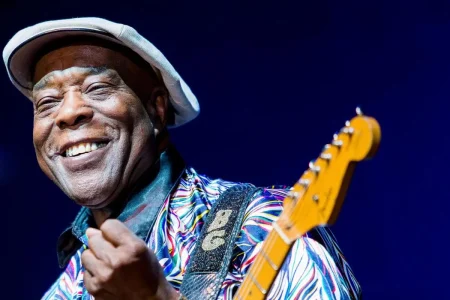
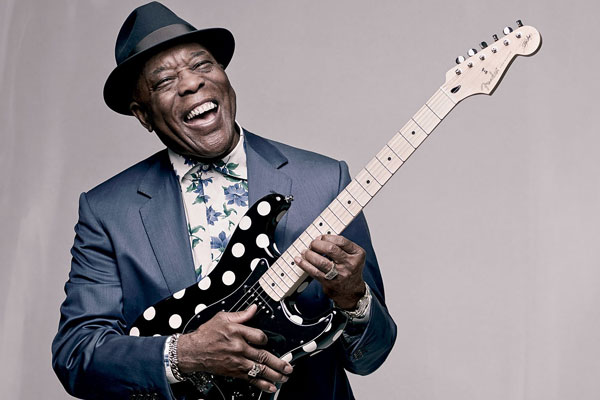
Buddy Guy talks about the blues the way most people talk about family: with pride, frustration, laughter, and the sharp awareness that time is undefeated. His stories are full of names that built modern music – John Lee Hooker, Muddy Waters, Howlin’ Wolf, Little Walter – but what makes Guy interesting is that he refuses to turn them into museum pieces. He treats them like working musicians who argued, teased, suffered, and, on the good nights, set a room on fire.
The quotes you’ve pulled capture Buddy Guy’s real superpower: he’s not just a legendary guitarist, he’s a first-person historian who still thinks like a hungry kid trying to steal licks. And he’s got a warning for anyone who thinks the blues is “over.” If the blues dies, it won’t be because it ran out of truth – it’ll be because we stopped listening.
“Mama told Papa… let the boy boogie woogie”: the moment Buddy Guy got claimed
Buddy Guy has described hearing John Lee Hooker and feeling like Hooker was calling him out personally: “Mama told Papa, let the boy boogie woogie,” and Guy thinking, he was speaking about me
. That’s not just fandom; it’s identity forming in real time.
Hooker’s boogie wasn’t “advanced harmony” or polite technique. It was groove as survival – one-chord hypnosis, stomp-and-shake rhythm, and a vocal delivery that could sound like a warning. Hooker’s legacy is heavily tied to that boogie style and its mesmerizing repetition, the exact thing young Buddy Guy wanted to learn by ear and by obsession, a tradition echoed in the broader history of ear-built blues learning.
“Man, whatever that is, one day, I sure wish I could learn it.”
Buddy Guy (as quoted by the user prompt)
Here’s the provocative claim: the blues doesn’t “teach” you in the way modern education does. It initiates you. You don’t graduate; you get recruited. For Guy, Hooker’s line was a recruitment letter.
The Chicago blues circle: mentorship with teeth
Buddy Guy’s interviews often drift toward a recurring theme: the greats weren’t just influences, they were a community that watched each other work. Guy speaks about talking with Muddy Waters, Howlin’ Wolf, Little Walter, and others, trading thoughts about what happens when the old guard is gone.
“Who would be left… please, don’t let the blues die.”
Buddy Guy (as quoted by the user prompt)
That fear wasn’t melodrama. In the 1950s and 1960s, the blues was already being exploited, repackaged, and sometimes pushed aside by newer commercial trends, even as it powered rock and soul from behind the curtain. Buddy Guy’s career sits right on that fault line, and Chess Records’ Chicago blues story is part of how that sound got documented, marketed, and exported.
Guy’s early association with Chess matters because Chess was a factory for electrified blues, capturing a sound that later guitar heroes treated like scripture. The label’s artist ecosystem shows how interconnected those players were, and Buddy Guy’s Blues Hall of Fame profile points to the company’s place in shaping his recorded legacy.
“There weren’t no pay”: the blues economy was brutal (and that shaped the music)
Buddy Guy doesn’t romanticize poverty, but he also doesn’t pretend money was the point. The line about playing for love – and teasing each other about maybe getting a “good-looking gal” if you played well – is funny because it’s true. In that world, the gig itself might not pay, but reputation could.
“Hey, man, I know you ain’t gonna get paid tonight, but, if you play good enough, you might get you a good-looking gal.”
Buddy Guy (as quoted by the user prompt)
This is where blues gets misunderstood by modern players. People talk about “authenticity” as if it’s a costume. What Buddy is describing is a working-class arts economy where the reward system is immediate and human: social status, romantic attention, a sense of being somebody. That pressure cooker produced a kind of intensity you can’t fake with boutique pedals.
And it explains his stage persona: wild bends, volume swells, walking into the crowd, playing with his teeth – not as circus tricks, but as competition. In a room where everyone’s broke, the only currency is impact.

Buddy Guy’s guitar style: controlled chaos that rock borrowed and cleaned up
Buddy Guy is often described as a key bridge between Chicago blues and the explosive guitar language of rock. That’s not hype; it’s a lineage you can hear in the phrasing: stinging single-note attacks, wide vibrato, sudden dynamic drops, and that feeling that the solo might break loose at any second.
One reason Buddy still hits hard is that his sound contains risk. Many later blues-rock players imitate the notes but remove the danger. Buddy’s tone and approach keep the sense that something could go wrong – and that’s exactly why it feels right.
Even broad reference sources point to his influence and stature within blues and rock history, though Buddy himself tends to frame it more simply: he wanted to play like the greats he heard, and he refused to play politely.
“Please don’t let the blues die”: what Buddy Guy is really asking for
When Buddy Guy begs people not to let the blues die, he isn’t asking for nostalgia. He’s asking for attention to the craft – the rhythm, the tone, the storytelling, the bandstand discipline. He’s also asking that the blues be treated as a living language, not a “genre box” at a streaming service.
Recognition has come his way in big institutional forms, including major honors that position him as a cultural figure, not only a guitarist, as reflected in major-profile cultural coverage of his life and work.
But here’s the edgy truth: awards don’t keep a tradition alive. A tradition survives when the next generation steals it, reshapes it, and fights about it in clubs. Buddy Guy’s anxiety is really about whether that handoff is happening in the right places, for the right reasons.
“These kids are more advanced now”: Buddy Guy is not scared of the future
One of the smartest things Buddy Guy says is also one of the most generous. He admits he hears younger players doing licks he doesn’t know, and that the learning tools available now (video, TV, lessons on demand) create a different kind of musician.
“These kids are more advanced now than when we were children, because they got a lot of things that they can look and learn, and I didn’t have that.”
Buddy Guy (as quoted by the user prompt)
That’s not a bitter old-man take. It’s a realistic assessment of access. Buddy learned by grinding it out: sitting down and picking out what players like Hooker and Lightnin’ Hopkins were doing “myself.”
The hidden lesson is this: modern players can learn faster, but they can also skip the part that makes blues dangerous – the part where you suffer through uncertainty until your own voice shows up. Technology can speed up information. It cannot replace identity.

The blues “survival kit”: what Buddy Guy’s stories teach guitarists today
If you’re a player, Buddy Guy’s quotes can be turned into a practical checklist. Not a generic “practice more” list – a blues-specific survival kit that respects where this music came from.
1) Learn the boogie engine, not just the lick
Hooker’s boogie works because of pulse and feel, not complexity. Practice locking a one-chord groove for 5 minutes without speeding up, then add small variations.
2) Treat the bandstand as a conversation
Chicago blues was social music. Don’t just solo; react. Leave space, answer the vocal, mirror the drummer, and build intensity like a story arc.
3) Use “showmanship” as a musical weapon
Buddy’s stage moves land because they ride the groove. If you move, make it serve the time feel and the dynamics, not your ego.
4) Steal from the elders, then steal from the kids
Buddy openly listens to younger players. Do the same: learn an old standard, then learn one modern trick (a rhythmic displacement, a hybrid-picking idea, a new chord color) and integrate it into the standard.
Why Buddy Guy still matters: he’s proof the blues is not polite
Buddy Guy’s greatest contribution might be psychological. He kept the blues from becoming safe. His playing insists that blues is not background music, not “mature,” not a tasteful drink in a dim lounge. It’s hunger, flirtation, humor, and confrontation.
Even today, footage of Buddy Guy performing live shows that he treats every night like it’s still a test, still a challenge, still something to earn. Watching him live, you see the message behind all the stories: the blues lives when somebody plays like it matters.
And if you want the institutional version of that same idea, his Musicians Hall of Fame recognition reflects how widely his musicianship is respected beyond blues circles.
Conclusion: the blues won’t die, but it can be domesticated
Buddy Guy’s warnings are less about extinction and more about domestication. The blues can survive as a brand while losing the thing that made it powerful: the human volatility inside the groove.
If you take anything from his quotes, take this: learn from the giants, respect the community, stay curious about younger players, and never confuse “advanced” with “alive.” Buddy Guy didn’t become Buddy Guy by playing it safe, and neither did the blues.