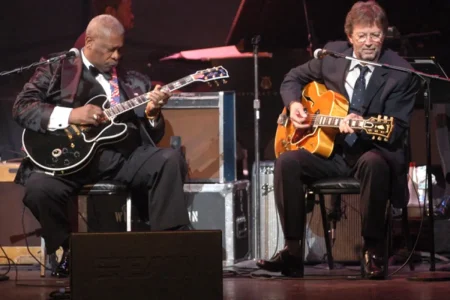
Bobby Rush does not talk like a museum exhibit. He talks like a man who has done the miles, shook the hands, and watched the room change while keeping the groove steady.
In a widely quoted profile about his memoir, Rush summed up the weight of his long view: “I’ve known so many of these cats,” he said. “I’ve lived the history.” (Brett Anderson, The New York Times). That exact piece is hard to access reliably online due to publishing restrictions, but the story it tells is echoed across interviews, award citations, and institutional profiles.
This is the Bobby Rush paradox: he is both the last link to an older blues world and a performer who never stopped adjusting his hustle. If the blues is supposed to be “real,” Rush is the kind of real that makes people uncomfortable because it includes money, sex, marketing, and showmanship, not just sorrow.
The “dying breed” claim: why Bobby Rush stands out
Rush is often described as a bridge between Delta-rooted tradition and the urban, electrified world that turned blues into nightlife. The Blues Foundation, which documents major figures in the genre, places him in that continuum through his Blues Hall of Fame recognition and career overview.
What makes him feel “almost unique” is not only longevity, but proximity. Rush moved in circles where names like Muddy Waters, Jimmy Reed, and Little Walter were not “influences” but people you ran into, learned from, and competed with for attention and gigs.
Chicago before the first single: the long apprenticeship
One detail that consistently catches readers is that Rush spent years in Chicago before his first single came out. The commonly cited first release is “Someday” in the mid-1960s, a late “debut” by modern standards, when many artists expect instant documentation.
That lag is a clue: in the old blues economy, being good was not enough. You had to be seen, trusted by bandleaders, booked by club owners, and recognizable to the crowd before a studio cared. In other words, you had to be a working musician first and a “recording artist” second.

Hot dog cart economics: the blues as a business reality
Rush’s hot dog cart story has become legendary because it punctures romantic ideas about musicianship. The point is not that music failed him, but that he understood the cash flow outside the club could beat the cash flow inside it on a slow night.
This is a blunt truth blues audiences sometimes ignore: the blues has always been tied to the informal economy. Tours, door deals, tips, plate sales, food, bars, and side businesses kept many performers alive long before “legacy” payouts existed.
The provocative take: the blues is not anti-commerce, it is anti-fake
Some fans act like selling anything besides records is “selling out.” Rush’s career suggests the opposite: the blues tradition is full of entrepreneurs. What the culture rejects is not commerce, but pretending you are above it.
“That’s how you git it dirty – make them notes bend.”
Little Walter, as recalled by Bobby Rush in his memoir
The harmonica lesson that explains his whole aesthetic
The “dirty” harmonica line is more than a technique tip. It is a philosophy: you take something clean (a straight note) and you force it to testify (a bent note). That “dirt” is what turns a scale into a story.
Rush has long been credited as a multi-instrumentalist and entertainer who uses voice, guitar, and harmonica as tools for tension and release. Biographical summaries describing him as a singer, guitarist, and harmonica player emphasize that he doesn’t fit neatly into one lane.
Quick practical breakdown: what “tongue-blocking” does for blues harp
- Thicker tone: covering holes with the tongue lets you isolate notes with more air and body.
- Built-in rhythm: tongue slaps create percussive “chick” sounds that function like a snare.
- Chordal effects: you can jump between single notes and partial chords fast.
- Better bends (for many players): bending becomes a controlled vocal-like inflection, not a squeal.
If you want “dirty,” practice bending slowly on draw notes, then add tongue slaps. The goal is a bend that sounds like speech, not like an alarm.
“I Ain’t Studying You”: memoir as a survival manual
Rush’s memoir, I Ain’t Studying You: My American Blues Story (with David Whiteis), is framed less as a chronology and more as a set of lived lessons. Publisher descriptions emphasize the arc from the Jim Crow South to national stages, told in Rush’s voice and sensibility.
The Library of Congress catalog entry underscores the book’s formal identity as autobiography, which matters because Rush is not merely “a character” in blues history. He is documenting his own record, on his own terms.
Three lessons modern musicians can steal from Rush immediately
- Outwork your mythology: the legend is useless if you do not show up and deliver.
- Own your audience: be unmistakable, even if critics call it “too much.”
- Build side income: if the gig money is thin, get smart instead of getting bitter.
Networking like a bluesman: proximity is power
Rush’s story repeatedly returns to relationships. In scenes where younger artists might name-drop for status, Rush’s recollections function like oral history: who played what, how they got their sound, what kind of neighbor they were.
That is why producers and historians pay attention. It is not nostalgia. It is verification. In radio interviews and features, Rush is often treated as a living connector who can confirm how styles and techniques actually traveled person to person. A Chicago-area public radio profile highlights his long-running presence and the way he carries stories as naturally as songs.
From juke joints to institutions: how the blues becomes “heritage”
One of the strangest turns in American music is watching something once dismissed as low-class entertainment become institutional culture. Rush’s career sits right at that pivot: he is a nightclub figure who also gets treated as a cultural ambassador.
Public media coverage of his memoir leans into that idea of a performer narrating American life, not just a niche genre. Minnesota Public Radio’s The Current frames the book as a collection of life lessons and history, not simply backstage stories.
KQED’s arts coverage similarly presents Rush as both entertainer and witness, emphasizing personality, memory, and his ability to translate an older blues world for contemporary listeners.
A career of awards, late recognition, and why it matters
Blues careers often peak in public visibility late, if they peak at all. Rush’s major honors reinforce the point that “success” in traditional American roots music can look nothing like pop stardom.
DownBeat reported Rush’s Grammy win for Porcupine Meat in the Best Traditional Blues Album category, a moment that introduced many jazz and roots readers to his work in a new way.
Rather than treating awards as a finish line, Rush has used them as fuel. The reputation bump creates touring leverage, press attention, and better bargaining power. That is not cynical – it is professional.

Where to start listening (a simple roadmap)
| If you want… | Start with… | Listen for… |
|---|---|---|
| Modern traditional blues punch | Porcupine Meat | Big humor, bigger groove, tight band discipline |
| Showman energy | Live performances (any era you can find) | Call-and-response, pacing, crowd control |
| Memoir context | I Ain’t Studying You | The “why” behind the songs and the hustle |
The edgy truth: Bobby Rush proves the blues never needed permission
The blues establishment sometimes prizes purity: the right guitar tone, the right wardrobe, the right seriousness. Rush has often worked the opposite angle: flirtation, comedy, sharp talk, and relentless entertainment. The implication is daring but defensible: a lot of “respectful” blues presentation is sanitized for polite audiences.
Rush’s brand of blues says the quiet part out loud: adult life is messy, desire is real, money matters, and the band still has to hit on the one. That is not a betrayal of tradition. It is closer to what juke joints always were.
How to learn from Rush as a guitarist and harp player
For guitarists
- Think rhythm-first: make your right hand feel like drums before chasing fancy licks.
- Use space as comedy timing: pauses can be punchlines, not just “rest.”
- Sing your bends: if you cannot sing the bend, you will not land it convincingly.
For harmonica players
- Commit to tongue-blocking basics: even partial adoption thickens tone.
- Practice “dirty” bends quietly: control beats volume every time.
- Copy speech: shape phrases like sentences, with commas and periods.
Smithsonian Folkways’ catalog search shows his presence in archival and roots-oriented contexts, a reminder that his work travels beyond the club circuit into preservation spaces too.
Conclusion: a living argument for the blues
Bobby Rush is not just “still around.” He is still teaching, still selling, still performing, and still challenging the idea that the blues is supposed to sit quietly in the corner. If the blues is a living language, Rush is one of the last native speakers who also knows how to code-switch for any room.
And if that makes him a “dying breed,” the real question is whether today’s musicians are willing to inherit the whole package: the sound, the hustle, the humor, and the unapologetic human mess that makes the notes bend.