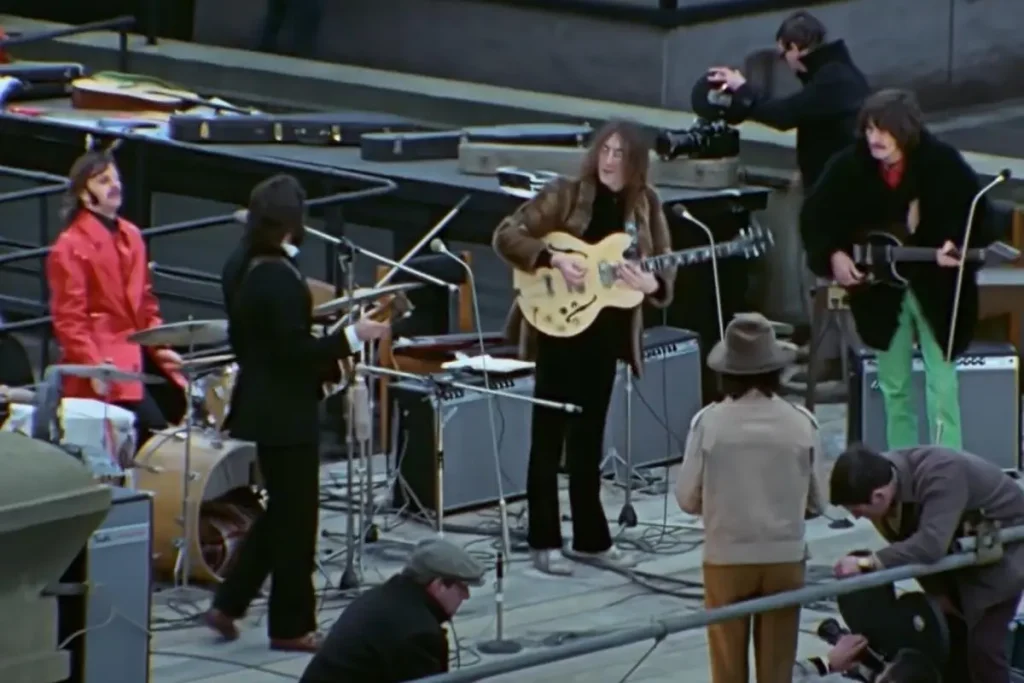
On a cold London lunchtime, The Beatles did something both mischievous and strangely final: they played a full electric set on the roof of their own headquarters at 3 Savile Row. No tickets, no stage lights, no farewell speech. Just amps, cameras, and the city below – plus the kind of tension that makes great rock and roll feel dangerous again, captured in the Beatles’ rooftop concert account.
The rooftop concert on 30 January 1969 has been mythologized as “the last Beatles show,” and in a very real sense it was: their final public performance arrived as a guerrilla blast of live energy that briefly erased months of arguments, business chaos, and creative gridlock.
“I’d like to say thank you on behalf of the group and ourselves and I hope we’ve passed the audition.” – John Lennon, closing the rooftop set
Why the rooftop happened (and why it was so un-Beatle-like)
By early 1969 The Beatles were trying to “get back” to being a playing band. The project that became Let It Be started as a plan to rehearse, write, and perform live again, with cameras rolling the whole time, even as their post-touring era still sat in the shadow of a catalog that would go on to dominate the official charts record.
That premise mattered because The Beatles had stopped touring years earlier. So the concept of a live performance – any live performance – became the narrative engine: it would provide an ending, a release valve, and a reason for all the rehearsal footage to exist, later reframed for modern viewers via The Beatles: Get Back.
Here’s the provocative part: the rooftop was not a grand artistic masterplan. It was a solution to indecision, nerves, and logistics. A roof was available, the cameras were already in place, and nobody had to negotiate with promoters, venues, or a stadium full of expectations.
The scene at 3 Savile Row: a concert designed to look accidental
Apple Corps’ building at 3 Savile Row sat above London’s everyday rhythm: office workers, traffic, curious pedestrians. The roof created a perfect illusion of spontaneity, even though the performance was carefully filmed and recorded as part of the Let It Be project.
The “accidental” vibe is why the rooftop still feels modern. It plays like a pop-up show decades before that term existed: no crowd control, no formal announcement, and a sense that it might be shut down at any second.
Who actually played?
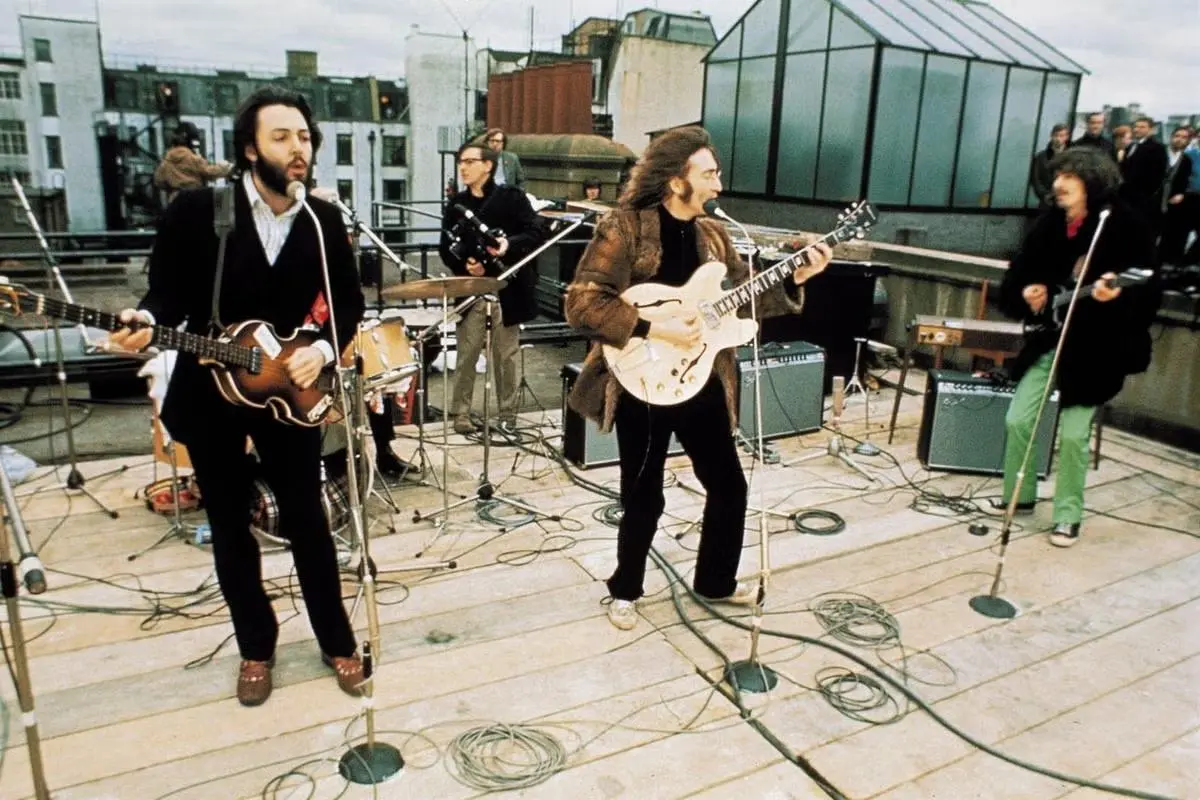
The lineup was The Beatles plus keyboardist Billy Preston, whose presence added musical glue and a subtle behavioral upgrade: everyone acts slightly more like professionals when a respected outsider is in the room.
Preston’s contribution also shows up in the credits and legacy of the sessions. The “Get Back” single is famously credited to “The Beatles with Billy Preston,” a rare official nod for a non-member on a Beatles release – an era you can see echoed in widely circulated rooftop concert photography.
Rooftop setlist: what they played (and what it reveals)
The set was built largely from songs being developed for the project: new material, not a greatest-hits victory lap. That’s the first clue this was not nostalgia – it was a working band stress-testing songs in public.
| Song | Notes from the roof |
|---|---|
| “Get Back” | Played more than once; the hook is built for street-level impact. |
| “Don’t Let Me Down” | Raw Lennon vocal, tension and tenderness in one take. |
| “I’ve Got a Feeling” | Two voices, two songs, one shared chorus-line energy. |
| “One After 909” | A return to early-era rock roots, tightened by late-era chops. |
| “Dig a Pony” | Odd phrases, hard groove; proof they were still chasing new shapes. |
Even if you know every note, the most interesting detail is what the setlist doesn’t do. There is no attempt to summarize Beatlemania, no “She Loves You,” no mass singalong. It’s almost defiant: we’re not your old band, we’re your current band
.
The police “shutdown”: myth vs. reality
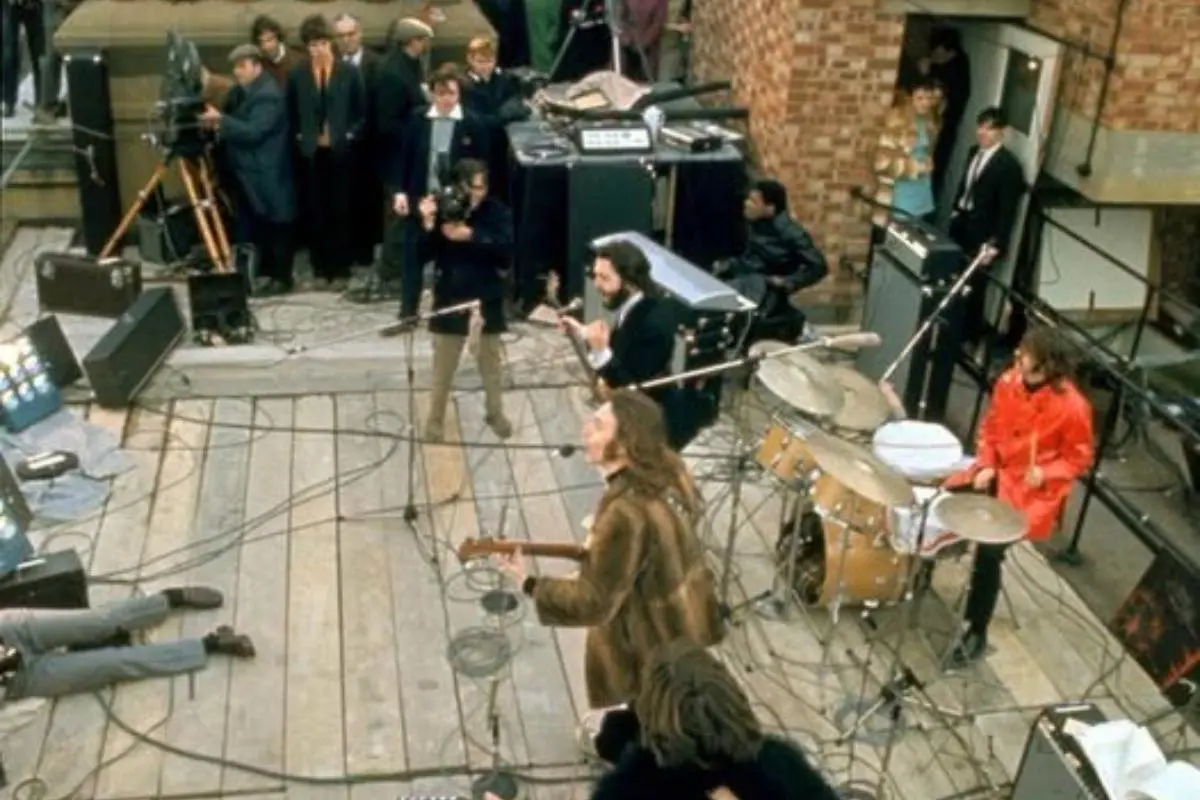
The legend says the police “stopped” The Beatles. The footage shows something subtler and more British: officers responding to complaints, climbing the stairs, and negotiating with Apple staff while the band keeps playing like schoolkids who refuse to come in from break time.
That tension is crucial to the concert’s emotional punch. Rock music regains its outlaw flavor when authority arrives, even if the authority is mostly trying to restore lunch-hour peace. The band’s insistence on squeezing in “one more” performance is the closest thing to a public statement they made as a group at the end.
Gear and sound: the rooftop as a real-world test bench
Musically, the rooftop show is often described as scrappy, but it is also surprisingly controlled. That’s because it was recorded and documented with professional intent, even if it was staged in an unprofessional place.
From a player’s perspective, the roof adds practical challenges: wind, cold hands, limited monitoring, and the acoustic weirdness of playing above a canyon of streets. The performance has that slightly tense “grip” you get when musicians can’t fully relax into the room – because there is no room.
What an older listener might miss on first watch
- The tempos are driven by adrenaline, not studio perfection.
- The vocals are “worked” – you can hear them reaching rather than polishing.
- The band chemistry still exists, even when the friendship doesn’t.
Was it really their final concert?
Yes, in the sense that matters: it was The Beatles’ last public live performance as a band.
But it’s also worth challenging the tidy narrative that the rooftop was their “end.” The group still worked after this, and their final recorded album release sequence is famously complicated. The rooftop is best understood as their last moment of public unity rather than the exact moment the band ceased to function.
How Let It Be and Get Back changed the rooftop story
For decades, most fans experienced the rooftop through the 1970 Let It Be film, which framed the sessions in a way that helped cement a breakup narrative.
Then Peter Jackson’s documentary series The Beatles: Get Back arrived and complicated the mood. Instead of a simple tragedy, the sessions look like a band that can still be funny, collaborative, and wildly effective – right up until business pressure and exhaustion drown the fun, a shift amplified by the later theatrical release of the rooftop concert.
The rooftop segment in Get Back is especially revealing because it restores time and texture: the stop-start decisions, the between-song chatter, the way the band locks in when the red light is on. It doesn’t “fix” the story – it makes it human.
Why the rooftop still hits: three big reasons
1) It’s rock and roll without permission
Most legendary concerts are monumental. This one is borderline impolite, and that’s why it endures. It breaks the invisible rules of where music is allowed to happen.
2) It captures a band being a band, not a brand
Even the best studio albums can feel like architecture. The roof is muscle and breath: missed cues, laughter, cold fingers, and a pulse that no overdub can recreate.
3) It gives the Beatles an ending they didn’t script
The Beatles didn’t do a farewell tour, and they never got a clean goodbye. The rooftop is messy closure: a final public act that feels earned precisely because it wasn’t packaged as “the final act.”
What musicians can learn from the rooftop concert
- Deadlines create endings. If you can’t decide on the “perfect” venue, play somewhere.
- Performance sharpens songs. The roof versions prove arrangement choices fast.
- Document everything. The lasting power of the rooftop is inseparable from the fact it was recorded and filmed as an event, not just a gig.
Rooftop trivia that’s actually useful context
The rooftop concert has become such a cultural image that major photo archives still treat it as a distinct event, not just a footnote in Beatles history, and even museum collections keep searchable records of Beatles rooftop materials.
And its continuing afterlife isn’t only nostalgia. The 2022 theatrical presentation of the rooftop performance underscores that the set stands on its own as a concert film, not merely an appendix to the Let It Be narrative – a reminder of how London’s cultural memory is continually curated by institutions and civic life that frame what the city chooses to celebrate, from galleries like Tate to the broader public story of London itself.
Conclusion: the last Beatles gig was a heist in broad daylight
The rooftop concert endures because it refuses to behave like an ending. It is loud, imperfect, playful, and slightly antagonistic to the grown-up world below – which is exactly what rock music is supposed to be when it’s alive.
In 1969, The Beatles didn’t walk onto a grand stage to wave goodbye. They climbed some stairs, plugged in, and tried to blow the roof off their own myth. Then they went back inside, and history had to do the rest.