
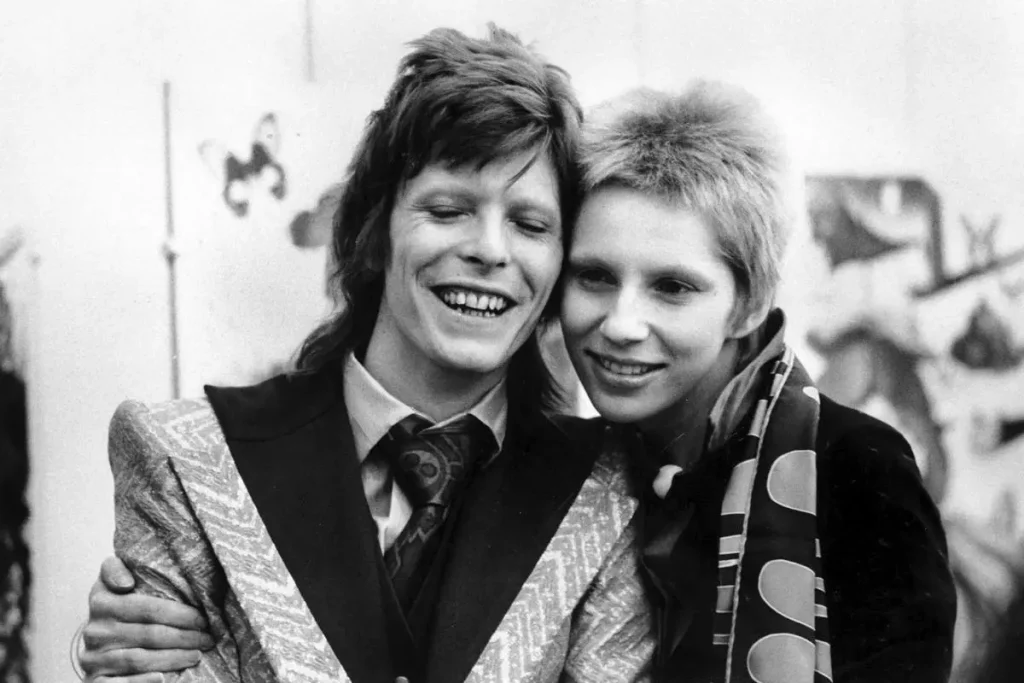
In late June 1971, a young couple pushed a pram through suburban Beckenham. The man wore a flowing dress, the woman a furry jacket, and in the carriage lay their three week old son, Zowie. Ron Burton’s photos from that walk capture David Bowie and Angie trying on the role of normal mum and dad while still looking like visitors from another planet.
Those images feel almost too calm for what was really happening. Behind the pram and the smiles was a calculated, chaotic partnership, an openly non monogamous marriage and a baby who was, depending on whom you believe, equal parts love child, career strategy and artistic muse.
From student crush to a showbusiness marriage
Angie Barnett was a tall, brash American studying in Britain when she met the still struggling David Bowie in 1969. Years later she described their bond with typical bluntness, calling it a marriage of convenience that secured her a work permit and gave him a fiercely driven ally rather than a conventional sweetheart.
She has also been frank that they were not in love in any traditional sense. Bowie told her before the wedding that he was not really in love with her, and she claims she was fine with that, seeing herself more as nurse, housekeeper, creative accomplice and business partner than fairy tale bride.
By Angie’s own account and by contemporaneous reporting, the union was open from the start. She later described their relationship as a showbusiness marriage, complete with bisexual affairs on both sides and even a threesome the night before the ceremony, a story Bowie himself repeated with amusement when Ziggy era mythology began to solidify.
Haddon Hall: a crumbling nursery for glam rock
Shortly before marrying, Angie and David moved into Haddon Hall, a decaying Victorian villa in Beckenham that looked like a gothic set left over from a silent film. They rented a cheap ground floor flat while the musicians who would become the Spiders from Mars crashed on the upstairs landing, and Angie filled the place with junk shop furniture, Carnaby Street knick knacks and future stage costumes.
In one of its vast rooms, with ceilings painted silver, Bowie wrote much of The Man Who Sold the World, Hunky Dory and Ziggy Stardust, while Angie cut his hair and stitched the first outlandish outfits. By the time she was pregnant with Zowie, the house had become a bohemian commune, rehearsal space, salon and crash pad, not remotely the quiet nest most new parents imagine.
May 1971: a son in the middle of the circus
On 30 May 1971, after a gruelling labour, Angie gave birth at Bromley Hospital to a son they named Duncan Zowie Haywood Jones. Writer Chris O’Leary notes that Bowie was at home listening to a Neil Young record when the hospital called with the news, and within a day or so he had written a new song for the baby, debuting it live on the BBC less than a week later.
Only weeks after the birth, the family ventured out for that now famous Beckenham stroll, with David still styled like a future alien messiah and Angie beaming beside him. Burton’s images from 29 June frame Zowie’s pram as if it were just another eccentric prop, yet the way both parents lean toward it hints at a genuine, if fragile, tenderness.

Kooks: lullaby, prophecy and self myth
The song Bowie wrote in those first days, Kooks, landed on Hunky Dory later that year, dedicated on the sleeve simply ‘for Small Z’. The Bowie Bible points out that it was explicitly written for David and Angie’s newborn son, with Bowie introducing it in 1971 as a freshly written tune about his baby and later recalling that fatherhood mainly pleased his ego.
Kooks paints Angie and David as a pair of charming oddballs inviting their child to join their lovers’ story, promising warmth, mischief and a proudly unconventional upbringing. A later track by track feature quotes Bowie telling Rolling Stone that he thought of Zowie less as his or Angie’s possession and more as a little plant to be nurtured, a revealingly detached way to talk about a tiny human he had just serenaded on record.
Musically, the song sounds like an off kilter nursery rhyme, with jaunty trumpet and piano masking some very grown up ambivalence. Critics have long noted how Bowie loved to slip an unexpected chord into an otherwise simple progression, a compositional trick that Know Your Instrument even nicknames the David Bowie move, and Kooks is full of those sly harmonic left turns that make the domestic scene feel slightly unreal.
Angie’s strategy and the PR baby
Decades later Angie added a darker, more calculating angle to the story of Zowie’s arrival. In a candid interview syndicated via Bang Showbiz she argued that, in early 70s America, David had to present as heterosexual with bisexual tendencies to satisfy network censors and promoters, and that one foolproof way to support that image was to have a child with his wife.
She said she felt that if she had David’s baby, no one could seriously claim he was anything other than straight enough for middle America, and added that she expected him to be a devoted father because of his own closeness to his dad. In her telling, then, Zowie was both emotional gift and tactical shield, a living rebuttal to anyone unsettled by her husband’s very public fluidity.
Open marriage, newborn, and ruthless ambition
Whatever their motives, the arrival of a baby did not close the marriage. Suzi Ronson, the Beckenham hairdresser who gave Bowie his Ziggy haircut and later toured with the band, recalls in her memoir that Bowie slept with everybody and that Angie appeared to encourage it, seeing herself as the impresario of a bohemian circus rather than a wronged wife.
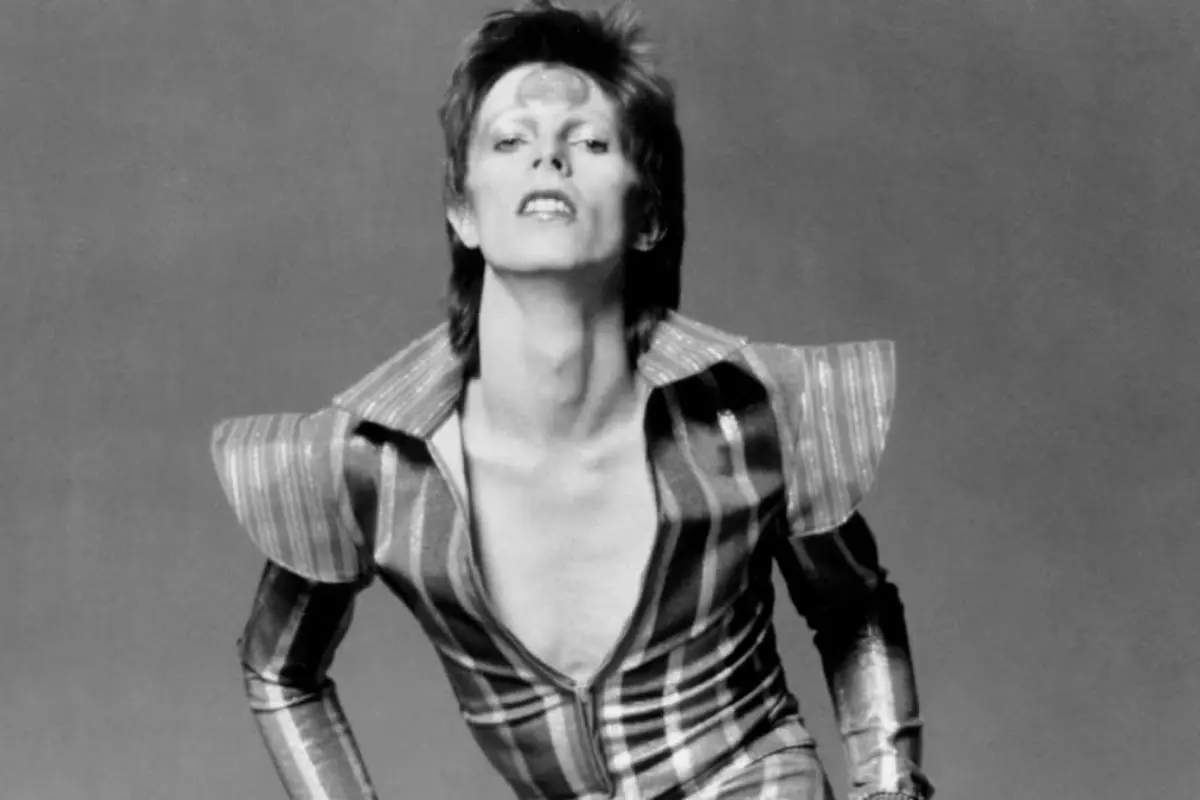
That circus swirled around a child who would soon be moved through hotel suites, studios and, later, multiple countries with a nanny as his main constant. In hindsight, it is hard to miss the tension between the playful promises of Kooks and the reality of two parents who were deliberately turning their home into a 24 hour theatre piece fuelled by sex, drugs and an almost brutal level of ambition.
Three weeks in 1971: what it all meant
Later, when the marriage imploded and the cocaine years grew dangerous, Angie chose not to fight Bowie for custody, saying in one TV interview that she had Zowie for David and would never use her son as a weapon in divorce. She admitted she last saw him as a young teenager and that the estrangement hurt so much she locked it in a mental box and refused to reopen it.
Seen against that bleak future, the three week old Zowie in Ron Burton’s photos becomes a haunting symbol. For a brief moment in 1971, Angie and David Bowie were a united front, wheeling their tiny son through suburbia as if a domestic life could coexist with everything they were about to unleash on rock culture. Kooks captured the hope, the humour and the warning all at once, and in doing so turned one baby’s arrival into part of the larger Bowie myth – equal parts family snapshot and beautifully crafted lie.


