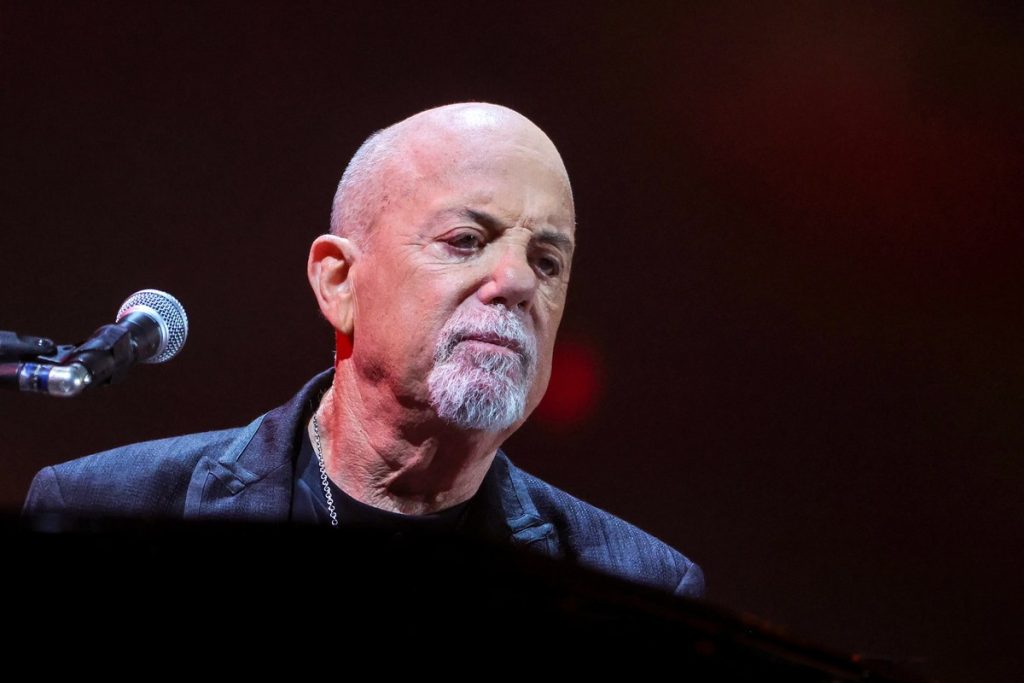
Billy Joel has told fans that surgeons implanted a shunt in his brain, and that the operation gave him back some of what normal pressure hydrocephalus had taken away. Speaking on SiriusXM’s The Billy Joel Channel on Wednesday, the 77-year-old described the surgery he initially refused, the moment his doctors explained what loud concerts were doing to him, and why the stage remains off limits for now.
“I agreed to do the shunt and I had surgery, and they implanted a shunt in my brain and it actually improved things,” Joel said in the interview, carried in full by The Music Universe. “My memory got better, my balance got a little better, my ability to function was better.”
It is the most detailed account he has given of his treatment, and a notably franker one than the version he was offering a year ago.
The symptom that started it: “like being on a boat”
Joel said the first sign that something was wrong was not pain or memory loss but a persistent instability underfoot. “I noticed that my balance was not good,” he recalled. “I had this sense of being on a boat, like this rocking motion. I wasn’t steady on my feet. I didn’t know why that was, and I went to meet with the neurologist, and I was diagnosed with having something called normal pressure hydrocephalus, which they used to call water on the brain.”
Normal pressure hydrocephalus, or NPH, occurs when cerebrospinal fluid accumulates inside the skull and presses on the brain. According to the Cleveland Clinic, as cited by NBC News, its three characteristic symptoms are difficulty walking, urinary incontinence and cognitive problems, and it is often treatable and sometimes reversible. The standard intervention is exactly the one Joel eventually accepted: a shunt implanted to drain the excess fluid.
Joel said his doctors were candid that nobody knows what causes it, and that it could worsen. “Nobody’s really sure what causes it, but they’re able to diagnose it, and I heard this, and I said, ‘Oh, well, what does that mean?’ ‘Well, you know, it could be progressive. It could get worse, but what we recommend is that you implant a shunt in your brain.'”
His first answer was no. The objection was the obvious one — the procedure requires drilling through the skull. He changed his mind after reading about the outcomes, and he framed the decision in characteristically blunt terms. “I didn’t want to do that, but then I read up on it and I realized it can help improve your balance and can help your memory. You know, I don’t want to lose my marbles. It’s hard to tell what’s age and what’s a condition.”
Why his doctors told him to stop performing
The part of the interview likely to unsettle fans most is not the surgery but the explanation that followed it. Joel said his doctors linked his condition directly to his job.
“Because of my job, which is playing rock and roll music very loud, that it was giving me something like a concussion every time I did a show,” he said. “It was causing damage to my brain nerves and I could be losing more brain cells the more shows I did.”
That warning, as Just Jared reported, settled the question of touring for him. “I realized that means I shouldn’t be doing this right now,” Joel said. “I gotta improve. They don’t want me to stress too much.” He added that he is doing physical therapy and following medical advice without argument.
It is worth noting how much the tone has hardened since his last widely reported comments on the subject. In July 2025, appearing on Bill Maher’s podcast Club Random roughly two months after his diagnosis was made public, Joel was dismissive of the framing around it. “I feel fine,” he said then. “My balance sucks. It’s like being on a boat.” He added: “They keep referring to what I have as a brain disorder, so it sounds a lot worse than what I’m feeling.” The account he gave this week — of nerve damage, lost brain cells and a concussion-like effect from every performance — is considerably graver than that.
Where things stand now
Joel announced the NPH diagnosis in May 2025 and canceled his scheduled concerts at the time, saying in a statement that the condition had been exacerbated by recent performances and was affecting his hearing, vision and balance. He had already postponed dates earlier that year while recovering from surgery for a condition that was not specified publicly.
EntertainmentNow reports that there is still no timeline for a return to the stage, and nothing Joel said this week suggested one is close. What he did offer was reassurance, delivered directly and without much ceremony: “I just want people to know, don’t worry about me. I’m not going anywhere. I’m here. I’m still here.”
The health update was not the only subject he covered. Joel also used the interview to talk about Bob Dylan, whom he placed at the top of his personal hierarchy of songwriters. “Nobody wrote like Dylan before Dylan, and even after Dylan, nobody wrote like Dylan,” he said. “Sometimes I don’t know what the hell he’s talking about and he’ll even admit to that, but his style of writing is totally unique.”
The full conversation is running on The Billy Joel Channel, on channel 93 on satellite radio and through the SiriusXM app, until October 1.