David Bowie invented characters the way other musicians wrote songs, and he retired most of them cleanly — Ziggy killed on stage, Aladdin Sane folded away with the face paint. One character was different. The Thin White Duke, the immaculate and hollow aristocrat of 1975–76, wasn’t a costume Bowie put on. By his own later accounts, it was a symptom — the persona that emerged when the man underneath was disappearing.
Los Angeles, 1975
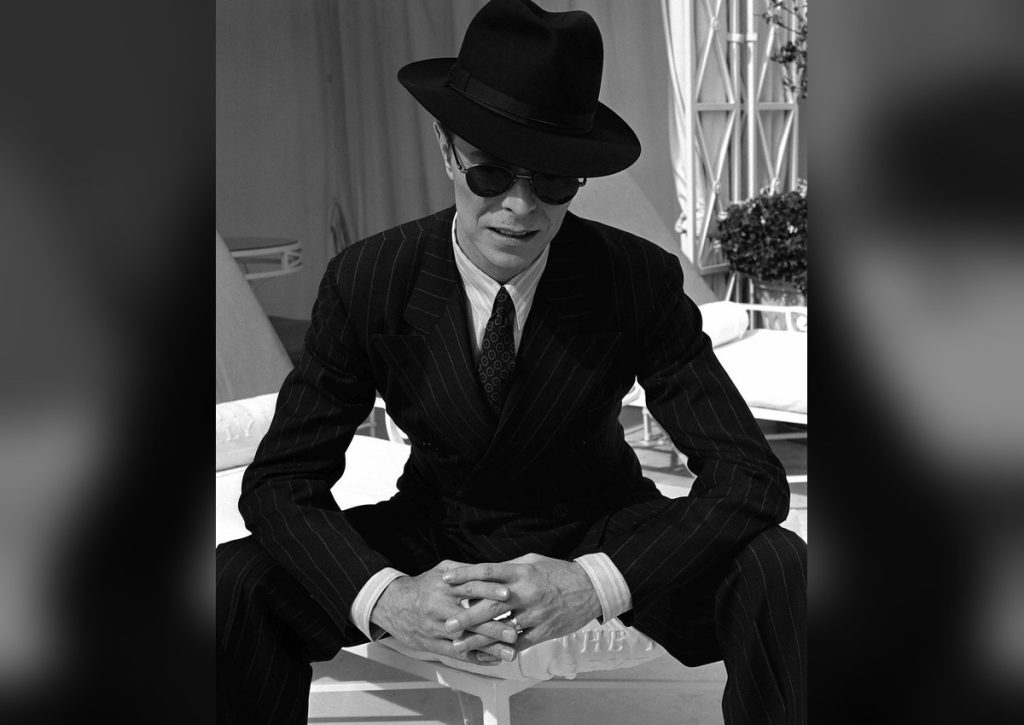
The setting is inseparable from the character. Bowie spent 1975 in Los Angeles at the peak of his cocaine use, living on milk, peppers and paranoia, immersing himself in occult reading and staying awake for days. Out of that condition came a figure of terrifying elegance: slicked amber hair, white shirt, black waistcoat and trousers — a skeletal, pallid aristocrat crooning romantic ballads with, as Bowie put it, no emotion at all behind the eyes. Where Ziggy had been alien warmth, the Duke was European ice: perfectly dressed, perfectly empty.
The album that carried him, Station to Station, released in January 1976, opens by announcing him — “the return of the Thin White Duke” — over ten minutes of motorik menace, and remains one of Bowie’s towering achievements. Its maker’s most chilling remark about it: he could barely remember recording the album at all.
The character even had a cinematic origin. Bowie spent mid-1975 in New Mexico starring in Nicolas Roeg’s The Man Who Fell to Earth as Thomas Jerome Newton, an alien aristocrat undone by Earth’s appetites — and the Duke stepped almost directly out of that role’s wardrobe and posture. The Station to Station sleeve is literally a still from the film. Actor and character and persona blurred into a single sleek silhouette, which was precisely the problem: by his own account Bowie was no longer sure where the film role ended, the stage character began, or he himself persisted.
When the mask says the quiet part
The Duke era produced the most notorious missteps of Bowie’s life. In character and in chemical freefall, he gave interviews flirting with fascist imagery and strongman rhetoric, and a wave at Victoria Station was photographed at an angle that made it look like a salute — an incident he always denied intended. Pressed at the time, he insisted the provocations were performance: “What I’m doing is theatre and only theatre,” he told the Daily Express in 1976.
But Bowie’s own retrospective verdict was harsher than his critics’. He called the Duke a nasty character indeed — an ogre he’d summoned when his grip on himself was weakest — and spent later decades apologising for the era’s statements with a directness he never applied to any other period. The persona built to explore emptiness had begun supplying opinions. That is the moment theatre stops being theatre, and Bowie knew it before anyone.
On stage, paradoxically, the era was magnificent. The 1976 tour stripped rock spectacle to harsh white light and black curtains — a stark, cabaret-of-the-damned staging years ahead of its time — and the band, driven by the Station to Station rhythm section, played some of the most muscular music of Bowie’s life. Audiences saw total command. The command was the costume; underneath it, by every later account including his own, was a man running on powder and willpower alone.
The escape
What he did next may be the most consequential decision of his life. When the 1976 tour ended, he did not book another. He left Los Angeles — a city he afterwards spoke of with something close to horror — and moved first to France and then to Berlin, cutting his hair, dropping the wardrobe, and dismantling the Duke entirely. The Berlin years that followed produced Low, “Heroes” and a rebuilt human being; the amber-haired aristocrat simply never reappeared.
The pattern matters. Bowie’s genius had always included knowing when a character was finished — he’d been managing personas and their dangers since the glam wars — but the Duke was the only one he fled rather than retired. No farewell concert, no announcement. Just distance, geography and sobriety deployed as exorcism, while the friendships of the old scene carried on quietly in the background.
Why the Duke still fascinates
Half a century on, the Thin White Duke remains Bowie’s most debated creation precisely because he sits at the exact border between art and pathology. Station to Station argues that the persona was worth it; the interviews argue it nearly cost him everything. Both are true, which is why the era gets studied rather than merely enjoyed.
And there’s a warning in it that has outlived its decade. Bowie’s characters were tools for exploring selves he didn’t dare inhabit plainly — a brilliant method, right up until the tools started using him. The Duke is what it looks like when an artist’s creation colonises its creator: the best-dressed cry for help in rock history, singing love songs with nothing behind them, while the man inside worked out — just in time — that the only move left was to stop playing him.
Bowie escaped to Berlin and made the greatest music of his life. The Duke stayed behind in Los Angeles, forever 1976, immaculate and empty. Exactly where he belongs.