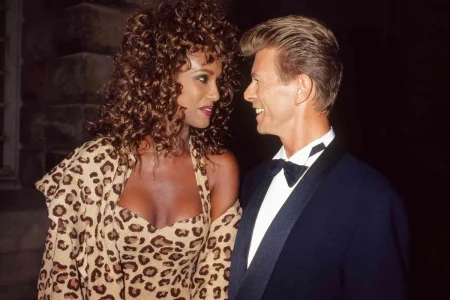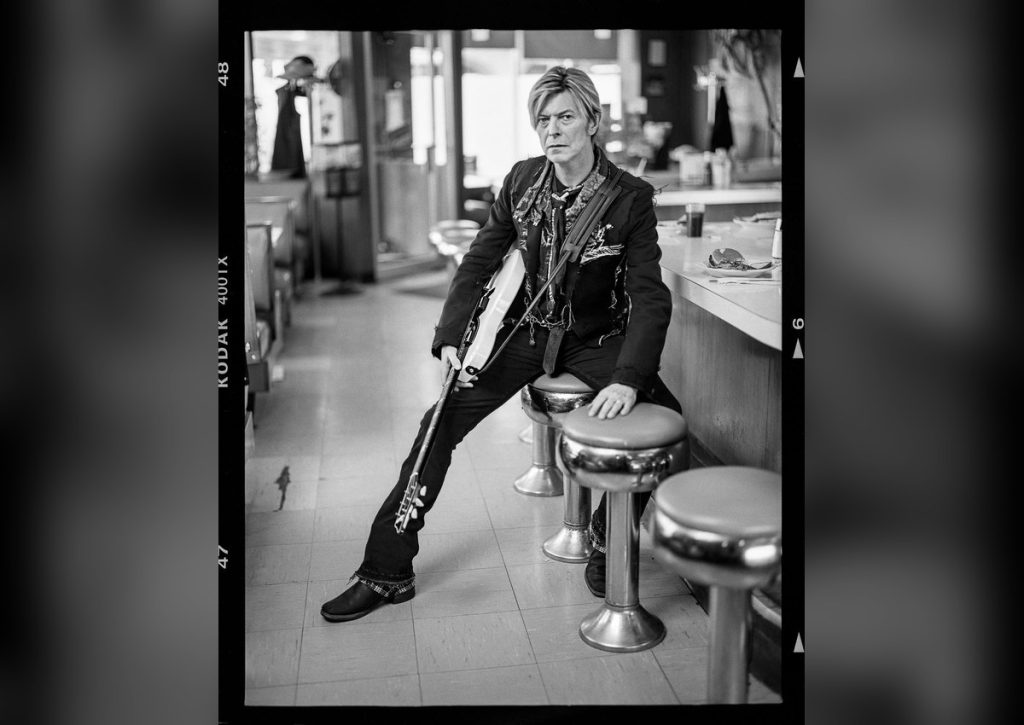
The most photographed shapeshifter of the twentieth century spent his final two decades performing his greatest illusion: being nobody. From the mid-1990s until his death, David Bowie lived not in a gated compound but in downtown Manhattan, at 285 Lafayette Street, where he walked to bookshops, bought his own coffee, rode public transport and raised a daughter — largely unbothered, in the most surveilled city on earth. It wasn’t luck. It was craft.
The man on the street
Neighbours in Nolita and SoHo remembered him exactly as the legend now runs: a friendly, modest local who did his own shopping and walked without an entourage. He wrote affectionately about his walking habit — a 2003 magazine piece cataloguing his beloved Manhattan routes and early-morning wanders — and friends described a man who had, after decades of restlessness across LA, Berlin and Switzerland, simply found the first city that let him be a resident instead of an exhibit.
The domestic architecture mattered. Married to Iman, with daughter Lexi born in 2000, Bowie organised his New York years around family and privacy with the discipline of a man guarding treasure — school runs, galleries, bookshops, studio work when it called. The rock star abdicated; the neighbour took over.
Hiding in plain sight
The mechanics of his invisibility were pure Bowie: theatrical thinking applied in reverse. The masterpiece, revealed by novelist William Boyd, was the newspaper. Bowie explained that he could move through the city unrecognised by carrying a Greek-language newspaper under his arm, in full view. Anyone who thought they’d spotted David Bowie would clock the Greek paper, run the arithmetic — why would Bowie read Greek? — and talk themselves out of it. He’d weaponised doubt. A flat cap, unremarkable clothes and confident ordinariness did the rest.
It’s the same insight that built Ziggy, inverted. Personas work because people believe what the props tell them; the man who had spent the seventies using costume to become more visible spent the 2000s using one prop to become less. Stagecraft is stagecraft, whichever direction it points.
The city as collaborator
New York held up its end. The city’s professional indifference — the local code of leaving famous residents alone — gave Bowie something Los Angeles and London never had, and he repaid it by becoming one of downtown’s quiet fixtures: turning up at small gigs and theatre, championing young bands, absorbing the jazz rooms whose players would eventually populate his final work. The last albums came out of this exact ecosystem — The Next Day announced with no warning after a decade of silence the whole industry had failed to penetrate, and a final record cut in secret with local jazz musicians while the man himself remained, to the end, unfindable except on his own terms.
The proof of the cover’s quality arrived in January 2013, when The Next Day materialised on his 66th birthday with zero advance warning — no leaks, no rumours, nothing — after two years of sessions conducted under handshake secrecy in the middle of Manhattan. An industry that cannot keep a tracklist quiet for a fortnight had entirely lost a David Bowie album for two years, because the man had spent the previous decade teaching everyone around him that his private life was genuinely private. The disappearing act wasn’t adjacent to the late masterpieces. It was their production method.
That is the under-appreciated punchline of the anonymity years: they weren’t retirement. They were cover. The disappearing act gave him back the two things fame had taxed away — an ordinary life with the woman he’d built it around, and total creative surprise.
The last lesson in image
Bowie’s career is taught as a masterclass in image-making, and the New York decades are its final module: the image of no image, executed flawlessly for twenty years. He proved that privacy, for the famous, is not a wall but a performance — sustained daily, with props and blocking and absolute commitment to the role of a man nobody needed to look at twice.
It also explains why the mourning, when it came, took the form it did: not a stadium memorial but flowers on a SoHo doorstep, neighbours and fans standing quietly outside an apartment building most had walked past for years without knowing. The city had kept his secret to the very end, and grieved him the way it had hosted him — locally.
The tourists now trace his routes down Lafayette Street, past the coffee places and the bookshop, hunting the ghost of a man who was, for two happy decades, deliberately unhuntable. He’d have enjoyed the irony. The world spent fifty years watching David Bowie transform. His longest-running character — the one he never broke, the one that let him live — was a bloke in a flat cap with a Greek newspaper, walking home to his family through a city politely pretending not to know him.