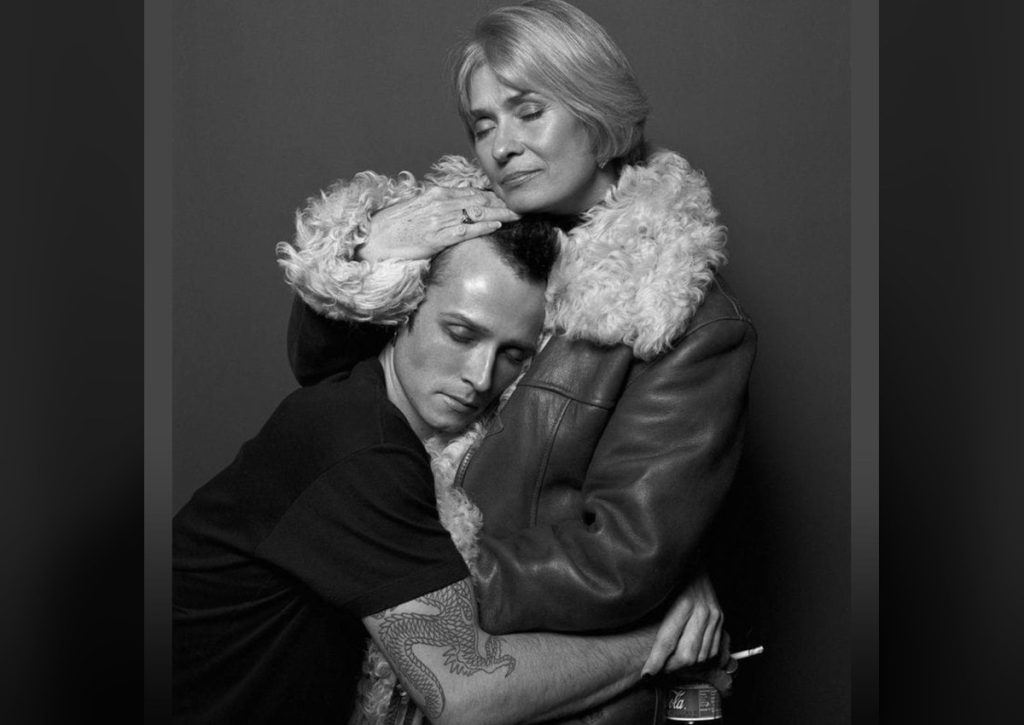
There’s a particular kind of photograph that circulates of Scott Weiland: not the shirtless megaphone showman of the Stone Temple Pilots years, but the son — standing beside his mother, Sharon, both smiling, an ordinary American family portrait with an extraordinary story pressing on it from every side. We spend enormous attention on addicted artists. We spend almost none on the people standing next to them in pictures like this. Their story deserves telling too, and Weiland’s family told more of it than most.
A family, not a cautionary tale
Scott Weiland was born Scott Kline in Santa Clara, California; his parents split when he was two, and he took the surname of his stepfather, Dave Weiland, the aeronautics engineer who raised him. In his 2011 memoir Not Dead & Not for Sale, Weiland wrote about a childhood memory that stayed with him all his life: his mother sitting him down and admitting to him, while he was still young, that she was an alcoholic.
That honesty turned out to be generational armour and generational burden at once. Sharon got sober and stayed sober — for a quarter of a century. Then came the cruellest detail in the whole family story: her sobriety slipped after she learned that both of her sons were using heroin. Addiction in families is so often drawn as a one-way inheritance, parent to child. The Weilands’ experience shows the current running both directions — a mother’s decades of recovery buckling under a mother’s fear.
What the spotlight never shows
Weiland’s public arc — the arrests, the relapses, the band he fronted through it all, the 2015 death on a tour bus at 48 — played out in headlines for two decades. What the headlines structurally cannot show is the parallel life run by the family: the mother tracking tour dates for bad news, the stepfather who’d given him a name, the brother fighting the same enemy (Michael Weiland died young too), the ex-wives and children managing love at a survivable distance.
His ex-wife Mary Forsberg Weiland forced that hidden half into the light within days of his death. In an open letter she asked the public, bluntly, not to glorify the tragedy — describing years in which the children had gradually lost their father long before he died, and challenging the reflex that paints an addict’s death as somehow romantic. It remains one of the most clear-eyed documents any rock family has produced: grief, expressed as a correction.
The scene that buried its sons
Weiland’s story sits inside a larger one. His generation of frontmen — Seattle-adjacent, platinum-selling, self-medicating — was decimated in public, one locked door at a time, and each loss trailed a family through the same stations: hope, boundaries, relapse, distance, phone calls you learn to dread. The music industry has slowly built better support for artists. Support for artists’ families — the mothers who get sober and get scared, the kids doing arithmetic about which memories are real — remains mostly a private improvisation.
That’s the reason to keep photographs like the one of Scott and Sharon in circulation, and to read resources on how addiction reshapes whole families rather than just its famous casualties. Every addicted artist the culture mourns was somebody’s boy. Some of them were photographed, smiling, next to the person who knew it best.
There’s a practical dimension to that visibility, too. Family-support programmes built around addiction — the Al-Anon model and its many descendants — exist precisely because the disease reorganises every relationship it touches, and because the people doing the loving need tools as surely as the person using does. Stories like the Weilands’ are, functionally, recruitment posters for that idea: proof that the strongest, most honest families still need help, and that needing it is not failure. If a mother with twenty-five years of sobriety can be knocked sideways by her sons’ addiction, the lesson is not her weakness. It’s how heavy the load actually is.
What survives
It would be false to end this neatly; the Weiland story doesn’t resolve, it just stops. But two things survive worth keeping. The first is the music — because whatever the chaos around it, the voice on those records was a genuine instrument, and the songs hold up. The second is the family’s insistence, at every stage, on telling the truth in public: a mother naming her disease to her own child; a son writing his memoir without self-forgiveness; an ex-wife spending her grief on a warning.
Addiction thrives on silence, in families most of all. This family, whatever else it lost, kept refusing to be quiet — in a memoir, in an open letter, in a mother’s kitchen-table confession decades before any of it. That refusal is a legacy too, and arguably the one most worth inheriting. The photographs of Scott and Sharon will keep circulating, as they should. Look at them the right way: not as a before-picture from a tragedy, but as a portrait of two people who kept telling each other the truth in a situation built to prevent it.