
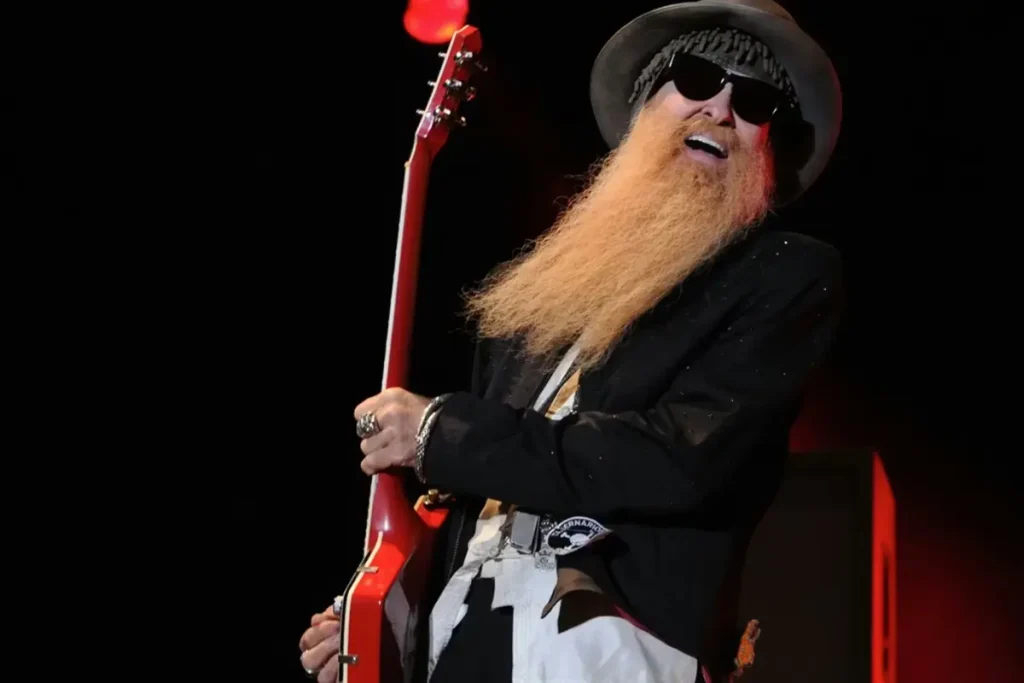
Billy Gibbons calls the blues a “secret language” – and he’s not being cute. He’s describing a craft where the most important information is implied, not spelled out. In an interview with Amit Sharma, Gibbons grins about learning musical “truths,” then drops a jaw-dropper: his Mo’ Slower Blues “just has one chord that it never leaves… It just stays on the tonic.” He follows it with a story from Jimmie Vaughan about B.B. King showing up, plugging in, and reportedly needing only a couple of notes to make the entire room feel something big.
That’s the blues at its most dangerous: less as a chord progression, more as a controlled leak of emotion. If your playing feels busy but not believable, this is the reset button you’ve been avoiding.
What Gibbons really means by “secret language”
In the Sharma interview, Gibbons frames the blues as poetry and mystique living inside “those simple three chords” that players have stretched “every which way,” and then he points out that sometimes you don’t even need all three in his discussion of blues “truths” and one-chord playing. That’s not anti-theory, it’s anti-filler.
“There’s a secret language to the blues – you need to say it without saying it!” – Billy Gibbons (interviewed by Amit Sharma, MusicRadar)
The “secret language” is the set of shared expectations between player and listener: micro-bends, rhythmic patience, call-and-response phrasing, and the way a single note can function like a raised eyebrow. It’s also cultural memory: blues phrasing carries the sound of voice, speech, and testimony.
Translation: the blues rewards implication
In everyday conversation, the most powerful line is often the one you don’t say outright. In blues, that’s the half-bent note that refuses to fully resolve, or the pause that forces the band (and the crowd) to lean forward.
One chord, infinite gravity: the tonic drone blues
Gibbons’ one-chord boast is more than a gimmick. A tonic vamp strips away harmonic tourism and leaves you with a brutal spotlight: time, tone, touch, and storytelling. If the groove isn’t convincing, there’s nowhere to hide.
When a song stays on I (the tonic), the interest has to come from:
- Rhythmic placement (behind the beat vs. on top of it).
- Dynamics (how quickly you grow, and how long you stay quiet).
- Articulation (slides, rakes, staccato pops, muting).
- Color notes (blues scale tensions, major/minor ambiguity).
This is why “simple” blues can feel terrifying on stage. It isn’t complex, it’s exposed.
The edgy truth: three chords can be a crutch
The classic I-IV-V form is iconic because it works, but it can also make players lazy. You can “sound like blues” by moving through the changes while never saying anything personal. A one-chord blues removes the costume and asks for your real voice.

The B.B. King lesson: “two notes” and total control
Gibbons’ second point lands even harder: Jimmie Vaughan recounts B.B. King showing up with a guitar, taking a solo, and (as Vaughan tells it) playing no more than two notes, but “that’s all that was required.” Whether it was literally two or “basically nothing,” the lesson is the same: restraint isn’t the absence of ideas, it’s the presence of judgment.
B.B. King’s official biography emphasizes that he became a global blues ambassador through decades of performance and recording, shaping a lead-guitar approach that prioritized vocal-like expression. His signature sound is inseparable from the idea that a note is a statement, not a unit of speed.
“Sometimes those spare, skinny moments make the most sense.” – Billy Gibbons (relaying Jimmie Vaughan’s B.B. King story)
Why “skinny moments” hit so hard
Minimalism works because listeners fill in the gaps. A sustained note invites the ear to track vibrato width, pitch drift, and the way the band cushions the line. In blues, space is not empty – it’s suspense.
Blues basics (without the boredom): the 12-bar myth and the real DNA
Yes, the 12-bar blues is foundational, and it’s worth understanding as a shared framework rather than a rulebook. Many blues songs use variations of the 12-bar form, typically cycling I, IV, and V functions in a predictable narrative arc built from primary chords (I, IV, and V).
But the blues’ real DNA is bigger than any template. The living blues tradition has deep roots and many branches, not a museum piece frozen into one progression. That’s why Gibbons can talk about “three chords” and then celebrate “one chord” without contradicting himself.
A quick “secret language” cheat sheet
| Device | What it communicates | How to practice it |
|---|---|---|
| Micro-bend (quarter-tone) | Uncertainty, longing, tension | Bend the minor 3rd toward major 3rd slowly, stop short |
| Vibrato control | Confidence and “voice” | Hold one note for 4 bars; vary vibrato speed every bar |
| Call-and-response | Conversation, not noodling | Play 1-bar “question,” then answer with 1-bar variation |
| Strategic silence | Authority, drama | Force a 1-bar rest after every phrase for 2 minutes |
How to build a one-chord blues like Gibbons (and not bore anyone)
A one-chord blues can be hypnotic or unbearable. The difference is arrangement discipline. Here’s a practical blueprint you can use with a band, a looper, or a backing track.
1) Choose your “home base” sound
Pick the tonic chord voicing and commit. Use a dominant 7 shape if you want grit, or a straight major triad if you want that eerie major/minor tension to come from the melody.
2) Create motion without changing chords
Use bass movement (walking around the root), chord embellishments (sus4 to 3, 6ths, 9ths), and rhythmic displacement. This is where the groove becomes your harmony.
3) Make the lead part obey a “meaning rule”
Try this: you only get to play a new phrase if you can sing it first. That keeps you in the blues’ vocal tradition and stops the fingers from freelancing nonsense.
4) Treat dynamics like the real chord changes
Instead of I-IV-V, think quiet-medium-loud, then reset. You can also “fake” a turnaround by thinning the texture, letting drums drop to rim clicks, or making the guitar answer the vocal like a second character.
Learning from Jimmie Vaughan: fundamentals, not fireworks
Jimmie Vaughan’s reputation is built on taste and time: clean choices, sharp rhythm, and a refusal to overplay. His career built on feel and consistency is a good reminder that a career can be forged on fundamentals rather than flash.
That matters because the Gibbons story isn’t really about B.B. King humiliating anyone. It’s about recalibrating your definition of “enough.” If your solo depends on the audience being impressed by your effort, you’re already losing.

Want B.B. King-level emotion? Steal these three habits (ethically)
You don’t need to copy licks to copy the method. B.B. King’s artistry is widely documented, and the throughline is clarity: clear melody, clear rhythm, clear intent. Build your own version with these habits.
- Play fewer notes, and make each one identifiable. If a note can’t be remembered, it probably didn’t matter.
- End phrases like a singer. Let lines “breathe,” and avoid the panic-fill between ideas.
- Use vibrato as punctuation. Decide when vibrato starts, and how wide it gets, instead of shaking everything by default.
Listening homework: study space, not speed
If you want to hear how blues phrasing survives on minimal material, watch a live B.B. King performance and pay attention to what happens between the notes: band cues, audience response, and the timing of vibrato.
For a broader view of the blues tradition and its ongoing documentation, the blues-related collections and essays connecting the music to American history highlight how the music intersects with lived experience. That context is part of the “secret language,” too.
The provocative takeaway: blues “truth” is a discipline, not a vibe
The blues has been romanticized into a mood, but Gibbons is pointing to something tougher: a technical and emotional discipline. A one-chord track demands you manage tension without harmonic help. A two-note solo demands you mean what you play.
And here’s the uncomfortable part: if you can’t make a single note sound honest, more notes won’t save you. They’ll just make the lie louder.
Conclusion: say it without saying it
Billy Gibbons’ “secret language” isn’t secret because it’s mysterious. It’s secret because it’s earned – through restraint, listening, and the courage to leave space. Whether you’re stuck on three chords or daring yourself to live on one, the blues only asks one question: do you have something real to say?


