

Elvis Presley’s relationship with his mother, Gladys Love Presley, has been mythologized into something half-holy, half-taboo: a poor Southern family’s devotion turned into pop culture’s most famous mother-son bond. It is also one of the few Elvis stories that consistently survives the noise, the marketing, and the Elvis-industrial complex. When you trace the arc of his life, Gladys is not a footnote. She is a lens.
And if you want an edgy claim that holds up under scrutiny, here it is: the “King of Rock and Roll” was emotionally crowned at home long before he wore gold lamé onstage. The intensity of that early attachment helped drive his hunger, his generosity, his insecurity, and his tendency to build a protective bubble when the world got loud.
Gladys and Elvis: poverty, faith, and a two-person universe
Elvis was born in Tupelo, Mississippi, to Gladys Love Smith and Vernon Presley, and the family’s early years were marked by economic instability and a tight-knit, church-centered life. Those conditions can shrink a household into a single unit: you survive by sticking together, trusting each other, and leaning on ritual. Many Elvis biographies describe Gladys as protective and Elvis as unusually attached in return.
Gladys is also inseparable from the story of Elvis as a “feel” singer. In Pentecostal and Southern gospel environments, emotion is not decoration; it is the point. The young Elvis absorbed that, and the person most consistently around him to reinforce it was Gladys.
He was a twin – and that matters
Elvis’s twin brother, Jesse Garon Presley, was stillborn. That kind of loss often becomes a family ghost: spoken of directly, or silently shaping how parents hold on to the child who lived. A widely cited overview of Elvis’s twin status and early family context helps frame why Gladys’s protectiveness is frequently highlighted by biographers and historians.
The famous “mama’s boy” label: sweet truth, lazy stereotype
Calling Elvis a “mama’s boy” can sound dismissive, like a punchline. But in his case it is closer to a psychological clue. In a world where he would later be sexualized, criticized, commodified, and chased, Gladys was the pre-fame anchor.
That anchor did not merely comfort him. It helped form his instinct to please, to give, and to overcompensate when he sensed disapproval. Elvis’s adult generosity is legendary, but so is his sensitivity to rejection. Those traits sit comfortably together in someone who learned love as something you earn through loyalty.
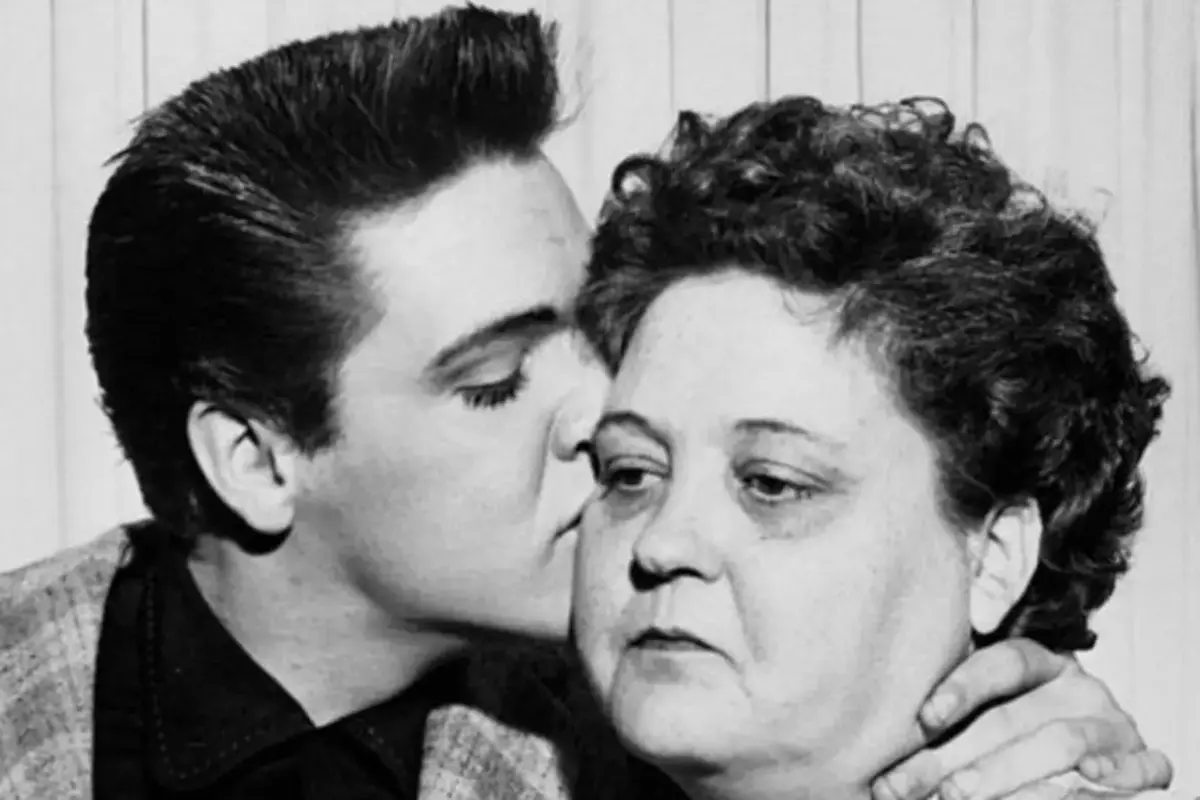
A protective bond, and the cost of protection
Protection is not neutral. It can teach safety, or it can teach fear. If you grow up with the message that the outside world is dangerous, then stardom is not freedom; it is exposure. Many mainstream biographical summaries emphasize how deeply Elvis was affected by his mother’s death, which suggests the bond was not casual.
Money arrives, anxiety stays: what fame did to Gladys
One of the more uncomfortable truths in the Elvis story is that his meteoric rise did not simply “save” the Presleys. It relocated their stresses into new forms. When money arrives quickly in a family not used to it, the emotional rules often do not update as fast as the bank account.
Gladys, by many accounts, struggled with Elvis’s sudden public life. A small-town protective mindset does not easily adapt to screaming crowds, predatory adults, and nonstop travel. The family moved to Memphis, and Elvis’s world expanded, but the bond with Gladys remained intensely personal. Background on Elvis’s early life in Tupelo and the Presley family’s roots helps explain why the jump to national fame could feel destabilizing.
The Army, separation, and the beginning of the ache
Elvis’s induction into the U.S. Army in 1958 is often told as a narrative of maturity: a superstar doing his duty. It is also a mother-son separation story. For someone with a strong attachment to home, the Army is not just discipline; it is forced distance.
Public fascination with Elvis as a soldier was intense, but behind the headlines was a family dealing with stress and change. The U.S. National Archives explains how Army military service records are organized and accessed, underscoring that Elvis’s service is part of a formal historical record, not just celebrity lore.
Gladys’s death in 1958: grief, guilt, and a fracture that never healed
Gladys Presley died in 1958 at age 46, and Elvis was devastated. That statement is not fan melodrama; it is a consistent through-line in serious writing about him. A contemporaneous “On This Day” note records the death of Elvis Presley’s mother in Memphis on Aug. 14 and the public significance of the event at the time.
Here is where the story gets provocative, but still responsible: Gladys’s death functioned like a psychological fault line. Elvis had already been famous, already desired, already criticized. But after Gladys, the “safe place” wasn’t just far away – it was gone.
“They don’t know what it means to lose someone you love.” – Elvis Presley (widely quoted in accounts of his reaction to Gladys’s death)
Because quotes are often repeated without context, it’s smart to treat exact wording cautiously. What we can say confidently is that multiple credible sources describe Elvis’s grief as overwhelming and long-lasting, and that it influenced how he sought comfort afterward.
Was it “a broken heart” story?
Popular retellings sometimes imply Gladys died purely of heartbreak because Elvis was away. That is emotionally neat and historically messy. The better way to phrase it: Gladys’s health issues and stresses were real, and the family’s circumstances did not help. Treat the “broken heart” phrasing as metaphor unless you have a clinical source in hand.
How the loss shows up in Elvis’s music (even when he isn’t singing about her)
Elvis did not write most of his material, so his inner life is not neatly “documented” in lyrics the way it might be for singer-songwriters. But interpretation is still possible if you focus on performance choices: vulnerability, phrasing, and song selection.
After Gladys, listen for the way Elvis leans into loneliness, pleading, and spiritual reassurance. He had always been capable of tenderness. Later, tenderness becomes weight-bearing.
Three places to hear the Gladys-shaped Elvis
- Gospel recordings – not as genre exercise, but as emotional home base.
- Ballads about regret and distance – where his voice sounds like it is trying to “reach” someone.
- Live performances – moments where he slows time and holds a line longer than expected.
An overview of the Library of Congress National Jukebox’s mission to preserve historically significant recordings is a helpful reminder that the emotional vocabulary Elvis drew from (early popular and sacred music styles) sits inside a much larger American recording heritage.
Edgy, but fair: did Elvis replace Gladys with an “inner circle”?
After Gladys died, Elvis increasingly relied on a tight group of friends and employees, later nicknamed the “Memphis Mafia.” It is easy to mock that circle, but it also resembles a coping strategy: if you cannot go home to safety, you build a home that travels with you.
This is where the Gladys relationship becomes more than sentiment. It becomes a blueprint. Elvis creates an environment where loyalty is constant, outsiders are filtered, and intimacy is controlled. That is not purely ego. It is also grief management.
Grief and control travel together
When a person loses their primary emotional stabilizer, control becomes a substitute stabilizer. Control over schedules, over who gets close, over what gets said in the room. Elvis’s later life can be read through that lens without reducing him to a diagnosis.

Gladys in the public story: why filmmakers keep circling her
Modern Elvis portrayals often highlight Gladys because it explains him quickly. You can show one scene of maternal devotion and audiences instantly understand why this superstar still feels like a scared kid sometimes. But the best versions avoid treating Gladys as a plot device.
A broad biographical overview of Elvis’s career and cultural role is useful here because it places personal history alongside the machinery of fame.
Practical listening guide: if you want to “hear” the mother-son bond
You do not need to hunt for a single “song about Gladys” to connect the dots. Instead, use this quick approach when you listen to Elvis:
| What to listen for | Why it matters |
|---|---|
| Sudden softness mid-phrase | Often signals vulnerability rather than showmanship |
| Gospel-inflected turns | Points back to family and church as emotional training |
| Performances where he seems to “plead” | Suggests attachment and fear of loss |
| Onstage jokes that feel defensive | Humor as cover when emotions run hot |
What we can say with confidence (and what we can’t)
Elvis and Gladys shared a deeply close relationship, and her death marked him profoundly. That is the safe center of the story, supported across mainstream biographies and historical summaries of Elvis Presley’s life and family.
What we should avoid overstating: that Gladys singlehandedly “caused” Elvis’s later issues, or that every career decision is a direct echo of her loss. Human lives are multi-causal. But it is also fair to say that when your core attachment disappears at 23, it leaves a permanent imprint.
Conclusion: the King’s most human headline
Elvis Presley’s relationship with his mother is not interesting because it is unusual to love your mom. It is interesting because it is one of the few places where Elvis’s life resists cynicism. Fame can explain a lot, but it does not explain everything.
Gladys explains something simpler and harder: before Elvis was a brand, he was a son. And after she was gone, he spent the rest of his life trying to recreate the feeling of being safely loved, on a stage where nothing is ever safe.


