
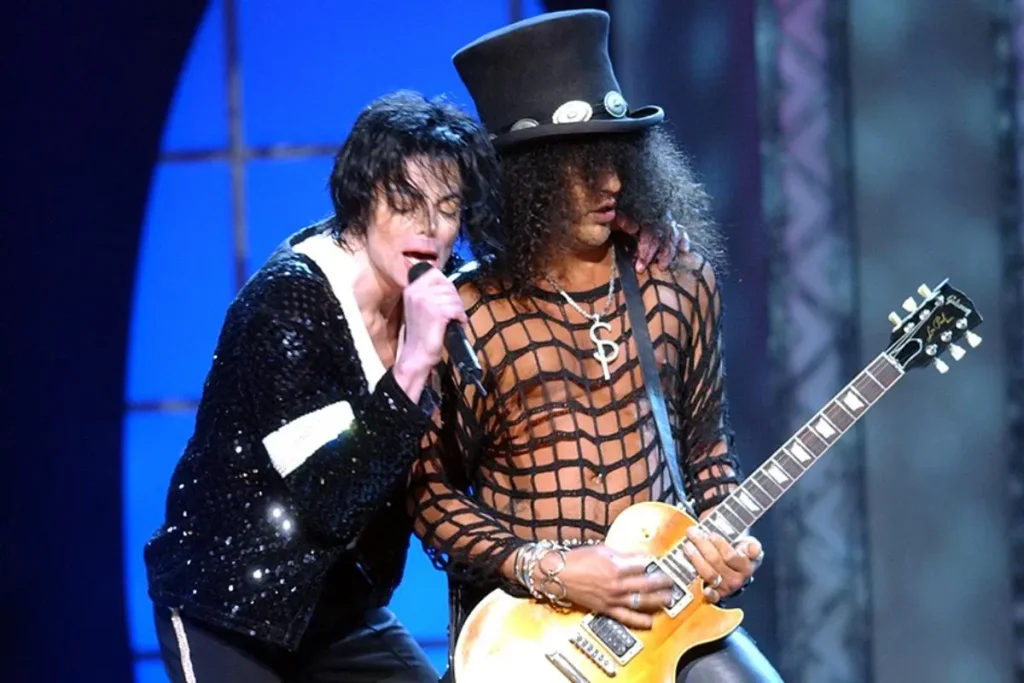
It is easy to remember Slash with a Les Paul in a Michael Jackson video and file the whole thing under “fun celebrity crossover.” That memory is wrong in the most important way. Slash was not hired as set dressing for MTV; he was hired as a musician, and his guitar is a loud, creditable part of Jackson’s meticulously crafted Dangerous-era studio world (1991), most famously on the scorched-earth lead work of “Give In to Me” and in the guitar-driven architecture around “Black or White.”
In the early 90s, this was a borderline rude move for a pop superstar at Jackson’s level: inviting the era’s most recognizable hard-rock guitarist into your meticulously controlled sonic universe and letting him sound like himself. It is one of the clearest signs that Dangerous was not designed to be “the next Thriller.” It was designed to fight for oxygen in a culture that was getting heavier, louder, and more cynical by the week, as reflected in contemporary 1991 music-industry coverage and chart-era context.
The early-90s backdrop: pop had to get meaner
By 1991, Jackson was no longer competing only with other pop stars. Rock radio had teeth, hip-hop was becoming the center of gravity, and “safe” was turning into a punchline. Even if you never read a think-piece in your life, you can hear that anxiety on Dangerous: hard drums, sharp edits, and a willingness to let distortion sit right next to pristine vocal stacks.
The album also marked the end of Jackson’s long Quincy Jones run and a full embrace of newer production voices, including Teddy Riley, whose new jack swing palette gave Jackson a modern, street-level edge during the post-Quincy shift in Jackson’s career arc.
Why Slash made sense (and why it was risky)
Slash in 1991 was not “legacy rock.” Guns N’ Roses were the loudest band in the world, Use Your Illusion had just hit, and Slash’s tone was instantly identifiable: thick midrange, vocal-like bends, and a slightly reckless time-feel that makes solos sound alive. Jackson did not need that for credibility. He needed it for danger.
“Michael wanted me to play like I play.” Slash, interviewed by The Current (Minnesota Public Radio) (Slash recalling how Jackson directed his approach in the session)
That quote is the key. Jackson was famous for controlling performances down to microscopic details, yet he brought in a guitarist known for swagger and spontaneity. If Slash overplayed, it could have sounded like a novelty. If he underplayed, the whole collaboration becomes pointless. The tightrope is why the results still feel exciting decades later.
“Give In to Me”: the moment pop let the lead guitar back in
“Give In to Me” is a dark, adult record: a jealous, tense groove with a chorus built for arena volume rather than dancefloor sparkle. Slash’s lead lines are not polite punctuation marks. They are narrative devices, answering Jackson’s vocal like a second character that is angrier, less controlled, and more physical.
Production-wise, the track works because the band elements are not treated as “rock in a box.” The guitars are integrated into a modern pop mix where drums are tight, vocals are forward, and the solo is allowed to feel big without drowning everything else.
Slash has described how he approached the session with real pressure, because you do not stroll into Michael Jackson’s world and act casual – and that same recollection of the “Give In to Me” session explains why the performance feels so urgent. That tension reads on tape as urgency. His phrases push and pull against the grid, which gives Jackson’s otherwise laser-precise framework a human wobble.

Listening guide: what to notice in Slash’s playing
- Wide vibrato and long bends that “sing” in a way synth leads cannot.
- Call-and-response phrasing with Jackson’s vocal lines, almost like a duet.
- High-gain sustain that creates drama even when he is not playing fast.
- Rhythmic looseness that keeps the solo from sounding programmed.
“Black or White”: the riff, the rock framing, and what Slash actually did
“Black or White” is often remembered for its global message and its blockbuster video, but the single is also built around a rock guitar hook. The record leans on that riff to launch the song before it pivots into pop and chant-like sections. This is where the Slash story gets fuzzy in casual retellings.
Credited guitar on “Black or White” has been attributed to Slash in many popular accounts, while detailed session credits also cite other players. Some releases and databases list Slash among the guitar contributors on Dangerous overall, while the exact allocation per track can vary by documentation, including the Dangerous personnel and credits listings.
What is safe to say is this: whether Slash played the primary riff, added supplemental parts, or shaped the “rock framing” through additional overdubs and feel, the single was conceived to sound like Jackson deliberately walking into rock territory. The guitars are not hidden behind strings. They are front-of-mix identity.
Commonly repeated background notes about Slash’s association with “Black or White” reflect how firmly the connection has stuck in public memory.
Not just audio: Slash as a visual weapon
The “Black or White” video made Slash a symbol as much as a musician. Jackson understood that guitar in pop is partly a visual language: it signals danger, masculinity, volume, rebellion. Putting Slash on-screen was Jackson saying, “This is not a soft era.”
That matters because Dangerous was a multimedia campaign at a level few artists will ever touch. Using Slash in that campaign was not a random guest spot. It was brand strategy with a distortion pedal.
What Michael got from Slash (and what Slash got from Michael)
Jackson got authenticity he did not technically need but artistically craved: a player whose tone and phrasing could not be faked with studio polish. He also got access to rock’s cultural capital at a moment when rock still functioned as pop’s “dangerous older brother.”
Slash got something different: proof that his guitar voice could live inside the most demanding pop production environment on earth. A Jackson session is not a bar-band jam. It is precision labor. Survive that, and you can survive anything.
Slash’s official career biography highlights the Dangerous collaboration as a notable credit, underscoring that it was more than a cameo in hindsight.
The studio reality: Jackson’s perfection vs Slash’s instinct
Engineer Bruce Swedien, a central architect of the classic Jackson sound, consistently described Jackson’s recording approach as detail-obsessed and performance-driven, with an emphasis on capturing emotional impact through meticulous craft.
That matters because Slash is not a “perfect take” celebrity. His magic is micro-imperfection: notes pushed sharp, phrases that lean forward, the slight chaos that makes a solo feel risky. The early-90s relationship between Jackson and Slash is fascinating because it suggests Jackson was willing to curate chaos, not eliminate it.
Why this collaboration still hits: pop’s most expensive flirtation with hard rock
Plenty of pop records hire guitarists. Fewer let those guitarists sound like a threat. “Give In to Me” is not a wink at rock fans; it is a full-bodied rock performance inside a pop juggernaut. That is why guitar players still talk about it like a “real” Slash track and not a marketing gimmick, especially when you look at how the album is documented and preserved in publicly archived physical-release listings of Dangerous.
And culturally, it was bold. In an era where genre lines were hardening (and gatekeeping was a sport), Jackson essentially dared both sides to complain. Rock purists could call it pop cosplay. Pop purists could call it noisy. The record went massive anyway.

Quick credit snapshot (what documentation agrees on)
| Song | What you hear | What’s broadly supported |
|---|---|---|
| Give In to Me | Prominent hard-rock lead guitar, signature Slash phrasing | Slash is widely credited for lead guitar performance |
| Black or White | Rock guitar hook and rock-forward arrangement framing | Slash’s involvement is commonly cited, but specific part allocation varies by source |
How to get that “Dangerous-era rock-pop” guitar sound at home
If you want to chase the feel rather than clone the exact gear, focus on three practical moves. They work whether you play a Les Paul, a superstrat, or a modern modeler.
1) Put the guitar in a pop mix, not a rock mix
- Keep rhythm parts tighter and cleaner than you would in a rock band.
- High-pass guitars so the kick and bass own the low end.
- Let the vocal stay louder than feels “rock correct.”
2) Make the lead tone wide, then play like you are impatient
- Use moderate-to-high gain with long sustain, but avoid fizzy highs.
- Play phrases that answer the vocal, not endless scale runs.
- Use big bends and confident vibrato to sound larger than the track.
3) Leave a little human mess
- Do not time-align every note.
- Let pick noise and slides through on the lead track.
- If you record multiple takes, keep the one with the best attitude, not the best math.
Conclusion: the early-90s Jackson-Slash story is about control, not novelty
The smartest way to understand Slash on Dangerous is not as a cameo, but as a calculated artistic risk. Jackson wanted a harder edge, and he hired the most dangerous mainstream guitarist available to deliver it. The result is a pop record that does not just borrow rock aesthetics; it absorbs real rock performance energy and turns it into stadium-scale pop drama – exactly the kind of dynamic Slash emphasized when describing how Jackson wanted him to sound.
That is why the collaboration still feels provocative: it proves that the most controlled pop star on earth was willing, at least for a few minutes of tape, to let the room catch fire.


