
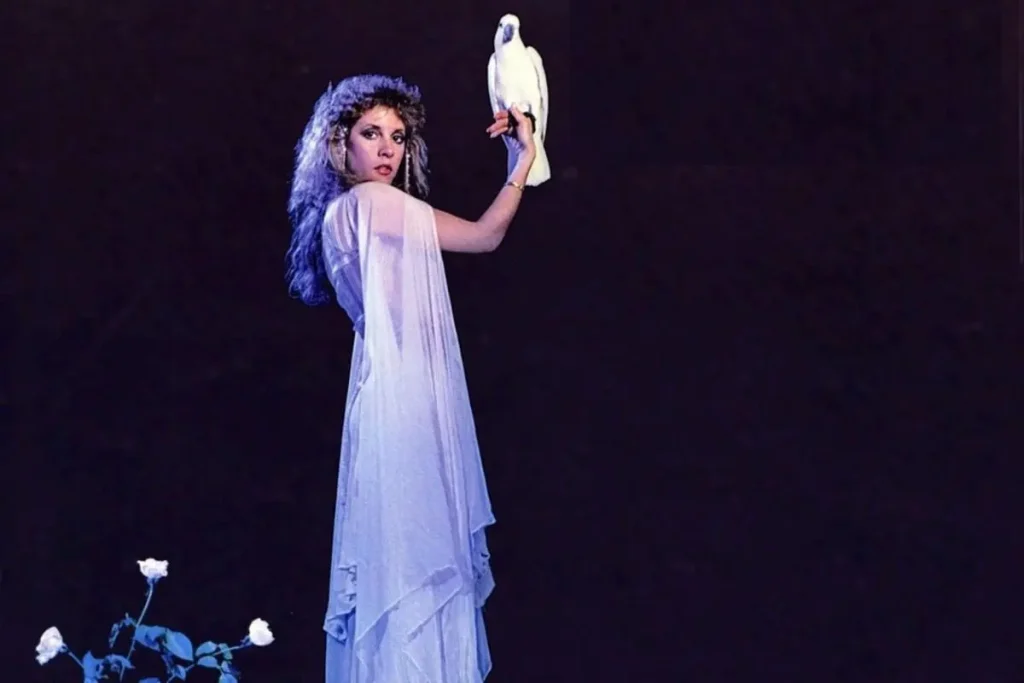
When Stevie Nicks walked into the 1980s, she was already famous in a way that can feel like a trap. Fleetwood Mac had made her a household name, but it also made her one piece of a very loud machine: five personalities, five agendas, and a public soap opera that threatened to swallow the music. Bella Donna (1981) was the moment she stepped out of that machine and dared the world to accept her as a complete artist, not merely the “witchy” voice in someone else’s band.
The edgy truth is that Nicks’ solo leap did not happen because Fleetwood Mac was “too successful.” It happened because the band’s fame came with a price: creative bottlenecks, interpersonal wreckage, and the constant suspicion that her most powerful work might be diluted by committee. Bella Donna was her proof-of-life outside the group, and it landed hard enough to change what a rock frontwoman could demand from the industry.
Fleetwood Mac gave her a platform – and a ceiling
By the time Bella Donna arrived, Nicks had already helped define Fleetwood Mac’s imperial phase. In the group setting, her songs were competing for space with the strengths (and egos) of Lindsey Buckingham, Christine McVie, and the rhythm section that powered everything.
That internal competition created quality control, but it also created friction. Even fans who adore the classic Mac lineup can hear the reality: an Nicks song inside Fleetwood Mac is an Nicks song filtered through the band’s identity. On a solo record, the filter comes off, and what you get is closer to the raw nerve that made her writing so magnetic in the first place.
“You can go your own way.” – Fleetwood Mac, “Go Your Own Way”
Why going solo in 1981 was a bigger gamble than it sounds
Today, side projects are expected. In 1981, the rules were harsher: if a star went solo and flopped, the industry would treat the failure as evidence that the band was the real talent and the individual was just branding. For women in rock, the trap was even tighter: the press often framed ambition as ego, and independence as betrayal.
Nicks took that risk anyway, and she did it without trying to “out-rock” Fleetwood Mac. Instead, she made a record that leaned into her strengths: narrative songwriting, cinematic atmosphere, and a voice that can sound intimate and commanding in the same bar of music. That artistic clarity is why Bella Donna still plays like a statement, not a detour.
The secret weapon: collaboration without surrender
Bella Donna is often described as Nicks finally “free” of Fleetwood Mac. That is only half true. She didn’t escape collaboration – she escaped the wrong kind of collaboration.
Instead of being one creative pole in a five-way tug-of-war, Nicks built a roster around her songs. The result is fascinating: the album feels like a suite of different rooms, each lit by a slightly different band, but all inside the same haunted mansion.
Tom Petty and the Heartbreakers: credibility with teeth
“Stop Draggin’ My Heart Around” is the obvious crossover play: Nicks meeting Heartbreakers grit in the middle. But the deeper point is what that pairing signaled. She wasn’t asking permission to be taken seriously; she was choosing peers who already were.
And it worked. The track became one of the era’s most durable rock duets, and it helped position Nicks as a front-line rock artist rather than a soft-focus pop star borrowing edge for a single.
Don Henley: romance turned into radio
“Leather and Lace” is a different kind of power move: quiet, patient, and engineered for emotional impact. It is also an example of Nicks understanding that intimacy could be as commercially potent as swagger. In the Fleetwood Mac context, her romantic narratives were famously intertwined with real-life drama; here, she weaponized that aura into a controlled, crafted duet.

Track-by-track: what the hits reveal about her creative identity
It’s easy to summarize the album as “it had hits.” The more interesting question is what kind of hits they were. Nicks did not chase trends so much as create a personal mythology that pop radio could not resist.
| Song | What it proved about Nicks | Why it mattered in the transition |
|---|---|---|
| “Edge of Seventeen” | She could build a pop-rock anthem from imagery and obsession | Solo Nicks could go bigger, weirder, and more relentless |
| “Stop Draggin’ My Heart Around” | She could trade lines with a major rock institution and hold the center | It smashed the idea that she needed Fleetwood Mac to sound tough |
| “Leather and Lace” | She could make tenderness feel epic | It broadened her audience without diluting her persona |
| “Bella Donna” | She could make a title track feel like a character | It framed the album as a world, not a playlist |
Chart performance helped seal the narrative that the transition “worked,” and the major singles from the album were notable hits in the early 1980s, with “Stop Draggin’ My Heart Around” posting a strong chart run.
“Edge of Seventeen” and the art of turning a phrase into a legend
“Edge of Seventeen” is the sound of Nicks refusing to behave. The guitar figure is insistent, almost mechanical, and her vocal rides it like a storm system. Lyrically, it’s built from images that feel half remembered and half invented, which is exactly why it sticks.
There is also a key piece of Nicks’ solo identity here: she could take an intensely personal trigger and write it as myth. That is a different skill than writing a confessional diary entry. It is the skill of a storyteller, and it is one reason the song has survived countless recontextualizations in pop culture.
On the charts, the song’s performance confirms it was not just a fan favorite; it was a mainstream success that cemented her solo viability as part of the album’s enduring commercial story.
The commercial shockwave: success that changed the power balance
When a band member goes solo and wins, it alters every negotiation afterward: creative control, touring expectations, even how the public assigns credit. Bella Donna didn’t just give Nicks independence; it gave her leverage.
That leverage mattered inside Fleetwood Mac, too. After Nicks proved she could headline under her own name, she was no longer “lucky to be in the band.” The band was lucky to still have her attention. It is a subtle distinction, but in rock history, it is everything.
Decades later, her unique position as an artist recognized both with Fleetwood Mac and on her own became historically notable via major institutional recognition of her solo legacy.
Image, voice, and the 1980s machine: Nicks used it without being used
The early MTV era rewarded strong visuals, and Nicks already had one: chiffon, boots, moonlight, mystery. The risk was becoming a caricature of herself, a Halloween costume instead of a songwriter.
Bella Donna dodged that risk because the songs are not flimsy. They are specific, built on character, and emotionally pointed. The image worked because the music carried it, not because the label invented it, and archival photos from the “Bella Donna” era show how tightly the look and the moment fused together.
What Bella Donna did for women in rock (and why that claim is not sentimental)
It’s tempting to frame Nicks as a “trailblazer” in a soft-focus way. The more provocative framing is this: Bella Donna helped normalize the idea that a woman could be the brand, the writer, the star, and the decision-maker in arena-level rock without being packaged as someone’s girlfriend or someone’s muse.
Yes, she collaborated with famous men. But the point is she chose them, and she did it on an album that presented her as the gravitational center. That model has echoed through generations of singer-songwriters who want the scale of rock stardom without surrendering authorship.
Listening guide: how to hear the “transition” in the production
If you want to understand the shift from Fleetwood Mac to solo Nicks with your ears (not just your biography), listen for these telltale differences:
- More vocal foreground: the mixes often place her voice as the main event, not one color in a blend.
- Harder contrast between songs: the album jumps between rock drive and hushed intimacy like a mood swing you’re not allowed to ignore.
- Mythic lyric framing: the writing leans into symbols and characters rather than band-saga realism.
For a quick, practical reset, stream the album straight through once, then replay the first 30 seconds of “Stop Draggin’ My Heart Around” and “Edge of Seventeen.” The gap between them is the point: Nicks wasn’t trying to make one coherent band sound. She was making a world where her voice could inhabit multiple scenes.

Conclusion: Bella Donna wasn’t a side quest – it was the thesis
Bella Donna succeeded because it was not an “escape album.” It was a declaration that Stevie Nicks’ artistry was not dependent on Fleetwood Mac’s internal chemistry, and that her creative identity could thrive in a wider arena.
In hindsight, the album feels inevitable. In reality, it was a daring power grab executed with songwriting, collaborators, and a persona strong enough to survive the spotlight alone. And once she proved she could stand there by herself, the entire story of Stevie Nicks changed.


