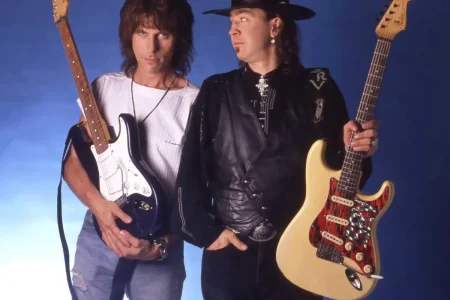
When Jeff Beck sat down with Total Guitar in 2016, he did something rare for a guitar god: he sounded genuinely humbled. He talked about listening to more Jimi Hendrix than ever, marvelling at rare recordings, and admitting it was “humiliating” that Jimi had done all of that by 1970 in barely three and a half years. Then he said the Miles Davis album Jack Johnson and John McLaughlin’s Mahavishnu Orchestra showed him “here’s where you can go.” [interview]
Those comments are not just nostalgia from an aging virtuoso. They are a roadmap to how the language of electric guitar mutated between the Yardbirds, Hendrix’s psychedelic firestorm and the jazz‑rock fusion explosion of the early 70s.
Hendrix’s ‘peculiar voice’ and the guitar that screamed
Beck admitted in that interview that he hated his own singing voice and envied Hendrix’s ability to get away with what he called a “peculiar” voice that “wasn’t a great voice but it was just magic.” The key, as Beck heard it, was that Hendrix never screamed with his throat; it was always the guitar that did the screaming for him, something he said explicitly in that Total Guitar conversation.
That observation lines up perfectly with how Beck himself played. As Know Your Instrument has noted, he used a pretty standard Fender Stratocaster and a few basic pedals to create sounds that dissolved genre lines, treating the whammy bar, volume knob and his bare fingers as a second larynx rather than just a set of controls. His bends, swells and micro‑vibrato gave the instrument a human accent, almost like a singer leaning into consonants and vowels.
The Hendrix fixation ran through Beck’s whole career. The official Hendrix site points out that Beck regularly performed Little Wing and other Hendrix tunes live, and that he delivered a devastating take on Manic Depression for the 1993 Stone Free tribute album, calling Hendrix “the best jam I’ve ever had.” For a player of Beck’s stature to keep circling back to someone else’s songs tells you how deep that well ran.
Humiliated by a four‑year revolution
To understand why Beck called those Hendrix tapes “humiliating,” you have to look at the timeline. Hendrix’s main run as a featured artist lasted barely four years, yet in that span he fused blues, jazz, rock and soul into a radically new guitar language and became one of the most influential musicians of his era. Biographical overviews make it clear just how compressed that explosion really was. Then he was gone at 27.
No wonder Jimi still tops lists of the greatest electric guitarists and anchors Know Your Instrument’s own pantheon of all‑time players. If you are Jeff Beck, looking back across six decades of work, it is hard not to feel a bit small next to someone who rewrote the rulebook that quickly and then exited before he had time to repeat himself.

| Year | Hendrix milestone | Beck’s vantage point |
|---|---|---|
| 1966 | Hendrix arrives in London, forms the Experience | Freshly out of the Yardbirds, watching the new guy torch the scene |
| 1967‑68 | Are You Experienced, Axis and Electric Ladyland hit in rapid succession | Beck Group is grinding it out while Hendrix turns studio experiments into hit records |
| 1970 | Band of Gypsys, final tours, sudden death in September | Beck is left to pick up the pieces of blues‑rock after its most explosive voice vanishes |
Resetting all the rules: Hendrix vs the Yardbirds generation
Beck was not shy about how hard Hendrix hit the British blues‑rock elite. In a later GuitarPlayer piece he said flatly that “the first shockwave was Jimi Hendrix” and that even though players like him and Eric Clapton had already “established” themselves, Hendrix showed up, reset all the rules in one evening and left Beck feeling he had nothing to come back with while Cream exploded. That is the sound of a proud musician admitting he got wiped off the map.
Yet the traffic was not one way. Far Out magazine recounts how Hendrix was obsessed with Beck’s 1968 album Truth, blasting it on a hulking hotel hi‑fi console, and how he “swiped” the main riff of Beck’s Rice Pudding for his own song In From The Storm, a theft Beck later said made him feel he could die happy. The two men were not in separate weight classes; they were trading ideas in real time, and part of Beck’s humility is that he never pretended otherwise.
In that light, his “humiliation” is not self‑loathing so much as awe. Beck understood that being great in the late 60s meant constantly being outgunned by the guy you were also quietly influencing.
From Hendrix’s ashes to Jack Johnson’s fuse
Once Hendrix was gone, the heavy blues template started to sag. By Beck’s own admission, things took a “funny turn” in the early 70s: bigger amps, longer solos, fewer new ideas. He needed a way to get out of the endless twelve‑bar arms race.
Enter Miles Davis’s Jack Johnson sessions. A San Francisco Chronicle review of the Complete Jack Johnson Sessions notes that the album’s rhythm sections, featuring John McLaughlin on guitar with Dave Holland or Michael Henderson on bass and Jack DeJohnette or Billy Cobham on drums, made the music “rock harder than any previous jazz record,” fusing Sly Stone, James Brown and Hendrix‑style pulses and psychedelic wails into a single roaring engine. In that swirl you can already hear McLaughlin preparing to blast off into something even stranger.
For Beck, that record answered a question Hendrix had created: what if you take that electric ferocity but remove the vocal song form entirely, treating grooves and solos as the main event? Jack Johnson showed that the guitar could be the frontline voice in a band of killers without anyone ever stepping to a mic.
Mahavishnu: where Beck heard ‘here’s where you can go’
McLaughlin carried that energy straight into the Mahavishnu Orchestra. As Britannica sums up, after becoming a disciple of Sri Chinmoy he formed Mahavishnu in 1971, a quintet notorious for radical volume, complex textures and torrents of 16th‑note scales and arpeggios fired off on a double‑neck guitar, often in rock venues rather than jazz clubs. It was essentially a power trio on spiritual steroids, with violin and keys thrown into the storm.
Their debut The Inner Mounting Flame is routinely described as a furious, high‑energy yet carefully structured meeting of virtuosos that, for all practical purposes, defined the fusion of jazz and rock and grabbed rock audiences as hard as any Zeppelin record of the day. Pieces like Meeting Of The Spirits and Awakening sound like Hendrix’s abandon cross‑bred with Stravinsky and Indian classical music.
No wonder, then, that Beck told Total Guitar he heard Mahavishnu and thought, “this is a bit of me, I’ll have some of that.” At the same time, as UMass Lowell’s Alan Williams has argued, Beck only flirted with the kind of hyper‑mathematical, Mahavishnu‑style fusion, preferring to twist Beatles and Stevie Wonder tunes into his own abstract shapes instead of turning his band into a chops Olympics.
That is the crucial difference. Where Mahavishnu often felt like Hendrix squared, Beck took the lesson that you could be deadly serious about harmony and rhythm without sacrificing warmth, swing or sheer weirdness.
From listener to architect: Blow By Blow, Wired and Jan Hammer
Beck’s mid‑70s output is basically the sound of those influences being metabolized. Blow By Blow and Wired pushed him into instrumental territory where blues phrasing, funk grooves and jazz changes could coexist without a singer getting in the way. Then he doubled down by touring with Jan Hammer, fresh from Mahavishnu, captured on Jeff Beck With The Jan Hammer Group Live, a record Guitar Nine highlights for stretching tracks like Freeway Jam and Blue Wind into extended, high‑energy jazz‑rock workouts.
Crucially, Beck’s solos in that period almost never degenerate into pure scale practice. Even at warp speed he sounds like he is bending and choking syllables, letting notes sag sharp or flat for emotional effect, or yanking the bar so the pitch swoops like a human cry. It is fusion, but it is still the same basic idea he heard in Hendrix: the guitar takes the role of lead singer and the band becomes a giant rhythm section underneath.
By the time he drifted into rockabilly, electronica, world music and back again in later decades, that approach was baked in. Whatever the genre label, Beck’s compass stayed pointed at two north stars: Hendrix’s fearless sound design and McLaughlin’s proof that you could push harmony and rhythm to the edge without losing the plot.

What modern guitarists can steal from Beck, Hendrix and McLaughlin
- Treat the guitar as a voice, not a stunt prop. Spend more time on vibrato, bends, dynamics and phrasing than on raw speed. If a line would sound ridiculous sung by a human, ask why you are playing it.
- Study short, explosive careers. Hendrix crammed a lifetime of innovation into a few years; Mahavishnu’s key records arrived in a similar burst. Build your own “compressed curriculum” by living inside a handful of seminal albums instead of grazing a thousand playlists.
- Let humiliation fuel you. Beck did not pretend he matched Hendrix or McLaughlin note for note. He let their brilliance push him into new territory instead of retreating into safer blues clichés.
- Steal ideas, not licks. Hendrix pinched a riff from Beck and turned it into a different song. Beck stole the concept of guitar‑driven fusion from Jack Johnson and Mahavishnu but filtered it through his own ears. Copy the principles, not the exact runs.
- Refuse to be typecast. Beck was “too weird for blues purism” and too restless to sit in any one genre box for long. Use that as permission to ditch the tribalism that still dominates a lot of guitar culture.
Conclusion: Beck’s humility is the real flex
In the end, the most striking thing about Beck’s 2016 comments is not the gear talk or even the name‑dropping. It is the image of one of rock’s most feared guitarists sitting at home, still listening to Hendrix and McLaughlin with the awe of a kid, still hearing new possibilities and still feeling slightly embarrassed he has not caught up.
If you put on Are You Experienced, Jack Johnson, The Inner Mounting Flame, then Blow By Blow and Wired back to back, you can hear the whole story he is talking about. It is the sound of the electric guitar escaping the blues club, passing through psychedelia and fusion, and landing in a place where, for a player like Jeff Beck, the only honest response was to keep listening harder.