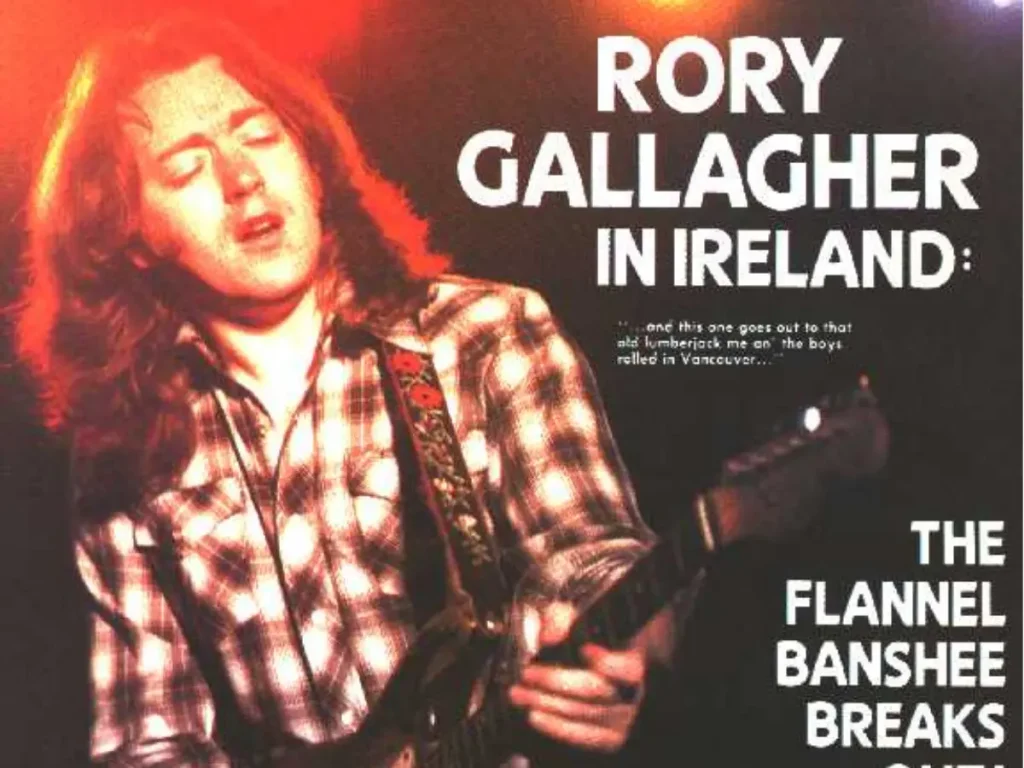
In the summer of 1984, Rory Gallagher sat down with Creem and calmly torched most of what passed for rock guitar. He complained that too many players only listened to rock, played straight on the beat, and treated rhythm like a dull obligation instead of a living pulse. Then he went further, warning that banks of synths and computers were already sucking the human blood out of the music.
Decades later, with rock guitar often trapped in a pentatonic autopilot and whole records built inside laptops, Gallagher’s rant feels less like cranky nostalgia and more like a survival guide. If you care about guitar that actually swings, surprises and connects, it is worth unpacking exactly what he was so angry about.
Rory in 1984: Calling Out the Rock Guitar Rut
In that Creem conversation, Gallagher summed up his core gripe in one sharp line: the trouble with a lot of rock players, he said, is that all they listen to is rock. For him, that narrow diet produced solos that sat obediently on the bar line, hammering the same safe shapes with no sense of risk or movement.
Gallagher argued that a rock solo could feel like a jig or a burst of jazz phrasing and the crowd up front would still go nuts, not complain that they were suddenly at a jazz gig. What he could not stand was guitarists who treated rhythm like a metronome exercise, playing exactly on the beat, exactly the same way every night. In his world, rhythm meant tugging at the pulse, pushing and pulling against the time, even dropping into mandolin style flurries that sliced across the bar lines.
He also took aim at the cult of the lead hero who floats on top of the band and never really locks in with them. Gallagher praised players like Mick Green of the Pirates, Pete Townshend, Jimi Hendrix and Keith Richards because their leads grew straight out of the chords and riffs underneath, not on top of them. The solo, in his view, should “bleed out” of the rhythm part, not arrive like a visiting dignitary with its own red carpet.

Roots and Crossovers: Why Gallagher Never Sounded Generic
Gallagher could afford to be brutal about rock’s bad habits because his own roots were ridiculously deep. Growing up in Ireland he soaked up Lonnie Donegan’s skiffle, American folk songs by Woody Guthrie and Leadbelly, and early rock and roll from Buddy Holly and Eddie Cochran, long before he became a blues rock cult hero. The first guitar sound that really grabbed him was not a stadium rig, but a battered acoustic in the hands of a traveling song collector.
That mix put him right in the slipstream of the wider folk revival that ran through the 50s and 60s, where traditional ballads, protest songs and rural dance tunes crashed into coffeehouse culture and then into electric rock. Gallagher carried that folk baggage with him even when the amps got loud, which is why Celtic scales, modal drones and reel like patterns keep surfacing in his solos if you actually listen past the distortion.
He was never a museum piece folkie, though. From the start he treated those old forms as raw material to collide with Chicago blues, early R&B and later, jazz. You can hear that on his records as well as on endless bootlegs, where a straight barroom shuffle will suddenly twist into something that sounds like a pub reel or a saxophonist’s run smashed onto six strings.
Jazz, Jigs and Dancing Around the Beat
Listening beyond guitar heroes
Gallagher’s advice to rock players to listen to jazz was not some vague “listen to everything” slogan. He was an obsessive fan of 50s jazz, drawn especially to freewheeling saxophonists like John Coltrane, Don Cherry and Pharoah Sanders, and he admitted that his own phrasing came as much from horns as from any guitarist. You can see that in a profile of Gallagher’s listening habits. He wanted lines that stretched across the bar, spilled over the turnaround and then snapped back into place at the last possible moment.
He also pictured the “ultimate” modern guitarist as someone who could move freely between folk tunings, Brazilian style rhythm, raw blues feel and James Burton style country picking. That vision of a stylistically fluent player comes through clearly in the same British rock guitar profile. In other words, someone whose solo vocabulary came from every corner of the record shelf, not from rehashing the same three rock records their friends worshipped in high school.
Rhythm as conversation, not a click track
In another interview, Gallagher pointed to Django Reinhardt as a model of rhythmic freedom, praising how Django seemed to dance around the beat rather than sit politely on it. He contrasted that with blues players who lock stubbornly onto the on beat and never risk stepping outside the grid. For Gallagher, that looseness was not sloppiness, but a kind of swaggering conversation with the rhythm section.
Try translating his ideas into practice:
- Take a straight 4-4 rock groove and practice playing your phrases slightly behind, then slightly ahead of the snare, without losing the pulse.
- Steal from jigs by writing licks in 6-8 or 9-8, then lay them across a regular rock backbeat until they resolve in an unexpected place.
- Build runs out of odd groupings – three note or five note cells – and repeat them over a 4-4 bar so the accents shift under your fingers.
None of this requires exotic theory. It just demands that you stop treating rhythm like a fence that keeps you contained and start treating it like a partner you can lean on, tease and occasionally shove.
Rhythm Guitar First: Solos That Bleed Out of the Groove
Part of what gave Gallagher such authority on rhythm was simple necessity. Fronting a trio, he needed to carry both the chords and the fireworks, which is why he fought so hard to buy that now legendary 1961 Stratocaster. He even sold his mother on the idea by promising that with a guitar like that he could cover both rhythm and lead by himself and bring in enough money to pay it off.
That attitude never left his playing. Watch any live footage and you see his right hand basically never stop strumming, even while the left hand darts into double stops, partial chords and sly inversions. He is soloing, but he is also comping for himself, which is why the band never collapses into that dead air feeling you get when a pure lead player steps forward and everyone else is left treading water behind them.
| Typical rock solo habit | Gallagher style alternative |
|---|---|
| Switching from chunky rhythm to endless single note flurries | Keeping chord fragments ringing while weaving short melodic bursts |
| Ignoring the riff once the solo starts | Quoting and mutating the main riff inside the solo itself |
| Letting the drummer and bassist carry all the groove | Pushing the beat with percussive strums, rakes and muted chords |
| Thinking “note count” first, “feel” later | Building tension through dynamics, space and rhythmic displacement |
If you want to steal from Gallagher in a concrete way, start by writing rhythm parts that are interesting enough to survive on their own. Then force yourself to solo without abandoning those shapes – keep at least two or three chord tones under your fingers at all times. The goal is not to show you can play over the band, but to make it sound like the band got bigger the moment you took off.

Traditional, But Not a Museum Piece
In that same 1984 talk he described himself as a kind of traditionalist, then immediately said he hated the word. What he meant was that he believed in songs and sounds that had proven themselves over decades of use, but he refused to dress up as a 50s revivalist or pretend that rock and roll had ended with Buddy Holly.
His real enemy was what he called tricking things up just because there were new toys available. Contemporary interviews have him grumbling about New Romantic synth bands and saying he still preferred music that sounded human, even if it meant sticking with more traditional names like Dylan and the Stones. For him, lining up in front of three synthesizers did not make your music modern, it just made it more likely that you were playing to the technology instead of to the song.
That is where his attack on computer glorification gets genuinely prophetic. He was not railing against electricity itself, or even against studio craft. He was warning that once you start worshipping the machine, you will quietly lower your expectations of what a human player should risk in real time.
Jigs, Rags and the Celtic Undercurrent
Gallagher’s talk about solos that feel like jigs was not hypothetical. His catalog is laced with tunes that yank ragtime, jug band feels and Irish dance rhythms into a rock setting. Acoustic pieces like “Barley and Grape Rag” show him writing in classic ragtime style and then tracking them in rough and ready spaces to keep the jug band stomp intact.
He also leaned on mandolin, National steel guitars and open tunings that came straight out of folk tradition. Some live arrangements layer droning open strings against quick picked figures that would sit just as happily in a ceili band as in a barroom blues. When he talked about solos built like jigs, he was describing techniques he had already tested night after night, not some theory he had read in a jazz harmony book.
What Gallagher’s Rant Means For Guitarists Now
If you strip away the 80s context, Gallagher’s manifesto is brutally simple. Rock guitar goes dull when players only consume rock, when rhythm is treated like a grid instead of a game, and when technology is allowed to bully feel into the background. The cure is not another boutique pedal, but a different way of listening and practicing.
- Put as much time into old jazz and folk records as you do into blues rock playlists. You are hunting for phrasing and rhythmic ideas, not licks to copy note for note.
- Practice with the band mix loud in your headphones and resist the urge to turn yourself up. Learn to make your lead lines cut through by rhythm and tone rather than sheer volume.
- Record yourself playing live with minimal effects and no editing. If the take only feels exciting once it has been chopped, pasted and quantized, that is a warning sign.
- Write at least a few songs where the most exciting moment is a rhythm figure, not a shred section. If you cannot get a room moving with two chords and a feel, more notes will not save you.
Rory Gallagher did not live to see laptop rock, backing tracks in clubs and plugins that can simulate almost any rig. But his instincts were dead on. If you want guitar playing with dirt under its nails and fire in its timing, follow his lead: study the roots, steal from jazz and folk, fall in love with rhythm, and let the human factor stay in charge of the machines.