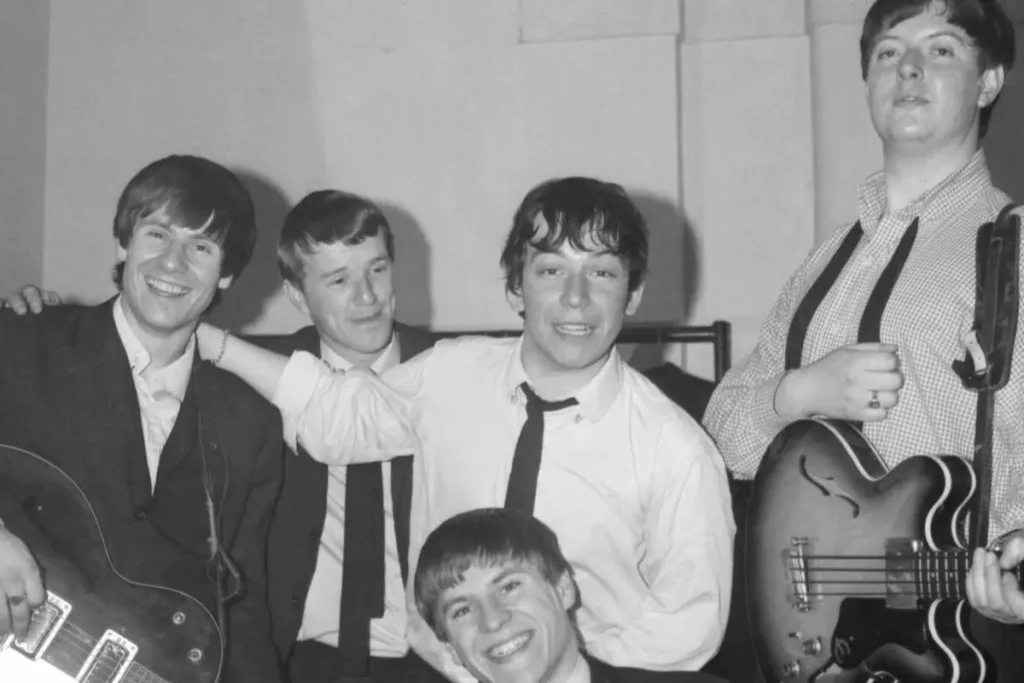
Few records captured the unease of the 1960s as brutally as The Animals’ “House of the Rising Sun.” A centuries old story about ruin suddenly roared out of AM radios as a four minute funeral march in minor key, sung by a working class kid from Newcastle. It sounded like the folk revival had stuck its fingers in a light socket.
From nameless folk song to global hit
“House of the Rising Sun” did not start life as a British Invasion single. It was an American folk song of murky origin, first collected in Appalachia in the 1930s, probably descended from older English ballads, and by the 1960s it had passed through dozens of singers’ hands.
Field collectors like Alan Lomax taped versions across the American South and published the lyrics in songbooks, helping the tune drift into the repertoires of Woody Guthrie, Lead Belly, Josh White and later the Greenwich Village folk crowd. By the time coffeehouses were packed with kids in cable knit sweaters, “Rising Sun” was already old news.
Journalist Ted Anthony has argued that a crucial turning point came in 1937, when Lomax recorded 16 year old Georgia Turner in Kentucky singing a stark version titled “The Rising Sun Blues.” Her melody and phrasing, archived at the Library of Congress, became the template that many later performers, including Bob Dylan and The Animals, indirectly followed.
Where is the House, really?
The lyrics feel specific: there is a house in New Orleans, it has a name, and it ruins people. That precision has tempted generations of fans and historians to hunt for a literal address. The truth is more slippery, and a lot more interesting.
Archaeologist Shannon Lee Dawdy examined one candidate, a short lived early 19th century hotel on Conti Street that called itself the Rising Sun. Excavations turned up liquor bottles, smoking pipes and makeup jars, but Dawdy concluded there was no solid proof this brief enterprise was the song’s direct inspiration.
Another long running theory points to a brothel on St. Louis Street, allegedly run by a madam whose French surname LeSoleil Levant translates as “Rising Sun.” A Washington Post feature detailed how a modern bed and breakfast has embraced that legend, complete with brothel themed decor, while carefully admitting the evidence is circumstantial at best.
Still other writers argue that the “house” might be a city jail or a women’s prison, pointing to lyrics about a “ball and chain” and the song’s long history of being sung from a female perspective. A detailed Songfacts-style summary traces how these interpretations emerged over time. In other words, the House of the Rising Sun is less a Google Maps location and more a symbol: a place where poverty, addiction and sex all get monetized.
The Animals hear a ghost story and plug it in
Eric Burdon did not discover the song through archives or academics. He heard it in a Newcastle folk club, sung in a traditional style, and recognized something darker than the polite protest songs filling up the folk charts. When The Animals hit the road in 1964 with Chuck Berry, they began ending their sets with a heavy, electric version of “Rising Sun” simply because it stopped audiences cold.
On May 18, 1964, the band ducked into a London studio and cut the song in a single take, producer Mickie Most assuming it was just a live showpiece. That four and a half minute performance, built on Hilton Valentine’s chiming arpeggios and Alan Price’s sinister Vox Continental organ, shot to number one in the UK and then the US, an unusually long single that broke radio rules and still conquered the charts..

Why this version hits so hard
Earlier recordings tend to feel like laments or folk tales. The Animals turned the song into a confession you could almost smell. Burdon does not sound repentant so much as doomed and exhausted, like a man reporting from the bottom of his own grave.
| Element | What The Animals did with it |
|---|---|
| Vocal | Eric Burdon’s rasp drags the lyric out like a confession under interrogation, more blues shouter than folk crooner. |
| Guitar | Hilton Valentine turns a simple minor chord progression into a tolling arpeggio that never stops, like a clock counting down. |
| Organ | Alan Price’s Vox organ swells and whines, filling the track with churchy drama and a hint of horror movie. |
| Rhythm | The band straightens the folk waltz feel into a rock pulse, giving the song weight without speeding it up. |
| Lyrics | The narrator switches from ruined woman to ruined man, but the message to the next generation remains brutally the same. |
That combination made the single feel less like a cover and more like a haunting. You could file it next to Ray Charles and Howlin’ Wolf as easily as beside Dylan or Baez, which was precisely the point.
The first folk rock hit, or something nastier?
Rock critic Dave Marsh famously called The Animals’ “House of the Rising Sun” the first true folk rock hit, and BBC presenter Ralph McLean agreed, dubbing it a revolutionary single that changed the face of modern music. That debate around it being a turning point in popular music continues. Whether you buy that label or not, the record certainly proved you could drag a traditional song into a hard electric setting without turning it into novelty.
It also made folk dangerous again. This was not a pleasant singalong about freedom on the wind. It was a warning from someone already destroyed, sung over a relentless minor key groove that teenagers slow danced to at school halls while not entirely clocking they were swaying to a song about addiction and prostitution.
In that sense, “Rising Sun” did something subversive. It smuggled a bleak working class morality tale into the pop charts. The narrator is not heroic, not noble and not saved. He is a gambler and a drunk, and the best he can offer is a failed man’s advice to the kids behind him.
Bob Dylan, electricity and bruised egos
By the time The Animals cut their hit, Bob Dylan had already recorded an acoustic version for his debut album, borrowing an arrangement from fellow Village folkie Dave Van Ronk. Later histories of the song note how Dylan’s early version was quickly overshadowed by the British single, a cruel joke in a scene obsessed with authenticity.
According to Animals drummer John Steel and later retellings, Dylan first heard their version on his car radio, pulled over and literally jumped in excitement, floored by how hard it hit. Stories from friends and critics suggest that hearing his own folk repertoire turned into chart killing electric drama helped push Dylan toward plugging in himself, a move that would explode the folk scene a year later at Newport. A detailed retelling of the Animals’ version underlines just how shocking that arrangement sounded in 1964.
So if you want a neat storyline, you can say this: a nameless Appalachian ballad flows into Dylan’s notebook, gets hijacked by a snarling band of Geordie R&B punks, then shoves Dylan to pick up a Stratocaster. That is a lot of cultural mayhem for four chords in A minor.
The song that shook the gatekeepers
Traditionalists hated plenty about this record. It was too long for radio, too heavy for folk purists and too grim for pop. Yet it sold anyway, and in doing so it proved that listeners did not need everything trimmed to two and a half minutes or sweetened with strings.
The Rock and Roll Hall of Fame later listed The Animals’ “House of the Rising Sun” among its “Songs That Shaped Rock and Roll,” putting it in the company of giants from Chuck Berry to The Beatles. That is fitting, because the track operates like a bridge between worlds: blues, folk, British beat music and the emerging idea of rock as something serious and stormy.
Its success also had a darker industry legacy. Only organist Alan Price was credited for the arrangement on the original single sleeve, reportedly because there was not room to list the whole band. That decision meant Price alone received publishing royalties, a sore point that helped fracture the group even as the song made them famous, as band histories later noted.
Why “House of the Rising Sun” still matters
Strip away the legends and you are left with something brutally simple. A poor kid goes to a city chasing action and ends up chained to his vices. Parents fail, institutions profit, and the only thing passed on is a warning that will almost certainly be ignored.
That story has not aged a day. Swap New Orleans for Las Vegas or any port city full of casinos and cheap rooms and the lyric still holds. Every generation has its own Rising Sun, usually advertised in neon.
The Animals just had the nerve to say the quiet part loud, at full volume, on a hit single. That is why the song still crawls under the skin today. It is not nostalgia. It is recognition.