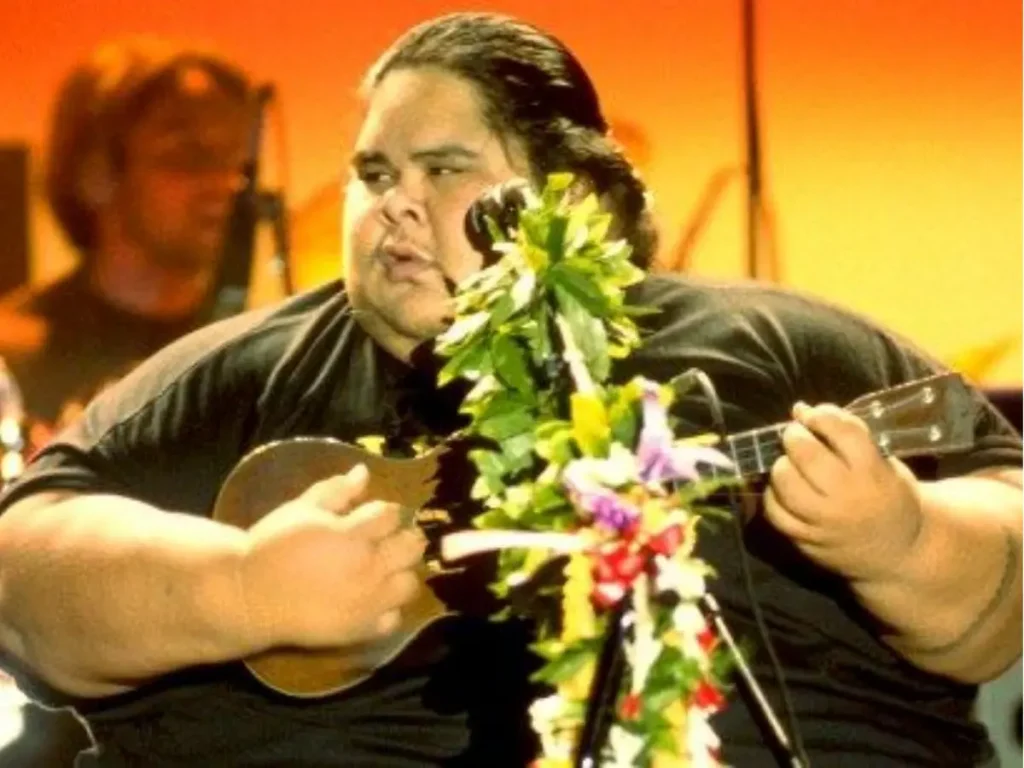
At three in the morning in Honolulu, a tired recording engineer picked up a studio phone he really should have ignored. On the line was a singer with an impossible last name who said he had an idea and needed to record right now. Fifteen minutes later, Israel Kamakawiwo’ole shuffled in, carrying a ukulele that looked comically small against his enormous frame.
What followed was a single live performance of “Somewhere Over the Rainbow/What a Wonderful World” that collapsed a half-century of pop history into five fragile minutes. That one-take demo would later be recognized by the National Recording Registry, preserved “for all time” as one of America’s essential recordings.
The 3 a.m. studio visit that nearly did not happen
In 1988, engineer Milan Bertosa was wrapping up a long day in his Honolulu studio when the phone rang. A client begged him to squeeze in a quick session for a big Hawaiian singer, but Bertosa said the place was shutting down until morning. Then Israel himself came on the line, speaking so gently and politely – “Please, can I come in? I have an idea” – that the engineer relented and gave him fifteen minutes, a story he would later tell in detail to Hawaiʻi Public Radio.
Israel made the deadline. Security had to find a heavy-duty chair so he could sit comfortably, the mics went up in a rush, and Bertosa ran a quick sound check. Then tape rolled, Iz cradled his uke, and without any studio small talk he eased straight into “Somewhere Over the Rainbow,” singing the entire medley in one unbroken take. No punch-ins, no overdubs, no safety pass. For the engineer, it was just another late-night demo to file away; he had no idea the cassette in his hand would eventually soundtrack half the planet’s weddings and funerals.
From after-hours demo to the heart of “Facing Future”
For a while, that 3 a.m. performance lived only as a private tape. Iz went on recording in a more conventional way, cutting a brighter, reggae-leaning version of the “Rainbow/What a Wonderful World” medley for his first solo album and touring as a beloved local star. The late-night take was a secret the engineer would occasionally play for friends, the kind of thing studio people trade like contraband.
When Kamakawiwo’ole began work on what would become his landmark solo album Facing Future, Bertosa finally pulled the demo back out and played it for producer Jon de Mello. The bare voice-and-ukulele take landed on the record almost as an afterthought, tucked among political anthems, love songs and traditional mele. That “afterthought” helped propel Iz out of the islands and into global consciousness, even though the album itself was anything but a slick crossover move.
Why this fragile take hits harder than a full orchestra
Voice, ukulele and a lot of empty space
Strip “Over the Rainbow” down to one voice and a four-string uke and the song stops being Hollywood nostalgia and starts sounding like a prayer. Iz sings in an unusually high register for a man his size, with a soft edge that makes the famous octave leap sound less like Broadway bravado and more like a sigh escaping his chest. The ukulele is not showing off; it is just a heartbeat pulse under the melody, with extra space where an arranger in Los Angeles would have stuffed strings and woodwinds.
Importantly, the tempo is almost perversely relaxed. He stretches phrases over the bar line, lets silences hang a half-second too long, and sometimes seems to be waiting for the waves outside the studio to answer him. That looseness pulls the Tin Pan Alley standard out of its 1930s context and drops it into island time, where longing for “somewhere” is not a child’s fantasy but a colonized people’s daily reality.
The magic of getting it “wrong”
Musically, Iz’s take is full of so-called mistakes. He shifts the melody, flips lyric lines out of order and even lets out a tiny chuckle when he stumbles. In an NPR profile of Kamakawiwoʻole, Bertosa joked that you could sit there with the sheet music and tally every deviation – or you could put down the scorecard and just listen, which is clearly what the world chose to do. That same report notes that, according to music publisher EMI, Kamakawiwo’ole’s rendition has become the most requested version of “Over the Rainbow” by far, especially among younger listeners who met the song through his voice, not Judy Garland’s.
What Hawaiians hear: sovereignty, sorrow and pride
Outside Hawaii, Iz is often reduced to “the Over the Rainbow guy.” At home, he is remembered as an aloha ʻāina singer who tied his music directly to Native Hawaiian rights and sovereignty. Tracks like “Hawaiʻi ’78,” “E Ala E” and “Living in a Sovereign Land” imagine ancient chiefs returning to see freeways and tourist towers, mourning what has been lost and insisting that to care for the land is to care for the people.
That weight is why his death in 1997 felt less like a celebrity passing and more like a royal funeral. He was only 38 when respiratory failure finally caught up with his massive body, yet he became the first musician allowed to lie in state at Hawaii’s Capitol. Crowds lined the streets, and fans later raised money for a bronze bust in Waianae that looks out toward the ocean, draped in fresh lei from visitors who still make the pilgrimage to honor him.
How a 3 a.m. cassette conquered the world
The little demo that almost did not happen turned into a career-defining anchor. Facing Future, the album that carried the medley, went on to sell more than a million copies and has been widely cited as the best-selling Hawaiian album of all time. The same bare recording of “Somewhere Over the Rainbow/What a Wonderful World” has since been reused on multiple compilations and licensed relentlessly for film, television and advertising, pushing Iz’s voice into living rooms that could not find Hawaiʻi on a map.
Once downloads and digital charts arrived, the numbers made it clear this was not just a niche island favorite. By various counts, the medley has racked up millions of paid downloads worldwide and spent years at or near the top of Billboard’s World Digital Songs chart, making it one of the longest-running hits on any of the magazine’s genre lists.
The streaming era has only cemented its weird afterlife. Chart services still show Iz’s “Rainbow/World” medley surging back into the top ranks of iTunes and Apple Music in the 21st century, while radio and streaming data log regular play on stations from Germany and Italy to the United States, Australia and beyond. This is not a nostalgia bump; it behaves like a contemporary hit that refuses to age out of rotation.
What musicians should steal from Iz’s 3 a.m. miracle
- Let urgency trump perfection. If Iz had waited for a proper daytime booking, that exact performance would not exist. Sometimes the right take is the one you are barely ready for.
- Use the smallest tool for the biggest feeling. A tenor ukulele and a soft tenor voice outgun a full studio orchestra here, because there is no place for emotion to hide.
- Make your mistakes specific. The cracked notes, reordered lines and audible breaths are not generic sloppiness; they are human fingerprints. Listeners will forgive “wrong” if it feels true.
- Smuggle your politics into your prettiest song. Knowing Iz’s catalog, you can hear “Rainbow” as more than a lullaby; it is a subtle bridge between Hollywood fantasy and the very real struggle for Hawaiian dignity.
- Document everything. Bertosa kept that tape when any sensible engineer would have recorded over it. Every hard drive in every small studio today holds the next accident that might outlive us all.
The take that stole the standard
Harold Arlen and Yip Harburg wrote “Over the Rainbow” as a show tune for a teenager in gingham; scores of divas and jazz musicians have tried to own it since. Yet a single 3 a.m. performance by a 500-plus-pound Hawaiian man with a ukulele may have done more than any of them to permanently rewrite how the world hears the song.
Every time Iz’s version drifts in behind a movie montage or a TV goodbye scene, you are hearing the sound of a tired engineer deciding, against his better judgment, to unlock the studio door one last time. It is proof that sometimes the most enduring recordings are not the ones that follow the rules, but the ones that arrive uninvited in the middle of the night – and leave you, as Iz intended, with nothing to do but close your eyes and smile.