Blues royalty did not talk about Jeff Healey like a colleague; they talked about him like family. B.B. King called the blind Canadian guitarist “like another one of my sons,” Bonnie Raitt remembers him as one of the sweetest, most humble and talented artists she ever met, while Toto’s Steve Lukather insists Healey “redefined what the guitar can do and how you can play it,” and slide master Sonny Landreth still marvels at the big, open sound of his fluid, soulful lap-style playing. Across two decades Healey laid a Strat flat on his lap, sold millions of records, finished the searing rock-blues set Mess of Blues, fought off cancer as long as he could and quietly poured time and money into causes for the blind, literacy and childhood eye-cancer before sarcoma finally took him at just 41.
For players raised on Hendrix, Clapton and Stevie Ray Vaughan, Jeff Healey is the one name that still feels a little dangerous: the guy who made impossible technique look casual and treated stunt moves as an afterthought. If you care about tone, phrasing and squeezing new ideas out of familiar gear, his story is not nostalgia – it is a very modern lesson in how to break rules without cheapening the blues.
From blind toddler to blues phenomenon
Healey was born in Toronto in 1966 and lost his sight in early childhood after developing retinoblastoma, a rare eye cancer that required surgeons to remove both eyes. Given a guitar at three, he instinctively set it flat across his lap and, rather than being corrected, spent his childhood turning that posture into a fiercely expressive language that could handle rock, blues and traditional jazz with equal authority. By the late 1980s and 1990s that lap-style guitar, paired with a gritty, church-bell voice, Grammy and Juno recognition and relentless touring, had made him a Canadian music icon rather than a novelty act.
Adopted into a middle class Toronto family, Healey grew up in the suburb of Etobicoke with a firefighter father who nudged him toward sound instead of self-pity. As a kid he first played in open tunings with a slide on his lap, until teachers at his school for the blind showed him standard tuning, which he promptly adapted to his horizontal setup and began attacking with frightening speed.
By his teens he was already a local draw, playing country and blues in bars alongside musicians twice his age and catching the ear of Texas legend Albert Collins, who brought him onstage in Toronto for guest spots. On top of the guitar he became a serious trumpet player and hot-jazz obsessive, eventually amassing a collection of more than 30,000 78 rpm records and cutting several albums in the raw 1920s and 30s jazz style.
Mainstream listeners first met him fronting the Jeff Healey Band, the power trio he formed with bassist Joe Rockman and drummer Tom Stephen in the mid 1980s. Their debut album See the Light arrived in 1988, went multi platinum, and the ballad “Angel Eyes” climbed to No. 5 on the U.S. Billboard Hot 100, while singles like “I Think I Love You Too Much” and “How Long Can a Man Be Strong” became top 10 hits in Canada.
Behind the blues-rock fame there was a restless musical brain: over time Healey released multiple albums of traditional American jazz, hosted radio shows built around his vast 78 rpm archive and earned an honorary doctorate plus induction into Canada’s Terry Fox Hall of Fame for the way he turned his disability into public advocacy. After a three year fight with sarcoma cancer he died in 2008 at just 41, leaving a catalog that still feels uncomfortably alive.
The radical lap-style that rewrote the Strat rulebook
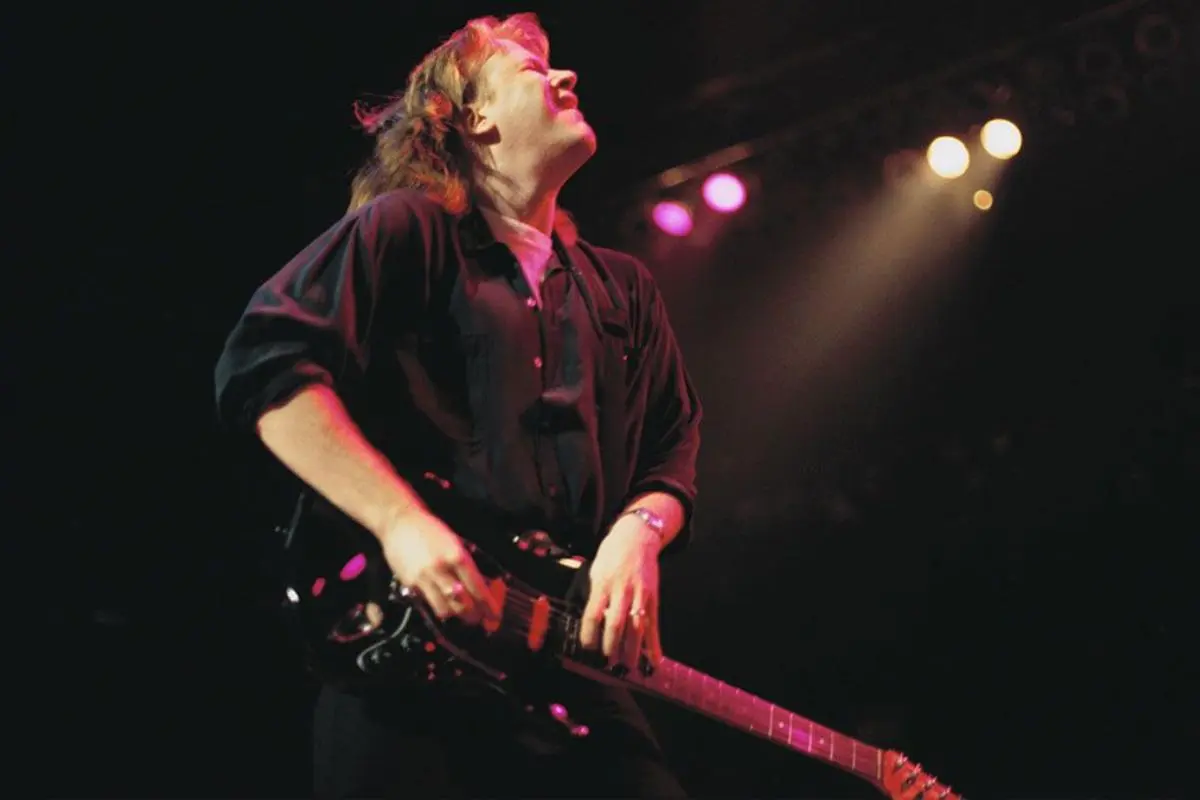
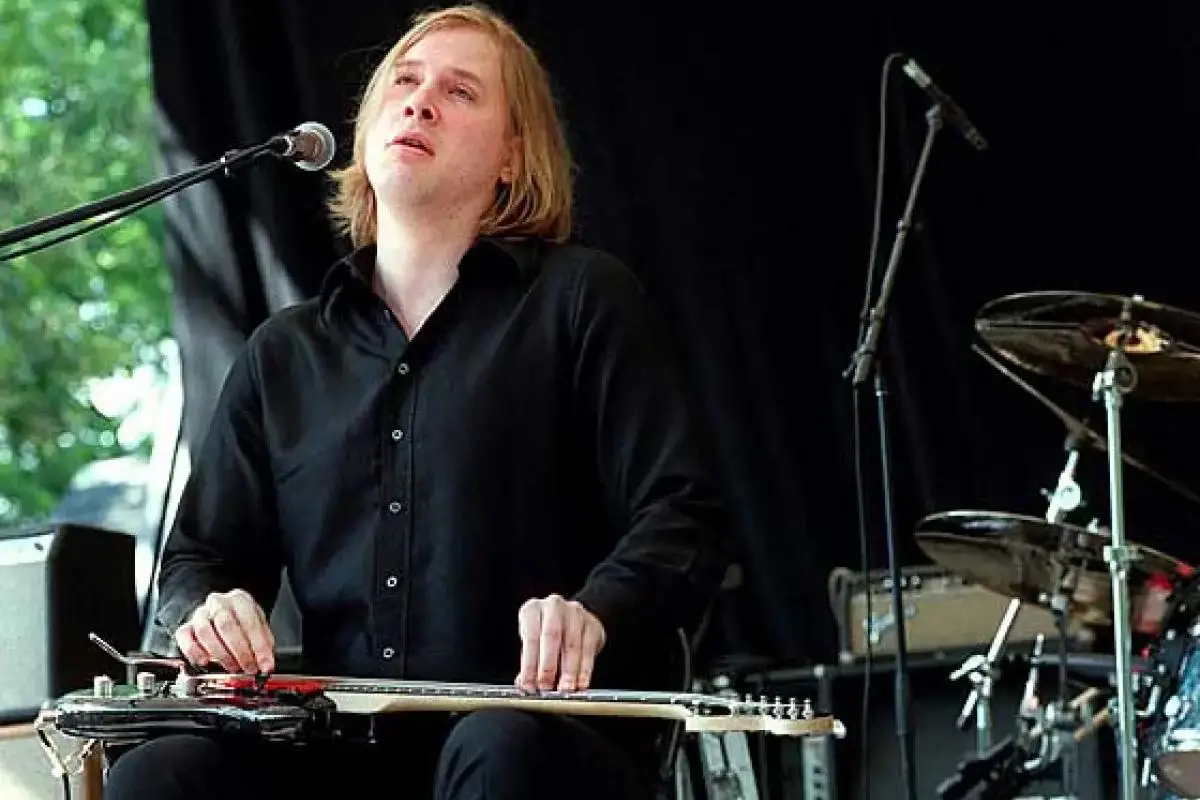
Healey loved to tell how his technique happened almost by accident. As a child he tuned the guitar to a chord, used a steel bar to change it, and when he finally learned standard tuning around seven or eight he simply kept the instrument on his lap and worked out all the chords from above the neck. Onstage he would sit at center stage with a Stratocaster laid flat, left hand spread over the fretboard like a pianist’s while his right hand picked, thumbed and raked, the whole rig plugged straight into a Marshall rather than a maze of effects.
It is easy to underestimate how radical that is until you try it yourself. With the neck facing up, his fingers could grab wide intervals that would be painful stretches in a conventional position, while his thumb bent strings far past the usual reach, creating almost pedal-steel levels of vibrato and those howling, vocal-like double-stops that made other Strat players sound oddly polite.
Visually, it looked like some mutant cross between a lap steel and a rock rig: black Japanese built Squier Strats, a white standard Strat, feeding relatively straightforward amps compared with the pedalboards of his peers. He freely admitted he tried playing “the normal way” and simply was not comfortable, so he trusted his body, kept the guitar in his lap and built his entire chord vocabulary around that posture instead of chasing technical approval.
From a technical standpoint that choice should have been suicide; no teacher would suggest it to a blind kid with small hands. Yet by treating the fretboard like a horizontal canvas, Healey stumbled into a new vocabulary of chord slides, screaming bends and unison lines where every note could be throttled or finessed with all five fretting fingers. In an era obsessed with speed, he quietly proved there were still unexplored frontiers hiding on a stock Strat.
Road House, cult status and the jazz brain inside the rock star
If you were renting VHS tapes in the late 80s or early 90s, you probably met Healey not in a club but in Road House, the 1989 Patrick Swayze barroom brawler where his trio serves as the Double Deuce house band and he plays Cody, the laconic guitarist delivering plot hints between flying bottles. The official Jeff Healey site notes that for many fans the movie was their first glimpse of his playing and that the film, a flop on release, slowly turned into a cult favorite that still pops up endlessly on television.
There was a twist of the knife though: while the movie used a dozen Jeff Healey Band performances, the original 1989 soundtrack album only carried four of them, padding the rest with other artists. It took until 2024 for his estate, Sony Music and Mondo Music, compiling all twelve film cuts plus seven bonus tracks from the same sessions and finally confirming what barroom veterans already knew – Healey and his band were the real sonic engine of that film.
As the 1990s wore on he grew increasingly uneasy with the machinery of rock stardom, peeling away from the major label treadmill to indulge his first love, pre war jazz. He led small bands that sounded like they had stepped out of a scratchy 78, built what writers have described as one of the world’s most extensive collections, and cared more about spinning obscure Louis Armstrong sides for friends than chasing another chart single.
That double life is exactly what the in production documentary See The Light:, with his widow Cristie and estate archivist Roger Costa describing a feature length film that will weave new interviews, archival footage and Healey’s own voice into a portrait of a musician who refused to be pinned to one scene or one stereotype.
Where he sits in the guitar pantheon
Even early in his career, veterans were rattled by what they heard: B.B. King reportedly told the young Healey that he had never seen execution like that and urged him to keep going. Add in the fact that King later introduced him onstage as his Canadian son, Bonnie Raitt calls him one of the sweetest and most gifted artists she toured with, and Steve Lukather flatly ranks him among the most unique players of all time, and you start to see the pattern. When other guitar heroes talk that way, they are not being polite – they are quietly admitting he scared them.
In terms of vocabulary, Healey sits in that dangerous triangle between Hendrix, SRV and early Clapton, but with a phrasing sense shaped as much by Louis Armstrong and hot jazz trumpet as by Texas shuffle. Watch him climax “See the Light” or tear through “While My Guitar Gently Weeps” and it is hard not to feel that a lot of modern shred has more notes but less actual risk.
What guitar players can steal from Jeff Healey
You probably are not going to flip your guitar onto your lap overnight, and you do not need to. But there are very practical lessons in how Healey worked that any serious player – especially those of us with a few decades on the clock – can use.
- Trust your body, not orthodoxy. Healey ditched “proper” posture because it did not feel right and built a monster technique around what his hands naturally wanted to do. If your current setup hurts your back, shoulders or wrists, that is not noble suffering; it is bad design.
- Turn limitations into design rules. Total blindness and a seated position should have been obstacles in a macho rock world; he turned them into a unique stage presence and a fretboard approach nobody else could fake. Age, injury or arthritis can be the excuse to quit, or the nudge that forces you to invent a better way to play.
- Build tone before toys. For most of his rock years Healey relied on a Strat into loud amps and used effects sparingly. The real magic was in his hands, touch and muting. If your pedalboard looks like a NASA control panel and you still are not happy, his example is a painful reminder of where tone actually lives.
- Steal from jazz, not YouTube. Healey’s deep immersion in 20s and 30s jazz phrasing is what gave his blues-rock lines that elastic, vocal quality. Spending time with Armstrong, early Ellington and small group swing will probably do more for your solos than another month of pentatonic speed drills.
- Consider ergonomics as you age. A lap-style electric setup spreads the weight, takes strain off your spine and opens up fingerings that are almost impossible standing with a low slung guitar. Even if you never go full Healey, experimenting with seated, classical or hybrid positions can buy you years of comfortable playing.
In the end, Jeff Healey was not “the blind guy who played funny”; he was the musician who proved that a supposedly exhausted instrument still had shocking new tricks hiding in plain sight. If you are willing to ignore what the guitar is supposed to look like when you play it, you will only scratch the surface of his genius – but you might find far more of your own.
Essential Jeff Healey listening for guitar nuts
| Album | Era | What to listen for | Start with |
|---|---|---|---|
| See the Light | 1988 breakthrough | Explosive lap-style Strat, bar-band energy colliding with radio-ready hooks. | “See the Light” or “Angel Eyes” |
| Hell to Pay | 1990 peak | More sophisticated songs, guests like George Harrison, still ferocious lead work. | “I Think I Love You Too Much” |
| Mess of Blues | Posthumous 2008 | Back-to-basics blues-rock, raw tone and late period authority. | “How Blue Can You Get” |
| Road House: The Lost Soundtrack | 1989 sessions, 2024 issue | Live-in-the-bar feel, Healey as the beating heart of a cult film. | “Roadhouse Blues” |
Put those four records on, turn the lights down and, just for a while, steal Jeff Healey’s trick and play with your eyes closed. The guitar will suddenly feel like a different instrument – which is exactly what he proved it could be.