
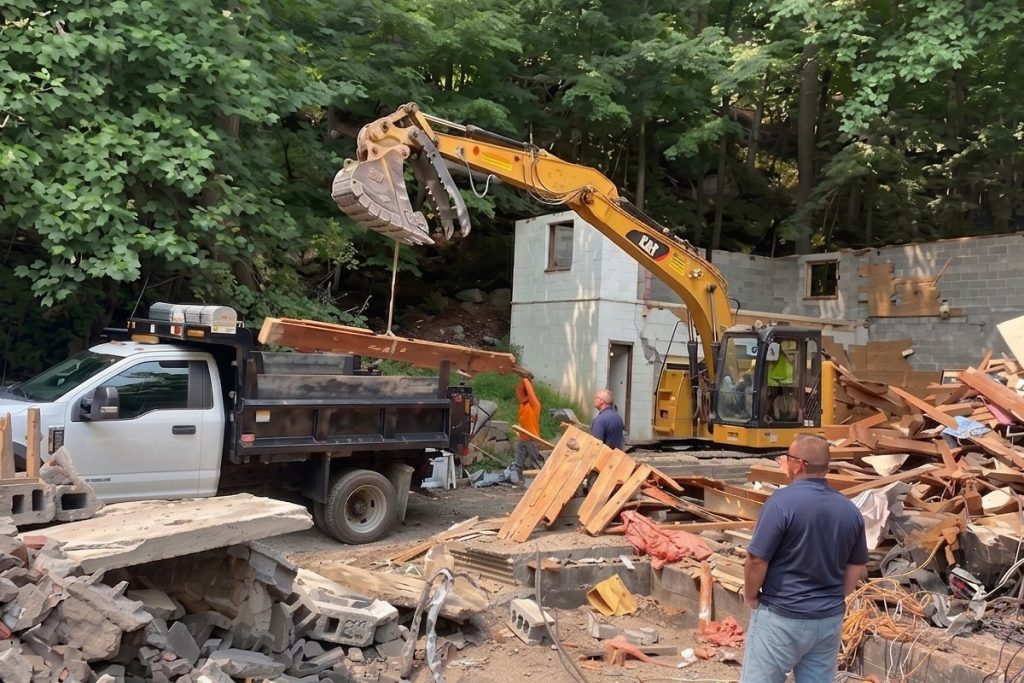
Video shot inside Les Paul’s home and workshop in Mahwah, New Jersey has surfaced online, recorded in the building’s final days before the wrecking crews arrived. The house at 78 Deerhaven Road — where Paul spent decades refining multitrack recording and experimenting with solidbody electric guitar design — was sold for a reported $990,000 and torn down in August.
The footage was filmed by guitarist, collector and recording-studio owner Perry Margouleff, who narrates as he walks through the deteriorating rooms where Paul worked. Margouleff, who founded Pie Studios on Long Island, says he went to document the property after a tip-off about its fate, expecting to find a site being cared for.
“I figured this place would be maintained as a site on the National Register of Historic Places,” he says in the video, according to Guitar World. “But what we found, and the footage we gathered, was horrifying — a house needlessly in disrepair only a decade or two after its fabled owner had passed.”
What was lost at 78 Deerhaven Road
The address mattered because of what happened inside it rather than what it looked like from the road. Paul lived and worked there for decades, and the basement laboratory is where he pushed forward the recording techniques — layering parts, sound-on-sound, the groundwork of modern multitracking — that changed how records are made. He also worked on pickup designs there, and recorded television appearances with Mary Ford in the house.
It was a working destination for other players, too. WCSX reports that Jimmy Page, Jeff Beck and Eddie Van Halen all visited the workshop to talk music and technology with Paul, who died in 2009. Guitar Player notes the property remained largely intact after his death, though much of the equipment tied to his work was eventually moved elsewhere.
That relocation is now central to the argument. Most of Paul’s recording gear is housed at the Les Paul Recording Studio in Hollywood, a commercial facility that opened in March 2025.
The family’s account, and the Foundation’s
Gene Paul, Les Paul’s son, went public in a series of Facebook posts in late August. “A few days ago, I saw my father’s home, our family home, gutted. It made me sick,” he wrote in a post quoted by Guitar World and WCSX. “That house was not just where Les Paul lived. It was his workshop. It was his laboratory. It was his journey of dreams.”
Gene says nobody warned the family that demolition was coming and that he was not allowed inside before the crews began work, describing a last-minute scramble to save artifacts. He also raised a broader complaint about how his father’s estate has been run, writing that Michael Braunstein, executive director of the Les Paul Foundation, “took control of everything” after Paul’s death and that “the entire family found ourselves on the outside looking in,” seldom consulted about the estate, the money or the legacy. On the sale itself, his question is blunt: “What happens to that money? My father had children and a family. Was that ever considered?”
The anger sharpened after Braunstein reportedly described the property as essentially “four walls” while discussing the decision to move Paul’s equipment — a characterization first reported by Guitar Player and picked up widely since.
Braunstein and the Foundation have now issued two statements in response to the backlash. In the first, Braunstein argued for separating the building from the legacy: “It is important to distinguish the loss of the structure from the preservation of Les Paul’s artistic and technical legacy.” Claims that the legacy had been “erased,” he said, are “completely inaccurate,” pointing to a significant collection of Paul’s original recording equipment that has been “preserved, meticulously restored, and is actively in use at the Les Paul Recording Studio.”
The second statement went further: “Les Paul’s legacy was never confined to one building. It lives in his music, inventions, recordings, instruments, archives, and the countless artists and listeners he inspired.” The Foundation also noted that the house sat in a residential neighborhood whose zoning would not have permitted a public exhibition — and added a pointed line of its own, saying many calls and emails had been sent to Gene over recent weeks “with no response.”
Where the accounts do not line up
That last claim sits directly against Gene’s position that the family was never consulted, and neither side has published a record that would settle it. It is the clearest unresolved conflict in the story.
There is a second one worth flagging. In his video, Margouleff says a name “kept coming up when trying to get to the bottom of who did this,” and states that Braunstein moved the gear to Los Angeles and “apparently sold the property to be razed.” That is Margouleff’s characterization; the published reporting says only that the property was sold for a reported $990,000 to private developers, and does not independently identify the seller. The Foundation’s statements do not address the sale directly.
A smaller discrepancy: Guitar Player attributes the line “It made me sick” to Margouleff in the video, while Guitar World and WCSX attribute the same words to Gene Paul’s Facebook post.
Gene has said Braunstein told him years ago that a historic-landmark designation, or any other preservation route, was not possible, and that the only realistic alternative to demolition would have been running the house as a museum. He now questions both assumptions, arguing preservation need not have meant a museum, and says he has begun looking into whether the property could have qualified for historic designation and whether such a nomination was ever pursued. He describes the years of decline that preceded the bulldozers as “demolition by neglect.”
For now the record is the footage, and one open question at the end of Deerhaven Road: there is no marker there telling anyone what used to happen in that house.


