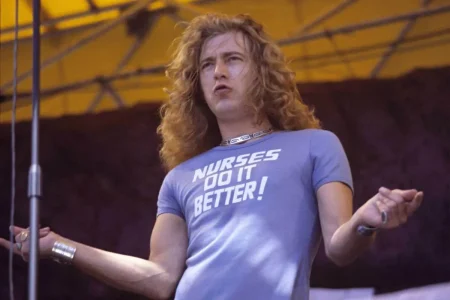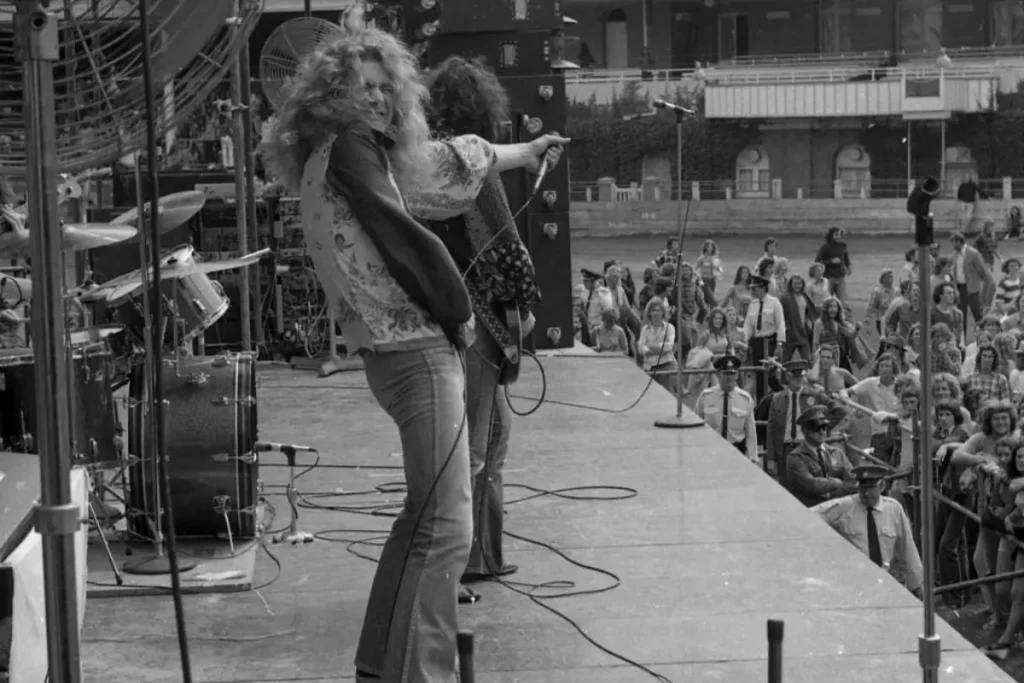
Led Zeppelin didn’t leave America with a neat farewell tour or a press-friendly victory lap. They left with a huge outdoor weekend in Oakland, squeezed into the chaotic machinery of a Bill Graham style mega-event, and then simply never returned. On July 24, 1977, at Oakland-Alameda County Coliseum Stadium, Zeppelin played what became their final concert on US soil at Day On The Green, with Rick Derringer and a young Judas Priest on the bill, and tickets reportedly priced at $11.50.
It’s a story that sounds like classic rock mythology because it kind of is: stadium-scale ambition, brutal touring reality, and a sudden ending that nobody in the crowd could have understood at the time. The fascinating part is how many separate histories collide on that grass: Zeppelin’s 1977 juggernaut, Day On The Green’s evolution into a prototype of modern festivals, and the strange symbolism of an $11.50 ticket to see a band that would never play the US again.
Day On The Green: the festival blueprint hiding in plain sight
Day On The Green was not “a festival” in the Woodstock sense as much as a concert-industrial system that happened to take place outdoors. It was a long-running series at the Oakland Coliseum produced by Bill Graham Presents, built for big crowds, big sound, and lineups with something to prove. A multi-year overview of the series captures how the name became shorthand for major Bay Area rock events across multiple years and genres.
Day On The Green’s project history is a reminder that it wasn’t a one-off, it was a repeatable model: headline-level rock (and later punk and pop), curated support, and the Coliseum as a reliable mass container for youth culture.
A KQED retrospective on its Oakland Coliseum legacy frames Day On The Green as a uniquely Bay Area institution, tied to the Coliseum and the era when promoter power and FM radio culture could turn a single show into a civic-scale moment.
Why July 1977 felt like the peak and the breaking point
Led Zeppelin’s 1977 North American tour was enormous, both commercially and physically. The dates, structure, and context of that run are laid out in broad strokes in an explainer of how their final U.S. show landed in July 1977, which makes the key point easy to see: this was a late-70s stadium machine, not a scrappy club victory march.
By the time Zeppelin hit Oakland, the tour had already been through heavy weather: exhaustion, chaos around the traveling circus, and a constant tension between musical greatness and human wear-and-tear. That matters because the Oakland shows were not planned as a “last US stand.” They only became that in hindsight, after tragedy ended the tour and the band’s relationship with America’s road schedule changed for good.
“Success at this level isn’t just loud music. It’s logistics, stamina, and luck.”
– General touring reality, as echoed across 1970s stadium-era accounts
The Oakland weekend: two nights, one historical full stop
Zeppelin played Oakland on July 23 and July 24, 1977, as part of the Day On The Green series. The second night, July 24, is widely cited as the band’s final US performance. Fan-compiled Oakland 1977 documentation keeps the dates, songs, and variations in constant circulation, which is part of why this weekend has stayed hot in collector circles.
One reason this weekend has stayed hot in fan circles is that it was not a short set or a token appearance. Zeppelin in 1977 was built around long-form arrangements, extended medleys, and a physical demand that could be thrilling or punishing depending on the night. The outdoor stadium setting magnified everything: the grandeur, the distance from the stage, and the sense that the band was operating at a scale almost too large to manage.

“Final show” does not mean “final moment”
It’s worth being precise. This was the final Led Zeppelin show on US soil, not the band’s final concert. Zeppelin would play later in Europe and the UK, and there were isolated performances after 1977. The Oakland show is historically important because it is the last time American fans saw the original band in its working, touring form.
The supporting cast: Rick Derringer and Judas Priest as tonal whiplash
On paper, Rick Derringer and Judas Priest make a weirdly perfect 1977 undercard: American guitar-hero swagger on one side, a British metal band sharpening its edge on the other. Derringer’s career bio places him firmly in the era’s hard-rock mainstream, known for hits and a reputation as a player’s player rather than a cult act.
Judas Priest in 1977 were not yet the leather-and-studs global brand many people picture. They were still in their early album years and learning what it meant to survive on big stages. Priest’s official band profile provides the cleanest baseline that they’re a Birmingham-formed group whose rise into heavy metal’s top tier was still underway in the late 70s.
The shock for many attendees would have been stylistic. Zeppelin were the elder giants of the decade. Derringer brought a more straightforward American hard rock energy. Priest, meanwhile, represented the future, faster and harder, leaning into a metal vocabulary that would dominate the next era.
The $11.50 ticket: cheap, yes, but not the way people think
$11.50 reads like a joke now, the kind of number you’d pay for parking. But in 1977 it was still real money, and it also reflected a different concert economy: fewer middle layers, less dynamic pricing, and a live business that had not yet fully transformed into a premium-transaction marketplace.
To avoid romanticizing it, it helps to translate the experience rather than the number. That $11.50 bought you a full stadium day: multiple major acts, the social event of the season, and the risk profile of a giant outdoor crowd. The “deal” was partly that you paid in hassle: heat, lines, distance from the band, and the occasional disorder that came with 70s rock mass gatherings.
What the crowd actually heard: a 1977 Zeppelin set in a stadium context
Any single setlist source should be treated cautiously, but fan-compiled databases still help explain the overall shape: long shows, signature epics, and room for improvisation. In that sense, Zeppelin’s stadium show of this era tended to revolve around a core identity: massive riffs, big dynamic swings, and enough onstage freedom that the same songs could feel precise one night and ragged the next. That unpredictability is exactly why some fans swear by 1977 and others swear at it.
A quick snapshot: why 1977 sounded so huge
| Ingredient | What it did in a stadium |
|---|---|
| Extended arrangements | Made the concert feel like an event, not a playlist |
| Guitar tone and volume culture | Turned riffs into physical impact you felt in your chest |
| Bonham’s power | Anchored the sound so the band could stretch without collapsing |
| Outdoor festival setting | Added scale and atmosphere, but punished nuance and intimacy |
Why this became Zeppelin’s last US show (and why it still stings)
Oakland is remembered as an ending, but the ending wasn’t announced. The remaining tour dates were canceled after the death of Robert Plant’s son, Karac, which effectively shut down the 1977 US run and made July 24 the last American chapter. That abrupt endpoint is central to the widely told account of why Oakland became the last U.S. stop.
There’s an uncomfortable honesty in that. Rock history loves clean narratives: farewell shows, bows, final encores. Zeppelin’s US ending was the opposite: abrupt, private, and permanent. That’s part of what gives Oakland its strange gravity. People went to a Day On The Green gig and unknowingly attended a historical cutoff.
Oakland Coliseum as the stage for mass rock history
The Oakland Coliseum complex was built to host major sports and mass events, and it became a natural home for huge concerts in the 70s. Venue information for the Oakland Coliseum underscores its identity as a large-capacity site that has hosted major touring productions across decades.
Day On The Green worked because Oakland could physically hold what rock had become: not just music, but a public gathering big enough to feel like a temporary city. In that sense, Zeppelin’s last US show didn’t happen in a legendary theater or a “perfect sounding” hall. It happened in the kind of place where legends had to compete with wind, distance, and sheer scale.
The collector afterlife: how Oakland became a bootleg cornerstone
One reason the Oakland weekend never disappears is that recordings circulate widely, discussed and dissected like sports film. Publicly indexed collector recordings of “Led Zeppelin 1977-07-24 Oakland” show how heavily this era is represented in open archives, even when individual items come and go.
This bootleg afterlife creates a second, parallel version of the event: not the sweaty afternoon on the grass, but the endlessly replayed document. It also means the show’s reputation is shaped by what survives on tape, not just what happened in the stadium.
What to listen for if you hear an Oakland ’77 recording
- Tempo vs. weight: 1977 Zeppelin can feel slower than earlier years, but the groove is often heavier.
- Vocal stamina: Plant’s performance can vary, and that variance is part of the era’s truth.
- Guitar architecture: Page’s approach often leans into long arcs, sometimes brilliant, sometimes risky.
- Band communication: Listen for moments where they steer back together after stretching out.
None of this requires you to declare the show “best” or “worst.” Oakland matters because it captures the contradictions of peak-stadium Zeppelin: enormous capability, enormous pressure, and an audience that came for myth-making and got something more human.

Conclusion: the loudest goodbye nobody knew was a goodbye
July 24, 1977 at Day On The Green is an uncomfortable kind of iconic: not a planned finale, but a last frame in the American film reel. With Derringer and Judas Priest setting the table and $11.50 tickets opening the gates, Zeppelin gave the US one more taste of their stadium-era power, then vanished from American stages for good.
If you want the takeaway in one sentence, it’s this: Oakland wasn’t just “a great Zeppelin show.” It was the moment when the biggest band in rock quietly stopped being a touring American reality and became something else entirely: legend.