
If you want to pinpoint the moment the 1960s folk explosion truly caught fire, skip Woodstock and the Newport Folk Festival. Picture instead a modest house in Howard Beach, Queens, where a skinny drifter in scuffed work boots knocked on the Guthrie family’s front door and a 13 year old named Arlo answered.
The Day Bob Dylan Knocked on Arlo Guthrie’s Door
A drifter in weird boots
Arlo Guthrie remembers that afternoon as almost absurdly ordinary. A babysitter answered the door to find a young man in odd work boots asking for Arlo’s father, Woody Guthrie. Arlo, intrigued rather than alarmed, invited the stranger in, sat down, and the two swapped stories and passed a harmonica back and forth while the babysitter quietly panicked in the corner.
The drifter, of course, was Bob Dylan, all of 19 and still largely unknown outside the scruffy coffeehouses of Greenwich Village. Years later Arlo would tell audiences how Dylan asked to see his dad, learned Woody was in the hospital, then went off to visit him, only for everyone to be singing Dylan songs shortly afterward. One knock on a door, and the center of gravity in American folk music began to slide.
From Howard Beach to a hospital room
Dylan did not show up at the Guthries’ place by accident. Months earlier he had borrowed Woody’s autobiography, “Bound for Glory,” in Minnesota and become obsessed with the Okie troubadour who wrote about dust storms, unions and fascists the way other songwriters wrote about love affairs. When Dylan finally reached New York, he made a beeline not for a record label but for the hospital where Guthrie was slowly dying of Huntington’s disease.
At Greystone Park Psychiatric Hospital in New Jersey, Dylan found his hero confined but still sharp enough to hand the kid a card that read, “I ain’t dead yet,” and listen as Dylan played him a new composition, “Song to Woody.” It was not just a fan paying his respects – it was a young songwriter asking for a benediction, and getting it.
| Year | Moment | What Changed |
|---|---|---|
| 1940 | Woody releases Dust Bowl Ballads | Turns migrant misery into modern protest song cycle |
| January 1961 | Dylan arrives in New York City | Sets out to track down Guthrie and the Village folk scene |
| Early 1961 | Dylan knocks on Arlo Guthrie’s door | The Guthrie-Dylan connection becomes personal and immediate |
Woody Guthrie – The Troubadour Dylan Was Chasing
Dust Bowl prophet of the underclass
By the time Dylan arrived, Woody Guthrie was already a folk legend and a physical wreck. Across his life he wrote hundreds of political, folk and children’s songs, from talking blues to raw ballads, and later piled up awards and Hall of Fame inductions as the establishment tried to catch up with what he had already done. One album in particular, Dust Bowl Ballads, turned the anonymous suffering of Okie migrants into a first person epic.
Mojo magazine’s “Big Bang – 100 Records That Changed the World” list places Dust Bowl Ballads at number 13, right alongside the Beatles, Little Richard and Dylan himself. That is a polite way of admitting that the entire modern idea of the topical singer songwriter – from protest folk to alt country confessional – sits on Guthrie’s cracked shoulders.
Other overviews of his career underline the point. Many of Guthrie’s recordings are preserved in the Library of Congress, and the roster of artists who cite him as a primary influence reads like a roll call of postwar American music, including Bob Dylan, Johnny Cash, Bruce Springsteen and Billy Bragg among many others. Dylan was not just visiting a hero in that hospital room – he was trying to plug himself directly into the source.

This machine kills fascists – and other dangerous ideas
Guthrie’s most famous song, “This Land Is Your Land,” began life as an angry answer to the syrupy optimism of “God Bless America.” Written in 1940, it originally bore the title “God Blessed America for Me” and included verses about breadlines, relief offices and “No Trespassing” signs that questioned who the country really belonged to, verses that were conveniently dropped when the song was sanitized for schools and TV. The version most Americans know is the safe one; the real song is a class war hymn disguised as a campfire singalong.
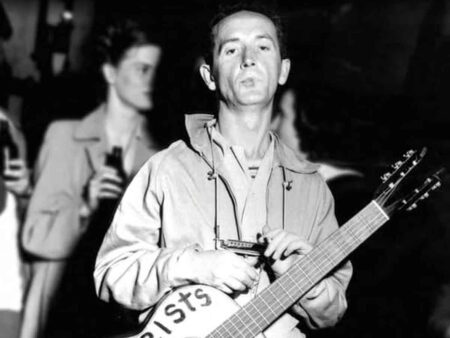
He matched those lyrics with the blunt slogan he painted on his guitar: “This machine kills fascists.” The phrase itself came from wartime morale stickers in defense plants, but Guthrie hijacked it, turning a patriotic bromide into a threat directed at racists, landlords and would be dictators, and his performances of songs like “All You Fascists” made the slogan feel less like a joke and more like a warning.
As one profile in the New Yorker points out, later generations tried to sand the rough edges off Guthrie and turn him into a cuddly symbol of Americana, but his reality was far less comfortable. He was openly socialist, fiercely on the side of the poor, and he deliberately kept his singing raw and conversational so it sounded like a neighbor talking, not a crooner entertaining – a style that would hit Dylan, and then the entire 1960s, like a brick.
Inside the Greenwich Village Folk Boom
Coffeehouses, chords and confrontation
While Dylan shuttled between hospital visits and cheap rooms, a new kind of urban folk scene was coalescing a subway ride away in Greenwich Village. Coffeehouses like the Gaslight Cafe and Gerde’s Folk City were turning into launchpads where anyone with a guitar, a notebook and enough nerve could try out original songs about civil rights, war or whatever was burning a hole in their conscience. These rooms were tiny, the pay was awful, and the stakes felt enormous.
Know Your Instrument’s look at the 1960s folk revival traces how this circuit, along with groups like Peter, Paul & Mary and elders such as Pete Seeger, dragged folk from the back porch into the mainstream without entirely declawing it. The Village coffeehouse might have been selling cappuccino instead of moonshine, but the best songs coming out of those rooms were still aimed squarely at presidents, generals and bosses.
The Village’s aura never really faded. Recent writing in People magazine notes that the same streets that nurtured Dylan and Joni Mitchell now exert a “mythic allure” on artists like Taylor Swift, who tap into its history as America’s bohemian songwriting capital. Even as the real estate got expensive and the clubs thinned out, the idea of Greenwich Village as a place where you go to reinvent both yourself and your country proved stubbornly hard to kill.
Film has caught the bug too. The biopic “A Complete Unknown” painstakingly recreates Dylan’s early 1960s New York, right down to the cramped stages of the Gaslight Cafe and Gerde’s Folk City and the feel of Columbia’s Studio A where he cut those first records. That level of obsessive set building only exists because what happened in those rooms still matters culturally, long after the cigarette smoke has cleared.

Arlo’s front row seat
Arlo Guthrie did not yet have a Village club residency when Dylan came calling, but he was hardly a bystander. He grew up literally surrounded by folk royalty – Pete Seeger, Sonny Terry, Brownie McGhee and others drifting through the Guthrie household – and gave his first public performance in 1961 at age 13, quickly falling in with peers like Bob Dylan, Joan Baez and Phil Ochs. He was the kid hanging around the grown ups’ table, soaking up every argument about politics, chords and how to get a crowd singing.
That made the Dylan doorstep visit more than a cute anecdote. It was a physical handoff of the tradition from Woody’s generation of union halls and dust storms to a new generation that would turn protest songs into pop hits and festival anthems. Within a few years Arlo would be onstage at Newport with “Alice’s Restaurant” and Dylan would be blowing up the boundaries between folk and rock, both of them walking through the door Woody had kicked open.
From Woody to Dylan to Arlo – Why That Knock Still Echoes
A lineage of beautiful troublemakers
One reason that small domestic scene sticks in the memory is that it compresses an entire lineage into a single frame. On one side is Woody Guthrie, the dust bowl radical whose songs and attitude rewired American folk music. On the other is Bob Dylan, determined to take that language of class and justice and fuse it with surreal poetry, electric guitars and a stubborn refusal to play nice.
Recent releases of Guthrie’s long lost home recordings, rescued and cleaned up with AI, reveal him still railing at racism, fascism and corrupt landlords from his Brooklyn apartment in the early 1950s, even writing a furious song about real estate mogul Fred Trump’s discriminatory housing policies. Nora Guthrie has said she hopes these recordings prod new writers into taking up the same fight, just as Dylan did after his hospital visits.

The legacy for listeners today
Far from being a sepia tinted figure, Guthrie remains a live wire in American culture. Wired’s look back on his birthday notes how his activism, his determination to fight for the oppressed and his refusal to lock his songs away behind strict copyright have kept him central to every new wave of protest music. His hometown throws festivals in his honor, and artists who were not even born when Dylan cut his first records still treat “This Land Is Your Land” as both anthem and indictment.
So when you hear the opening chords of a Guthrie song, a Dylan lyric about war or an Arlo monologue that starts as a joke and turns into a political punch, remember that quiet moment in Howard Beach. A nervous babysitter, a kid with a harmonica, and a drifter with weird boots accidentally connected three generations of musical dissent. The 1960s did not just happen in marches and festivals – they also happened in living rooms, one knock at a time.