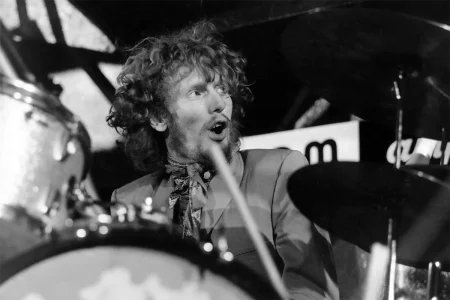
Two drummers could hardly be more different than Neil Peart of Rush and Tony Allen of Fela Kuti’s Africa 70, yet they agreed on one thing: Ginger Baker was dangerous. Not sloppy-dangerous, but the kind of drummer who could rip up the rulebook for rock, jazz and Afrobeat, then spit out something nobody else could quite follow.
Neil Peart, Tony Allen and the strange consensus
Peart grew up dissecting every detail of Cream records, and later admitted that Baker was his template for what a rock drummer should be. He praised Baker’s playing as “revolutionary – extrovert, primal and inventive”, called him the very archetype of the rock drummer, and credited Baker’s solo on ‘Toad’ as the first true rock drum showcase, insisting that every rock drummer since has built on that foundation in some way. Baker was his template for what a rock drummer should be.
On the other side of the musical map, Tony Allen spent decades as Fela Kuti’s rhythmic lieutenant, co-inventing Afrobeat’s matrix of interlocking grooves and political fury. He later summed up Baker with a cutting compliment, saying that whatever style Baker chose he brought his own pulse and sound, and that he “understands the African beat more than any other Westerner”—the kind of praise Allen rarely offered lightly.
From London jazz cellars to rock’s first drum superstar
Baker did not start as a rock gun-for-hire. As a teenager he worked through British traditional jazz bands, then joined Alexis Korner’s Blues Incorporated and later the Graham Bond Organisation with Jack Bruce, sharpening a fierce jazz-rock style and reputation for explosive solos long before Cream ever plugged in.
When he and Bruce teamed with Eric Clapton in Cream, Baker suddenly had a worldwide laboratory for those ideas. Histories now describe him as rock’s first true superstar drummer, a player who pulled jazz technique and African rhythmic concepts into a power-trio format and helped open the door to jazz fusion and the heavier, more aggressive rock that would mutate into early metal, as detailed in accounts of his career with Cream and beyond.
Revolutionary, extrovert, primal, inventive – in practice
Listen to Cream at full tilt and Peart’s description stops sounding like hype. Baker treated the kit as a front-line instrument, firing off rolling barrages of kick, tom and snare that one writer likened to tribal artillery while Cream jammed with the looseness of a jazz combo that just happened to be strapped to Marshall stacks.
That attitude flipped the hierarchy of rock rhythm. Instead of just marking time, Baker wrote parts that wove through riffs and vocals, full of polyrhythms he had soaked up from jazz and African music, and a hard, flat sound that cut through massive amplification. Modern drummers as different as Neil Peart, John Bonham, Stewart Copeland, Danny Carey and Gavin Harrison have all been singled out as carrying some piece of his revolutionary drumming approach.

The African heartbeat: Lagos, Fela and Afrobeat
Plenty of rock players name-check African rhythms; Baker actually moved there. In 1970 he drove overland to Lagos, Nigeria, set up what is often cited as West Africa’s first 16-track recording studio and began working closely with Fela Kuti, quickly becoming known locally as the ‘Oyinbo’ – the white drummer – in front of crowds that could hit 150,000 people, a story often retold in accounts of his collaboration with Fela.
The collaboration was more than a gimmick guest spot. Baker joined Fela’s Africa 70 on the live-in-studio album Live!, recorded at Abbey Road in 1971, and their partnership later resurfaced in a 16-minute drum duet with Tony Allen, taped at the 1978 Berlin Jazz Festival and issued as a bonus track on reissues of that record—a pairing explored in depth in retrospectives on Fela Kuti & Ginger Baker Live!
Tony Allen vs Ginger Baker: clash of styles, shared groove
To grasp why Allen’s praise matters, you have to understand his own standing. Fela Kuti later said bluntly that without Tony Allen there would be no Afrobeat, and profiles have described how Allen built his patterns from a stew of Yoruba and wider West African rhythms, demanding that each of his four limbs play an independent part inside one seamless groove, as charted in profiles of the veteran Afrobeat drummer.
Allen was also clear that Baker was not simply copying his homework. Asked years later about playing together, he explained that Baker relied on a double bass drum while Allen used just one, kept his hi-hat mostly closed because both feet were occupied, and forced Allen to carve out space so that their contrasting conceptions of time did not smear into mud—details he shared in interviews about the political and rhythmic power of Afrobeat.
When worlds collide: Afrobeat experiments and drum duels
Recordings from this period sound less like a polite fusion summit and more like controlled collision. On Live! and the later Berlin duet, writers have noted how Allen’s sly, behind-the-beat elasticity locks against Baker’s more thunderous, straight-ahead attack, creating passages where the groove seems to bend and flex without ever quite breaking—a tension described vividly in essays on the Live! sessions.
What makes those performances so gripping is that neither drummer backs off his identity. Allen keeps the hypnotic Afrobeat engine purring, Baker throws sparks all over it, and the band rides the tension instead of smoothing it out. In a world where world-music blends often got watered down to polite wallpaper, this was something riskier: two fully formed languages arguing, loudly, in real time.
Rock drumming after Ginger
If you strip away the mythology, Baker’s concrete contributions are easy to spot. He normalised double bass drumming in rock, stretched drum solos into compositional events rather than ego slots, and insisted the drummer could shape a band’s dynamics second by second instead of just confirming the backbeat.
You can hear his shadow in the next wave of British drummers. John Bonham took Baker’s sense of tribal power and welded it to brutal groove, then used that language on labyrinthine riffs like Led Zeppelin’s ‘Black Dog’, where the band toys with the listener’s sense of time while actually staying locked in 4/4 the whole way through.
The difficult man who refused to stay in the background
Baker’s playing was not the only thing that scared people. Interviews from the 1970s onward show him barking at journalists, including a notorious conversation about his Nigerian years where he explodes at simple questions about Fela sessions, snapping that he does not keep a diary and mocking the interviewer for not already knowing the dates—an encounter preserved in a 1999 discussion of his time with Fela.
That volatility made him an easy villain in documentaries, but it is also part of why Peart and Allen’s respect carries weight. Baker was not a lovable mascot of the drum community; he was a prickly, often self-sabotaging obsessive who burned bridges on multiple continents, yet players at the highest level still talk about his feel with a mix of admiration and unease.

Why Peart and Allen were right
Peart heard in Baker the moment rock drums stopped being polite and started behaving like a lead instrument. Allen heard a rare Westerner who had taken African rhythm seriously enough to internalise its logic rather than just borrow its surface patterns.
If you grew up on classic rock, you have already felt Baker’s impact filtered through Bonham, Peart and countless others, whether you ever owned a Cream record or not. Put on ‘Toad’, then Fela’s Live!, and you can hear the same restless mind trying to bend three different traditions to his will – messy, confrontational and, in its own unruly way, revolutionary.