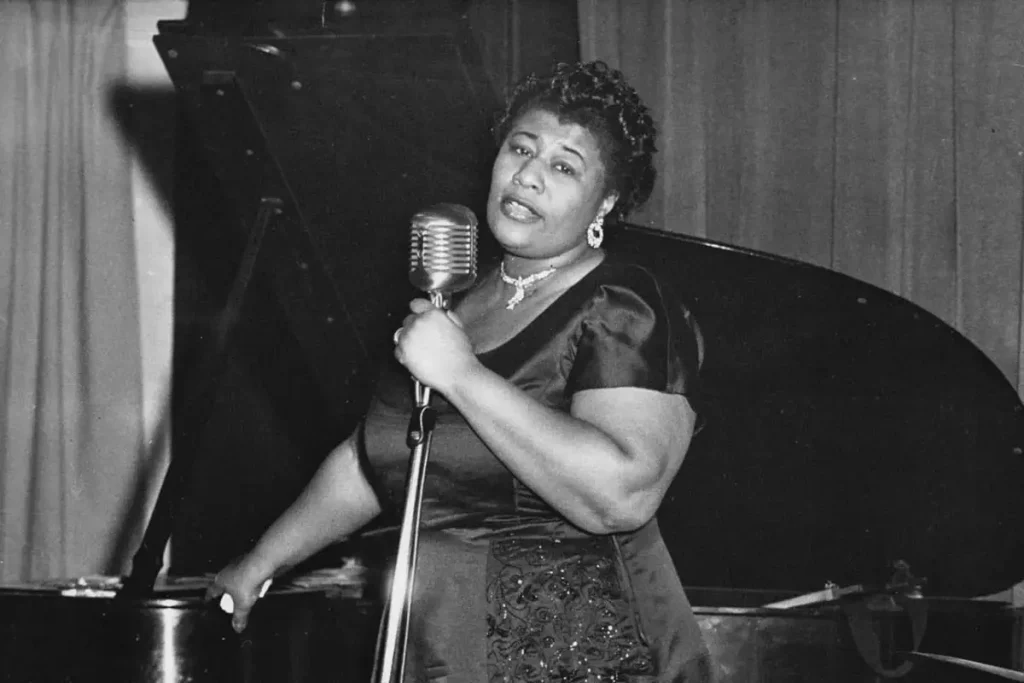
Ella Fitzgerald’s career makes the cleanest sense when you stop thinking in decades and start thinking in acts. The sound of American popular music changed violently from the Swing Era to bebop, from LP hi-fi to the youthquake of rock, and from label empires to boutique imprints. Ella didn’t just survive those shifts – she kept winning them, even when the industry didn’t know what to do with her across multiple eras of her life and career.
This five-period map (Big Band, Decca Solo, Verve, Transitional, Pablo) is useful because it shows a paradox: Fitzgerald was both an artist’s artist and a mass-audience phenomenon. She could turn a nursery-rhyme hook into a nationwide hit, then turn around and out-sing horn lines like she had valves in her throat. If that sounds like two different careers, that’s because it basically was.
Period 1: Big Band Years (1935-1941) – The Swing-Star Apprenticeship
Ella’s breakout begins with the Chick Webb Orchestra, the kind of band that could turn Harlem’s Savoy Ballroom into a nightly proving ground. In big-band settings, singers had to cut through brass and drums with time, diction, and sheer personality. Fitzgerald learned to phrase like a drummer and float like a lead sax, building the rhythmic poise that later made her scat feel inevitable rather than gimmicky.
The headline moment is “A-Tisket, A-Tasket” (1938), credited to Fitzgerald and arranger Van Alexander, built from a children’s rhyme and sharpened into swing-pop perfection. It wasn’t “important” in the highbrow sense, but it was culturally lethal: a mainstream smash that put a young Black woman’s voice at the center of the national soundscape, as highlighted in her early breakout recordings and career overview.
“The only thing better than singing is more singing.” – Ella Fitzgerald, quoted by the official Ella Fitzgerald website
When Webb died in 1939, the orchestra was renamed to feature Ella, a rare power move for a young vocalist in a bandleader economy. The big-band years are sometimes treated as warm-up, but they’re more like boot camp: she learned repertoire fast, kept pitch under pressure, and became a star without needing melodrama or scandal.
Listening homework (Big Band)
- “A-Tisket, A-Tasket” – the hit that made her unavoidable.
- Webb-era swing sides – hear how she locks into the band’s pulse rather than floating above it.
Period 2: Decca Solo Years (1941-1955) – Genius, Novelty, and Label Confusion
After leaving Webb’s orbit, Fitzgerald entered the messy middle that many legends have: years of singles, trends, and corporate indecision. Her Decca period includes truly significant jazz vocals, but it also includes novelty material that can feel like the label trying to squeeze her into whatever was selling that month. In other words: Ella was world-class, the strategy wasn’t.
Still, this era contains a key technical leap: the growth of her scat language. Scat wasn’t new, but Fitzgerald’s version was unusually precise, with crisp articulation and harmonic daring that treated her voice like an improvising instrument. If you’ve ever heard the claim that she “sings like a horn,” this is the period where the comparison stops being metaphor and starts sounding literal.
By the early 1950s, it became obvious that her gifts were bigger than Decca’s imagination. Enter Norman Granz: promoter, manager, and believer in presenting jazz with dignity and top-tier musicians. His role in Ella’s story is not just administrative – he created conditions where her best taste could become her public brand, a turning point covered in standard career accounts of her move into Granz’s orbit.
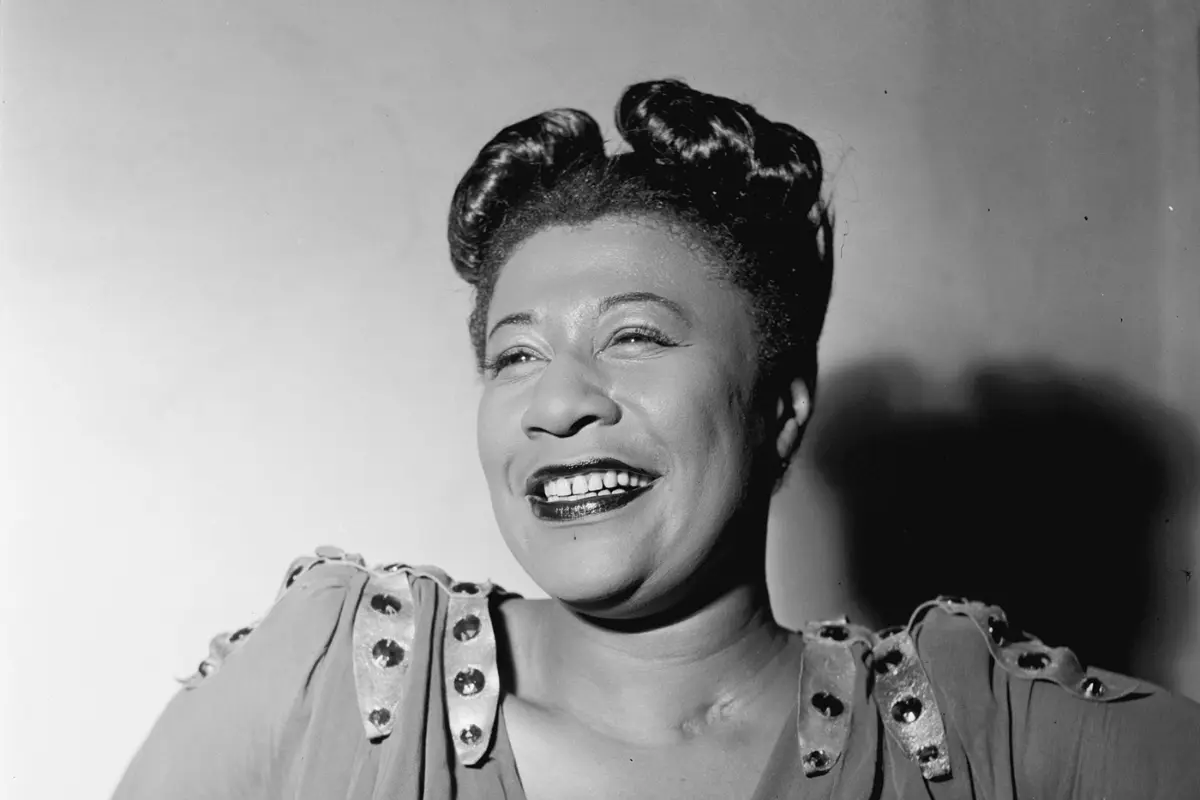
What to listen for (Decca)
- Time feel: she swings even when the material doesn’t deserve it.
- Vowel control: long tones that stay centered and clear.
- Scat phrasing: rhythmic clarity first, virtuosity second.
Period 3: Verve Years (1956-1966) – From Star to Cultural Icon
Verve is where the legend hardens into something like national heritage. Granz formed Verve Records with Fitzgerald as a central force, and the results are the albums people mean when they say “Ella Fitzgerald” with reverence in their voice. This is not nostalgia. It’s peak performance captured in the LP era, with sound quality and sequencing that finally matched her artistry’s scale.
The crown jewels are the Songbook albums, a concept that sounds safe until you realize how radical it was: treating American popular songwriters as canon, and giving a Black jazz vocalist the authority to define that canon for the mass market. It’s also where her interpretive discipline shines. Fitzgerald could be emotionally direct without the torch-singer theatrics. That restraint became its own kind of power.
Live performance in this era proves something else: her technique was not studio magic. The Grammy Hall of Fame recognizes her live “Mack the Knife” performance (recorded in Berlin) as a landmark, and it’s a perfect example of Ella turning a moment of lyrical uncertainty into rhythmic invention and crowd-commanding charm – one of the best-known moments in her live-performance legacy.
“She could take any song and make it swing.” – summary assessment in the NEA Jazz Masters profile of Ella Fitzgerald
Quick Verve guide (start here)
| If you want… | Try… | Why it works |
|---|---|---|
| Pure standards mastery | A Songbook volume | Pitch, diction, and swing as a complete system |
| Stage electricity | Live Verve-era sets | Improvisation, timing, and audience control |
| Jazz muscle | Small-group recordings | She trades ideas, not just melodies |
Period 4: Transitional Years (1967-1973) – When Rock Broke the Map
By the late 1960s, the center of popular music shifted hard toward rock, singer-songwriters, and youth identity. For a mature jazz vocalist, the problem wasn’t ability – it was context. The industry wanted “relevance,” which often meant forcing artists into contemporary arrangements that didn’t fit their natural strengths.
Fitzgerald’s transitional era is fascinating because it shows what happens when a genius refuses to become a costume of herself, but also refuses to retire. Some recordings chase modern textures with mixed results. Others double down on musicianship. The inconsistency is the point: it’s a portrait of an artist navigating a marketplace that had stopped speaking her language.
Here’s the provocative claim: the “awkward” late-60s experimentation is more honest than a spotless legacy. It proves she was still working, still curious, still willing to risk looking uncool rather than freezing herself into a museum exhibit.

Period 5: Pablo Years (1973-1989) – The Late-Career Reclaim
In the early 1970s, Granz launched Pablo Records, and Fitzgerald returned to a setting that suited her best: great jazz musicians, strong standards, and recording projects built around craft rather than trend. Think of Pablo as a late-career home base – not because it made her smaller, but because it let her be direct.
This era also tells a harder truth. Over time, age and health issues affected her voice. The miracle is not that she sounded 25 forever; it’s that even as her instrument changed, her musical intelligence stayed sharp. Late Ella can be more about phrasing choices, tempo control, and storytelling through rhythm than about pristine high notes. That’s a different kind of greatness, and it’s one most pop stars never have to learn.
Major institutions treated her as a living pillar of American music. The Los Angeles Philharmonic’s artist profile, for example, frames her not merely as a jazz singer but as a defining interpreter of the Great American Songbook.
The Five-Period Timeline (at a glance)
| Period | Years | Core sound | Big takeaway |
|---|---|---|---|
| Big Band | 1935-1941 | Swing vocalist with band precision | Fame built on timing and clarity |
| Decca Solo | 1941-1955 | Jazz, pop, novelty, early scat peaks | Genius survives imperfect curation |
| Verve | 1956-1966 | Albums, Songbooks, live landmarks | Icon status through sustained excellence |
| Transitional | 1967-1973 | Label-hopping, modern experiments | Rock era pressures exposed |
| Pablo | 1973-1989 | Standards with top jazz players | Late-career authority over trend |
What musicians can steal from Ella (practical takeaways)
Fitzgerald’s legacy isn’t only “she had a great voice.” It’s a playbook for longevity.
- Rhythm is the real brand. Even when material was lightweight, her time feel made it credible.
- Make technique serve joy. The virtuosity is obvious, but it never reads as homework.
- Build eras, not just releases. Verve worked because it created a coherent identity around her strengths.
- Don’t fear the messy chapter. Transitional periods are where artists either die or evolve.
Conclusion: The Industry Changed. Ella Changed Less.
Ella Fitzgerald’s five periods show a career that kept negotiating power: first with bands, then with labels, then with the very definition of the American standard. If you want the clean myth, live in the Verve years. If you want the full human story of a working musician, follow all five acts and listen to how the same core qualities adapt, resist, and finally endure as summarized in broad biographical overviews of her long career.