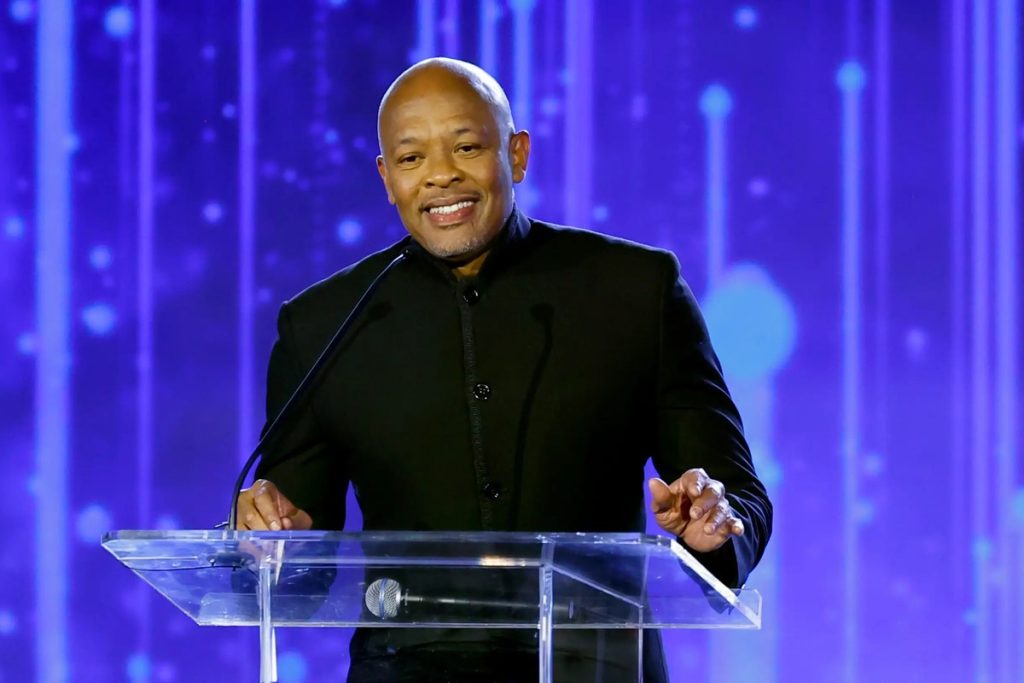
Dr. Dre has told the New York Times that he does not regard artificial intelligence as a threat to music, and that the people who do are simply not very good at making things.
“I think the only people that see it as a threat are the people who have trouble creating,” the producer said in an interview published Sunday alongside his longtime business partner Jimmy Iovine. It is the bluntest position yet from a figure of his stature on a subject that has divided the music business more sharply than anything since file sharing.
The remark landed at the end of a week in which one publisher went to court seeking up to a billion dollars apiece from two AI companies. Dre’s timing was almost certainly accidental. The contrast was still hard to miss.
The drum machine argument
Dre’s defense of the technology rests on a historical comparison that producers of his generation reach for often. He described a recent conversation with people who had objected to AI.
“I had a discussion with a few people a few days ago,” he said. “They were against AI and I’m like, ‘OK, you sound like the person that would have been against the drum machine when it came out.’ Or synthesizers, right? It’s a new tool for creativity. Some people are afraid of learning new things.”
That framing carries real weight coming from Dre specifically. His own catalog was built on machines that were treated as illegitimate when they arrived — samplers, drum machines, and the whole apparatus of West Coast production that critics once dismissed as theft dressed up as craft. He has been on the receiving end of the argument he is now making.
It is also where his critics say the analogy breaks. A drum machine did not need to ingest a hundred thousand copyrighted recordings before it could produce a sound. Generative models do, and that difference — rather than the novelty of the tool — is what the current fight is actually about. Dre did not address the training-data question in the interview.
What Dre is actually using it for
The headlines that followed the interview were more emphatic than the interview itself, and the gap is worth noting. Several outlets, Vice among them, reported that Dre is using AI to make music. What he actually described was narrower: experimenting in the studio, using it “as a tool to see what it would do with what I just did.”
Vice itself noted that it is not clear from his account whether any of that has reached released music, and that the most recent thing Dre said he had asked a chatbot was how to put on muscle and lose fat at the same time. A reader taking the headline at face value would come away with a stronger claim than the quotes support.
Iovine was the one who widened it. “So is Timbaland, another brilliant producer,” he said. “By the way, there’s a lot of closet AI producers out there.”
That is arguably the more consequential line in the whole exchange — an assertion that the practice is already common in professional studios and largely undeclared. Iovine named nobody beyond Timbaland, who went public with a similar position in November 2025, telling fans he understood the fear but intended to adapt anyway. “Of all people, this is my life’s work,” he said. “It probably impacts me the most.”
The industry around them is in court
Whatever Dre thinks of the objectors, the objection is being pressed expensively.
On August 17 the publisher Round Hill Music filed copyright infringement suits against the AI music company Suno and the AI developer Anthropic in the US District Court for the Northern District of California, seeking up to $1 billion from each. Round Hill told Music Business Worldwide that it has no intention of settling either case.
The complaint lists 500 songs the publisher says were scraped without authorization, and states that it expects to amend the filing to cover ten thousand or more. The catalog Round Hill is defending will be familiar to most readers here: the Kinks’ “Lola,” Dio’s “Holy Diver,” Bonnie Tyler’s “Total Eclipse of the Heart,” the Goo Goo Dolls’ “Iris.” The suits also allege the companies used scraping software to bypass copyright protections, which would breach the Digital Millennium Copyright Act.
Anthropic was already defending three music copyright cases before this one, brought by Concord, Universal Music Publishing Group and ABKCO. Suno has settled with Warner Music Group and struck a licensing deal with BMG, which is separately suing Anthropic. None of these companies has conceded the central point, and none of the cases has reached a verdict.
The platforms are moving as well. Apple Music has said it will begin labeling AI-derived songs later this year, following Spotify’s decision to flag suspected AI-generated artist profiles as “AI Personas.” Last month a coalition including the RIAA, the IFPI, the Grammys and SAG-AFTRA called for an industry-wide labeling standard along the lines of existing explicit-content warnings.
Where this leaves the argument
The awkward part of Dre’s position is that it folds two separate objections into one.
Some musicians are afraid of AI because they suspect it will eventually produce work as good as theirs. Many more are angry because their work was used to build it without permission or payment. The first is a question about talent, and Dre’s answer to it is at least arguable — the drum machine really did survive its detractors, and so did the sampler he made his name on.
The second is a question about consent. Calling it a failure of creativity does not engage with it at all.
Dre, named to Forbes’ billionaires list for the first time this year with an estimated net worth of $1 billion, is also insulated from however this resolves in a way that almost none of the people he was describing will be.