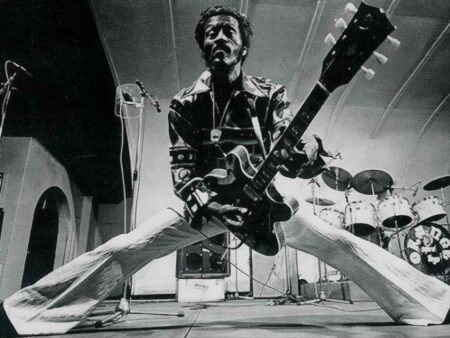
Brian Setzer likes to joke that he picked “the wrong style of music.” In a Goldmine interview he said that if he had gone into heavy metal or hard rock, he might be living on a beach instead of grinding away in a niche scene, yet he also described how rockabilly makes people obsess over the music in a way other genres rarely do.
That contradiction is the hook: rockabilly almost never makes anyone rich, but it turns an alarming number of listeners into lifers. To understand why, you have to look at how Setzer helped drag the style back into the spotlight and what makes this music feel less like a playlist and more like a full-blown addiction.
Brian Setzer and the style that chose him
In 1979 Setzer formed the Stray Cats with Lee Rocker and Slim Jim Phantom in Massapequa, New York, just as disco and new wave dominated radio. Instead of chasing trends, the trio worshipped 1950s rockabilly, relocated to London, and soon scored hits like “Rock This Town” and “Stray Cat Strut,” putting pompadours and slap bass back on the charts on both sides of the Atlantic.
He could have ridden that brief success into some safer flavor of rock. Instead, he spent the next decades doubling down: leading the big-band Brian Setzer Orchestra, then cutting lean trio records that sound like they could have been tracked in a Memphis garage. He behaves like a man who did not choose rockabilly so much as get claimed by it.

What rockabilly actually is
Rockabilly is one of the first styles of rock and roll, born in the early 1950s American South when country players collided with rhythm-and-blues grooves. The very name fuses “rock” with “hillbilly,” and from the start it spawned a distinct subculture that has stubbornly survived long after its initial chart run.
Musically it is brutally stripped down: a twangy hollow-body electric, a slapped upright bass that can replace an entire drum kit, maybe a snare and cymbal, all swimming in slap-back echo. AllMusic describes this setup as creating one of the most propulsive and implicitly sexual grooves white American music had ever produced in the 1950s.
It was also a cultural hand grenade. Writing about the “Rockin’ Bones: 1950s Punk and Rockabilly” box set, Pitchfork called this stuff brash, hedonistic youth music, blasting out of radios while nervous parents wondered what had happened to their obedient kids in the suburbs.
On paper it is simple: three chords, tales of cars and desire, short songs. In practice, that minimalism is merciless. Every note of the solo, every cymbal accent, every slapped bass note is naked in the mix. When a rockabilly band is on fire, you hear the whole engine working; when it is not, there is nowhere to hide.
Why rockabilly breeds obsession, not casual fans
If you need proof, look at Viva Las Vegas Rockabilly Weekend. Billed as the largest rockabilly event on the planet, it pulls more than twenty thousand people to one Las Vegas casino for four days of bands, DJs, burlesque, tiki pool parties, and one of North America’s biggest pre-1960s car shows.
At a typical mainstream festival, the music can fade into background noise between beer runs. At a rockabilly weekender, the soundtrack dictates everything: how people dress, what they drive, how they dance, even what they get tattooed. The details – the correct cuff on jeans, the right echo on a guitar – matter as much as the headliners.
Some fans never take the costume off. Photographer Jennifer Greenburg spent years shooting rockabilly devotees who live in meticulously preserved 1950s-style homes, drive period-correct cars, and dress like it is always 1955, while consciously rejecting the era’s racism and paranoia.
The same intensity pops up far from the American South. In Torremolinos, Spain, the Rockin’ Race Jamboree has grown since the mid-1990s into an international rockabilly festival that brings in thousands of visitors and more than forty bands, giving the town both an economic jolt and a new musical identity.
Multiply that by scenes in Mexico City, Tokyo, Berlin, and beyond, and you get what Setzer is really talking about when he says people become obsessed. In this world, rockabilly is not retro wallpaper. It is a shared language and a way of life.

The “wrong” style versus the beach-house genres
From a careerist angle, Setzer is right to call rockabilly the “wrong” style. Hard rock and metal, which he jokes might have bought him a beach house, produced mega-sellers like Guns N’ Roses’ “Appetite for Destruction”, a record that helped reboot hard rock and went on to become one of the best-selling albums in history.
Rockabilly never had that kind of late-century blockbuster. Even at the height of the Stray Cats’ fame, Setzer was competing with synthesizers and stadium choruses, not peers in his own niche. In a Time Q&A he shrugged that rockabilly remains underappreciated despite its rebel pedigree, but also made it clear that its outsider status is part of the attraction.
Put bluntly: if you want easy money and mass approval, rockabilly is a terrible bet. If you want a tight-knit tribe that will still care about how a guitar sounds forty years from now, it might be the only rational choice.
Getting your own rockabilly fix
Listen like a musician
- Start with the roots: early Elvis, Carl Perkins, Jerry Lee Lewis, Wanda Jackson, Gene Vincent. Then jump to the Stray Cats and Setzer’s later trio records to hear how the language evolved.
- On each track, lock onto the rhythm section first. Hear how the slapped bass and sparse drums create a trampoline for the guitar and vocal.
- Notice the space. Compared with modern rock, classic rockabilly leaves huge gaps between notes. That negative space is where the swing lives.

Steal the sound
- Guitarists: use a clean or slightly breaking-up amp, a hollow-body if you have one, a short slap-back delay, and mostly two- or three-note chord stabs. Keep the right hand moving; the groove matters more than the licks.
- Bassists: think like a drummer. Whether upright or electric, dig in on the root and fifth, mute aggressively, and make every note feel like a kick drum.
- Drummers: strip the kit. Practice whole songs with just kick, snare, and one cymbal. Tiny changes in touch replace flashy fills.
Find the obsessives
Finally, go where this music actually lives. That might be a rockabilly weekender, a vintage car show with a small stage, or a bar night where the DJ plays original 45s instead of streaming playlists. Talk to the lifers and you will hear the same story on repeat: they stumbled into rockabilly, and then it quietly took over their lives.
The right kind of “wrong”
In pure business terms, Brian Setzer probably did choose the wrong style of music. Rockabilly will never rival the streaming numbers of slick pop or arena metal. What it does have is something those genres rarely touch: a community that treats the sound, the gear, and the history as sacred.
That is the real punchline to Setzer’s joke. Rockabilly is not designed to sit politely in the background while you throw a beach ball. It is designed to grab you by the collar, shake you awake, and drag you into its world. For the people who fall for it, there is no such thing as casual fandom.