The last time Miley Cyrus spoke to her godmother, she was telling her about a record. Dolly Parton died on August 25 at the age of 80, and in an Apple Music interview published on September 17, Cyrus told Zane Lowe that their final conversation was her describing the album she had just finished making.
What gives the story its weight is how ordinary the ritual was. Parton, Cyrus said, was always the first person she sent her vinyl to once the records came back from the pressing plant — a habit that had held for as long as Cyrus had been pressing them at all.
“I’m just trying to keep myself together, but the time that we talked, which was the last time we would talk, it was actually me telling her about this record,” Cyrus told Lowe, “because even though we are so different, that’s what made us so perfect for each other.”
Parton died in Nashville after what her publicist, Marcel Pariseau, described as a brief battle with cancer. Her nephew Bryan Seaver, who also ran her security, announced the news to her fans. In the weeks since, flags were lowered to half-staff, the Empire State Building was lit pink on the night of her death, and her family asked that donations go to her Imagination Library rather than flowers.
A family friend before she was a co-star
Parton’s place in Cyrus’s life predates anything either of them did on camera together. She was a close friend of Billy Ray Cyrus long before his daughter was cast in Hannah Montana, the Disney Channel series on which Parton went on to appear as Miley Stewart’s Aunt Dolly. The godmother relationship was real; the on-screen aunt was the joke built on top of it.
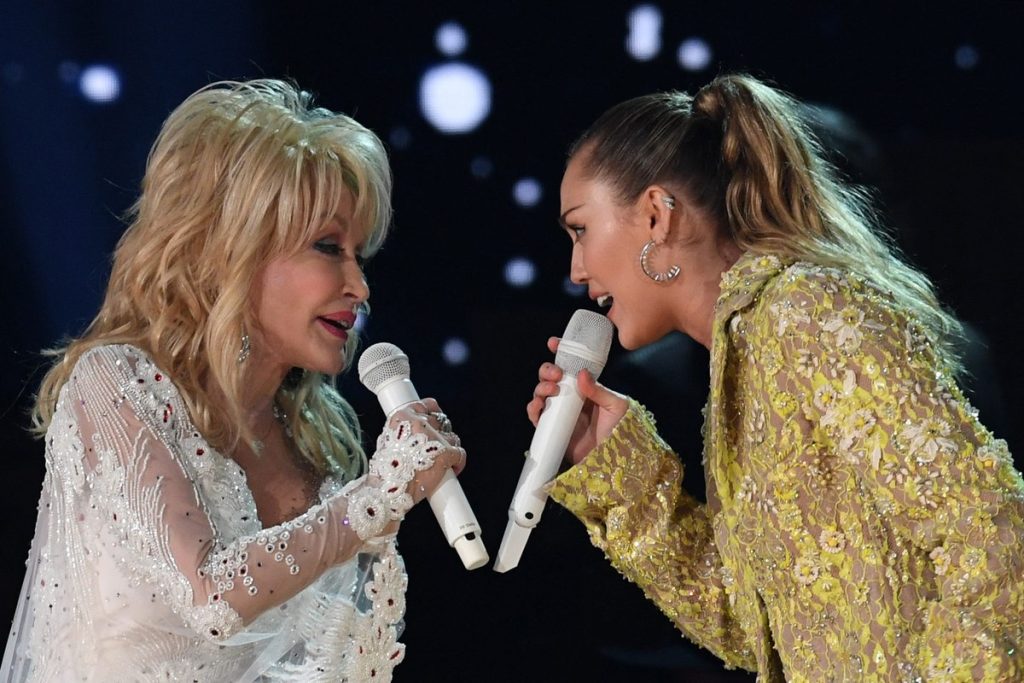
The two kept working together for the better part of two decades. Parton guested on “Rainbowland” from Cyrus’s Younger Now, released her own cover of “Wrecking Ball” in 2023, and later cut a new version of her 1977 song “Light of a Clear Blue Morning” featuring Cyrus alongside Lainey Wilson, Queen Latifah and Reba McEntire.
Billy Ray Cyrus, who turned 65 on the day Parton died, wrote his own tribute recalling the moment in 1992 when he walked into her dressing room to apologize for tabloid stories claiming the two were having an affair. According to him, Parton looked at him, winked, and said: “Honey, this trash sells records.”
The advice about crying on stage
The most revealing passage in the Apple Music conversation is not about grief at all. It is about Parton telling her goddaughter to pull herself together.
Cyrus recalled performing “End of the World” on David Letterman’s Netflix series in June 2024 and breaking down partway through. Parton watched it and rang her. “‘What are you crying about?'” Cyrus quoted her as saying. “Like, that song’s about the world ending and me never seeing my mom again.”
When Lowe suggested the note was essentially be professional, Cyrus agreed. “That’s pretty much what she said. She was like, ‘Music is escapism. Let them cry. You need to get through it.’ And I was like, I know, but this is who I am, and she loved me for it.”
The same conversation produced Cyrus’s explanation of why the two of them worked despite the obvious differences in how they present themselves. “Sometimes I call what I do drag,” she said, “because the way that I present myself is just someone that is so different from the person that feeds the tortoise every morning.” Parton, she argued, was the proof that a performer can build a persona without losing the person underneath it. “So much of my life was about persona. And I think a way that I could look at that as you can have a persona and still be who you are is because I had Dolly.”
Cyrus also described Parton talking her into returning to the Grammy stage during a period when she felt unable to. Parton picked her up in Nashville herself, which Cyrus said never happens, and told her to get her hair teased and find a dress she loved. “You’re gonna forget for that moment and you’re gonna step into your Hannah Montana, your Dolly Parton,” Cyrus quoted her as saying.
“She was always right”
The line that has travelled furthest from the interview is the plainest one in it. Cyrus described the particular loneliness of outliving the people you call for advice.
“So many of my really stabilizing peers that I have in my life are from generations before me,” she said. “And they’ve laid down, brick-by-brick, the road that I travel now. And they aren’t always going to be here for me to call them and say, ‘What do I do now?’ Which I always did with Dolly.”
Then: “And she was always right. It’s like how your mom’s like always right, and when you’re a kid, you’re like, what does she know? And then as you get older, you’re like, everything.”
It echoes what Cyrus wrote on Instagram the morning after Parton’s death, when she said their most sacred moments were private and would stay “behind the stage, beneath the glamour and between our hearts.” In that post she noted that one of their last conversations had been about music and metamorphosis — a description that sits slightly differently now that she has said plainly what the final one was actually about.
Parton’s public presence has not quite ended. A pre-recorded video message from her surfaced this week, accepting a lifetime achievement honor from the Americana Music Association that she did not live to collect in person. Her sister Stella, meanwhile, has asked for more compassion online after what she called snarky posts and AI-generated material circulating since the death.