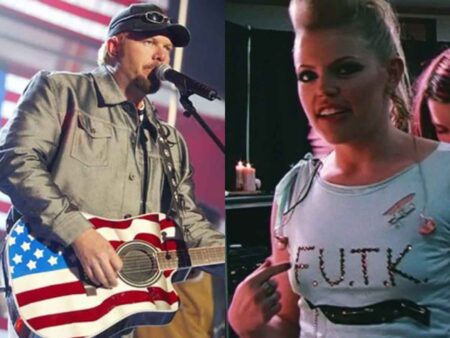
Country music loves its myths: the truck, the bar, the big break, the bigger ego. But the most reliable myth is the one nobody wants to romanticize because it sounds ordinary: partnership. In the story of Toby Keith and his wife, Tricia Lucus, the fireworks are real – but the real heat comes from the steady burn of a marriage that survived the pre-fame grind, the ruthless math of touring, and the long, private slog of cancer.
Keith was a hit-making machine and a headline magnet, but Tricia’s role is the part that actually explains the whole arc. Not as a “woman behind the man” cliche – more like the person who kept the dream from becoming an expensive hobby.
How it started: an Oklahoma nightclub, not a Nashville pipeline
Toby Keith (born Toby Keith Covel) met Tricia Lucus at a nightclub in Oklahoma in 1981, long before the label meetings, the tour buses, or the internet hot takes. Their early relationship is the kind that rarely makes it into artist branding because it’s not glamorous – it’s local, working-class, and practical.
They married in 1984, years before his debut album and nearly a decade before his breakout. That timing matters because it means Tricia didn’t marry “Toby Keith the star.” She married the guy with a day job, a guitar habit, and a plan that was nowhere near guaranteed to pay off.
The unsexy truth: security is what buys you creative risk
In the early years, Keith worked outside music (including oilfield work, as often reported), and the couple built a family while the music dream simmered. Those years are where a lot of “future legends” quietly fold – not because they lack talent, but because they lack runway.
Here’s the provocative part: many music careers don’t fail from lack of ability – they fail from household economics. Rent, diapers, car repairs, medical bills – they don’t care that you wrote a great chorus. Tricia’s reputation as careful and steady during the lean period is a big reason Keith even got to stay in the game long enough to become “Toby Keith.”

Family grew while the clock ticked
Toby and Tricia raised three children, including Shelley (Tricia’s daughter whom Toby adopted), Krystal, and Stelen. The timeline is important: the family was already real life and real responsibility when the record deal finally showed up. Basic biographical details about Keith’s life, career arc, and family are widely documented.
Breakthrough didn’t happen early – and that’s the point
Toby Keith’s debut album arrived in the early 1990s, and his breakthrough single “Should’ve Been a Cowboy” made him a star. That long runway is a reminder that “overnight success” often comes after years of nobody clapping.
Once success hits, the pressure changes form. Instead of “Can we afford this?” it becomes “Can we survive this?” and that’s where many couples crack – especially in a business built on attention, temptation, and ego.
Tricia’s behind-the-scenes job: stability in a chaos industry
Tricia Lucus largely stayed out of the spotlight as Keith’s career exploded. That wasn’t a lack of influence; it was a strategy. In celebrity marriages, being public can become a second job, and it’s a job with zero health insurance.
Multiple mainstream profiles note that she focused on home life and keeping the family grounded while Keith became one of country’s biggest commercial forces.
Why “staying private” can be the power move
- It protects the kids from becoming part of the brand.
- It limits the gossip economy that feeds on marriages under pressure.
- It keeps the relationship from being monetized, which is where resentment grows.
In other words, Tricia didn’t build a public persona – she built a life that could hold up a public persona.
The quote that says it all: “go get a real job”
Keith himself credited Tricia for helping him stick with music when others told her to push him into a safer path. In one often-circulated interview clip, he described people telling her, “You need to go tell your old man to get a real job,” and praised her for believing he was good enough to take the shot.
“Dozens of people told Tricia, ‘You need to go tell your old man to get a real job.’ … It took a strong-hearted and loving woman to say, ‘He’s good enough at music that I’ve got to let him try.’”
Toby Keith, as recounted in national entertainment coverage
That quote lands because it’s not romantic fluff. It’s about permission – not in a controlling sense, but in the realistic sense that family decisions are negotiated. When one partner says “keep going,” they’re also saying, “I’ll carry more for a while.”
From hitmaker to businessman: the empire wasn’t just songs
Toby Keith’s public image often centered on swagger, humor, and patriotism. But the business side is what turned superstardom into generational wealth: touring leverage, publishing, brand extensions, and restaurants. Major profiles summarize him as not only a singer-songwriter but also an entrepreneur who built a broader commercial footprint.
It’s tempting to credit “hustle,” but the harsher truth is that empires require someone to keep the personal world from collapsing while the professional world expands. Tricia did that work quietly, and quiet work is easy to undervalue because it doesn’t come with trophies.
A quick reality check: fame multiplies stress, not happiness
| Before fame | After fame |
|---|---|
| Money is tight | Time becomes tight |
| Dream is uncertain | Privacy is uncertain |
| Small circle of opinions | Millions of opinions |
| Local temptations | Global temptations |
If a marriage survives both columns, it’s not luck. It’s design.
Philanthropy and purpose: doing good at scale is still logistics
Keith’s charitable work became part of his legacy, including high-profile efforts tied to children and cancer causes. The part that gets missed is that philanthropy isn’t just writing checks – it’s relationships, planning, and follow-through.
One of the best-known examples is the OK Kids Korral, a program connected to families of pediatric cancer patients in Oklahoma. The organization’s own materials describe its mission to support children with cancer and their families.
While public narratives typically spotlight the artist, sustained philanthropy usually relies on family infrastructure, trusted advisors, and people willing to do the unglamorous coordination. Tricia’s behind-the-scenes steadiness fits that pattern.
Cancer, endurance, and the last chapter
In 2022, Toby Keith publicly shared that he had been diagnosed with stomach cancer, bringing a private battle into the open.
He died in February 2024 at age 62, after what many reports described as a multi-year fight with cancer. His death and career impact were covered extensively in national obituaries.
What “stomach cancer” means in plain terms
Stomach cancer (also called gastric cancer) can be difficult to detect early, and treatment may involve combinations of surgery, chemotherapy, radiation, targeted therapy, or immunotherapy depending on the case.
It’s worth saying carefully: we don’t need to know every medical detail to understand the human reality. Long illness turns marriage into a daily practice of patience – and it often reveals who the real grown-up in the room has been all along.

So what did Tricia actually “do” for his success?
People want a single heroic action, a movie moment, a signature sacrifice. Real marriages rarely work that way. What Tricia appears to have provided is something more powerful and less cinematic: an environment where long odds were survivable.
The Tricia blueprint (useful even if you’re not married to a star)
- She protected the runway – budgeting, stability, patience.
- She held the line on family normalcy when “normal” disappeared.
- She resisted the spotlight trap and kept the relationship less performative.
- She backed the risk when outsiders demanded security.
And yes, this is where the edgy claim lands: country music sells independence, but many careers are built on interdependence. Toby Keith’s persona was a big, loud, self-made story. The marriage underneath it was the quieter story that made the loud one possible.
Conclusion: the greatest “supporting role” is often the main engine
Toby Keith will be remembered for hits, controversy, and undeniable cultural weight. But if you want the practical takeaway, it’s this: talent is common, drive is common, and even luck is more common than we admit – but a steady partner who can endure the boring years and the brutal years is rare.
Tricia Lucus didn’t need a microphone to shape the arc of a superstar. She just needed the courage to keep saying, “Try,” when the safer advice was, “Quit.”