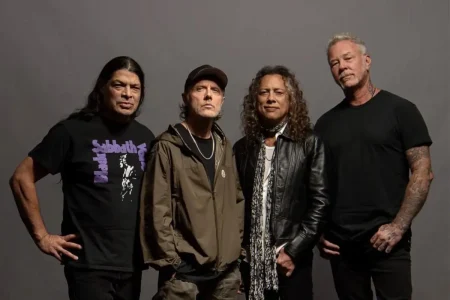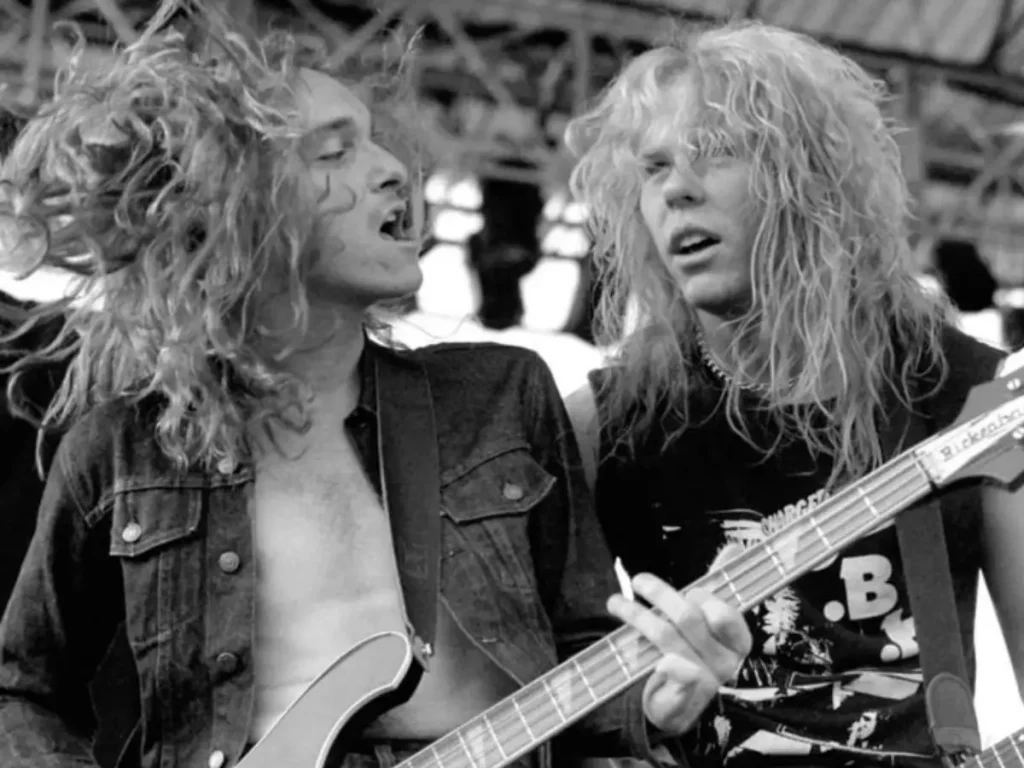
Cliff Burton and James Hetfield never even got four full years together, yet the collision between a quiet, wounded rhythm guitarist and a bell-bottomed bass mystic may be the single most important relationship in Metallica’s history.
For those who grew up wearing out vinyl copies of Ride the Lightning and Master of Puppets, the chemistry between those two is the sound of thrash metal learning to think. It is also a bond cut off so violently that Hetfield still talks about Cliff as if he were in the next room.
Whisky a Go Go: The Night Hetfield Met His Match
The story starts in a smoky Los Angeles club, not in the Bay Area where we like to place Metallica’s origin myth. In 1982, James Hetfield and Lars Ulrich walked into the Whisky a Go Go to check out a San Francisco band called Trauma and watched the red-haired bassist launch into a distorted solo that left them “losing their minds,” as Ulrich later recalled in his memories of Metallica’s lost bass titan.Memories of Metallica‘s lost bass titan Cliff Burton They were supposed to be scouting the scene; instead they discovered the guy who would rewire their band.
That bassist, Cliff Burton, agreed to join Metallica only on the condition that they uproot themselves from LA and relocate to San Francisco, a demand documented in biographical accounts of his life.Cliff Burton It was an outrageous demand for a still-local act, but Hetfield and Ulrich did it, effectively admitting that the stranger on bass had become the new center of gravity.
Cliff the Teacher, James the Student
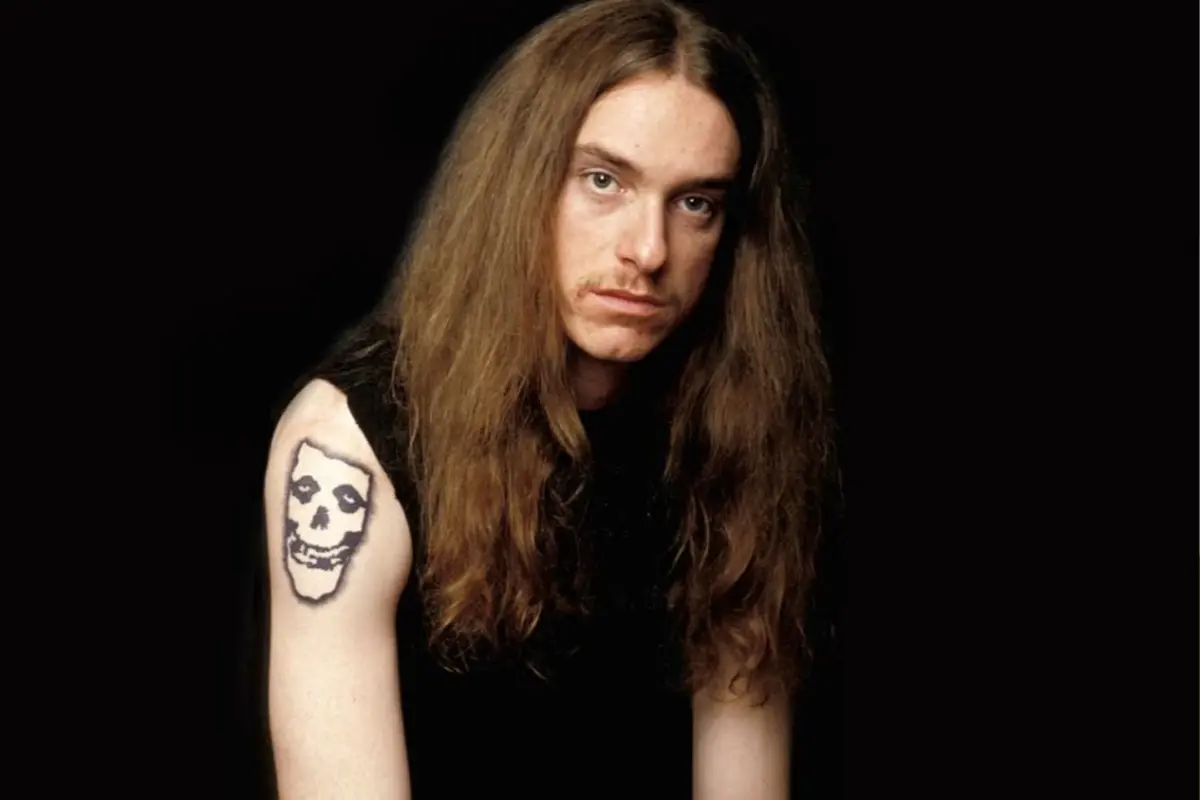
Burton arrived with something no one else in Metallica had: deep formal training and the ability to sketch melodies in his head and write them out without touching an instrument. Spanish-language biographical accounts note that he slowly taught James music theory and even pushed him toward lyrics and poetry, not as a hired gun but as a close friend sharing what he knew.
Lars Ulrich has been blunt about what that meant for him and Hetfield. Looking back, he credited Cliff with exposing “me and James” to a whole new horizon of harmonies and melodies, saying the way he and James still write together was “very much shaped around Cliff’s musical input.” Cliff’s musical input In other words, the Hetfield/Ulrich writing machine that dominates metal history was built around lessons from the bass player.
Rewriting Metallica’s Songbook
On Ride the Lightning, you can practically hear that relationship hardening into a sound. Guitarist Kirk Hammett has described how Burton wrote the harmony section in “Creeping Death,” the harmony in the intro to “Ride the Lightning,” and even the deceptively gentle acoustic intro to “Fight Fire with Fire.” Burton’s influence on Ride the Lightning Hammett says James absorbed Burton’s love of dual guitar harmonies and “made it his thing,” but the seed was Cliff’s.
By Master of Puppets, that seed had grown into epics like “Orion,” where Burton’s bass chords and harmonic sense turn a thrash record into something closer to a dark symphony. Hetfield’s right-hand precision suddenly had a strange, melodic universe to lock into, courtesy of the friend who kept handing him new colors to paint with.Cliff ran the band
- Harmonised guitar lines instead of one-note riffing
- Long-form song structures with classical-style movements
- Lyrics and themes pulled from horror literature and Lovecraft
Those shifts are often credited to “the band” as a whole, but much of that evolution traces back to one relationship: Cliff teaching, James soaking it up.
Opposites Attract: Hippie Mystic vs Wounded Control Freak
Part of what made the Burton-Hetfield axis so volatile is how different the two men looked from the outside. Burton has been described as an odd mix of San Francisco hippie and good-ol-boy redneck, equally into Lou Reed and ZZ Top, LSD and cheap beer.the life and death of the ultimate metalhead He wore out-of-date bell-bottoms, refused to conform and seemed utterly uninterested in anyone’s approval.
Hetfield has joked that Cliff was “not your basic human being” and admits he craved the respect Burton carried so effortlessly.Not your basic human being Where James came from a strict, fractured home and armored himself in leather, downstrokes and booze, Cliff was the guy who could be deeply intellectual and absolutely blunt in the same breath, radiating a kind of unselfconscious authority James did not yet have.
Kirk Hammett later summed up those early days by saying he, James and Lars all came from broken homes and were “a gang of youths just looking for somewhere to belong,” while the most well-adjusted person in the room was Cliff.“We were all basket cases!” In blunt terms, Burton was the adult in a band of damaged kids, and Hetfield gravitated toward that stability even as they all tried to drink each other under the table.
The Crash, the Bottle and Decades of Guilt
In September 1986, that fragile balance ended on a cold Swedish road. Hetfield later described waking in the tour bus’s back lounge, walking out into the freezing dark and seeing his friend crushed under the overturned bus after it supposedly hit black ice.their anger at Cliff Burton’s death He was furious, stalking the road in his underwear looking for ice and accusing the driver of being drunk, because anger was easier than admitting what had just been taken from him.
Management’s solution was simple: keep touring. Years later, Hetfield admitted they drank even more after Cliff’s death, “doubling” the booze to stuff the pain down rather than grieve.He’s here in spirit In rehab, he was finally forced to sit with the fact that he had never properly mourned either his parents or Cliff, and he realised he missed Burton “more as a person than as a musician,” calling him someone who taught James it was okay to be different and stand his ground.
Jason Newsted, who walked straight into that emotional minefield as Burton’s replacement, has said flat-out that he does not think Hetfield will ever fully recover from “the Cliff thing,” tying it to earlier patterns of abandonment in James’s life.will ever recover from losing Cliff Burton That is a brutal insight, but it tracks with what we see: a frontman who turned unresolved grief into fuel and armor, but still talks about his dead friend like a living standard he has to live up to.
In a separate conversation, Newsted recalled joining a band where “everybody was full alcoholic” and emphasised that, in their minds, they had lost their guide and teacher when Cliff died, a point echoed in long-form profiles of Metallica’s enduring genius.The Enduring Metal Genius of Metallica The result was …And Justice for All, a masterpiece whose near-absence of bass and suffocating mix many critics interpret as a monument to both their ambition and their inability to deal with Burton’s loss.album review
Hetfield has even admitted that in the late 80s the band tried to “beat the fan” out of Newsted, effectively taking their unprocessed grief out on the new guy while pretending the hole Burton left could simply be filled with another pair of hands.“I didn’t realise how much I missed Cliff…”
Cliff as Hetfield’s Ghost Collaborator
The dark irony is that Burton may have influenced more of Hetfield’s career after his death than during his life. On Metallica’s own podcast, Hetfield recently said “Cliff still lives in all of us” and described literally asking in the studio, “What would be really cool right here, Cliff?” before challenging himself with the question, “Would Cliff like this?”how the late Cliff Burton still influences Metallica For a man already obsessed with standards and control, turning a dead friend into an internal judge is a heavy move.
The band chose Burton’s largely instrumental epic “Orion” as the music at his funeral, a track he considered his favorite Metallica song and one he had stamped with multiple bass solos and arrangements.the Metallica song played at Cliff Burton’s funeral Later, Hetfield and Ulrich built “To Live Is To Die” on unused riffs Burton had left behind, with James reciting one of Cliff’s favorite bleak quotes about truth and death in the middle section.To Live Is To Die
Critics have called “To Live Is To Die” the emotional Rosetta Stone of …And Justice for All, pointing out that it functions as an outlet for the band’s sublimated grief: a funeral march that blossoms into something grand before collapsing back into silence.emotional Rosetta Stone Listen to James’s dry, almost wooden delivery of Burton’s words and you can hear a man trying to hold himself together while giving the last word to the only bandmate he never really got to argue with.
| Era | Cliff’s place in Hetfield’s world | Key track |
|---|---|---|
| 1982-84 | Teacher and musical compass, dragging Metallica toward harmonies and theory | Ride the Lightning (title track) |
| 1985-86 | Onstage anchor and offstage moral authority in a band of chaos | “Orion” |
| Post-1986 | Invisible co-writer and inner critic living in Hetfield’s head | “To Live Is To Die” |
Would Metallica Be a Different Beast If Cliff Lived?
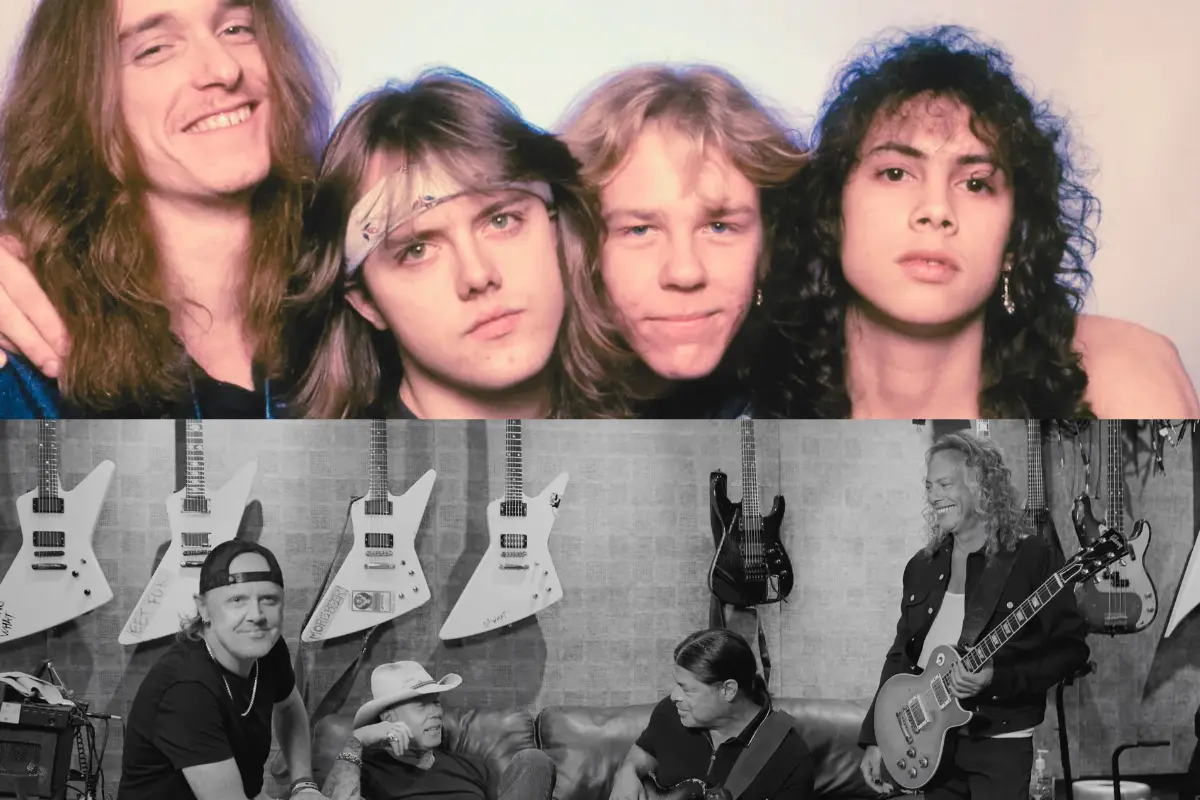
Hetfield has been surprisingly candid about that counterfactual. Asked what Burton would have made of their 90s reinvention, he said there “would have been some resistance,” imagining Cliff pushing for more challenging music and louder bass while standing with James against what he later called the “U2 version” of Metallica: designer clothes, short hair, bloated tracklists and all.what Cliff Burton would have made of Metallica’s 90s era Hetfield is careful to praise the Black Album itself, but he clearly believes Burton would have been an ally against some of the image-driven excess that followed.
It is not hard to picture Cliff refusing makeup and photo shoots, arguing for stranger arrangements instead of radio polish. The edgiest read is that Burton’s death made Metallica both bigger and blander: the trauma supercharged their drive just as it removed the one member most likely to slam the brakes on their march toward mainstream rock respectability.
From Basement Tapes to Global Iconography
Whatever you think of that arc, it is impossible to separate Metallica’s global footprint from the Hetfield-Burton connection that reshaped the band in the first place. By the time hedge fund kids started buying vintage Metallica shirts as fashion pieces, journalists were already pointing out that classic rock merch had shifted from cheap tour souvenirs to high-fashion signifiers, with Metallica logos sitting comfortably next to luxury brands. That kind of cultural saturation rests heavily on the early records Cliff co-wrote and the way he taught James to turn simple riffs into epics.
Profiles of the band now talk about Metallica as a kind of heavy-metal Apple, a global product launch every time they release an album, but the New Yorker piece that made that comparison also quoted Newsted’s line about Cliff being their teacher and guide.Metallica as a kind of heavy-metal Apple Strip away the stadiums, the lawsuits and the luxury merch, and you are left with a simple, almost old-fashioned rock story: a damaged kid met a musician who knew more than he did, learned everything he could, then spent the rest of his life trying not to betray what that friendship awakened in him.
Why Their Bond Still Matters
For older fans who lived through the tape-trading days, that is why the Burton-Hetfield relationship hits harder than any later soap opera inside the band. This was not just a bassist and a frontman; it was the guy who dragged Metallica out of bar-band tunnel vision and the singer-guitarist who turned that education into songs the whole world knows by heart.
Hetfield still checks new riffs against an imaginary nod from a 24-year-old in bell-bottoms. That alone tells you everything you need to know about how deep this bond went, and why, in a very real sense, Cliff Burton and James Hetfield are still writing Metallica songs together.