
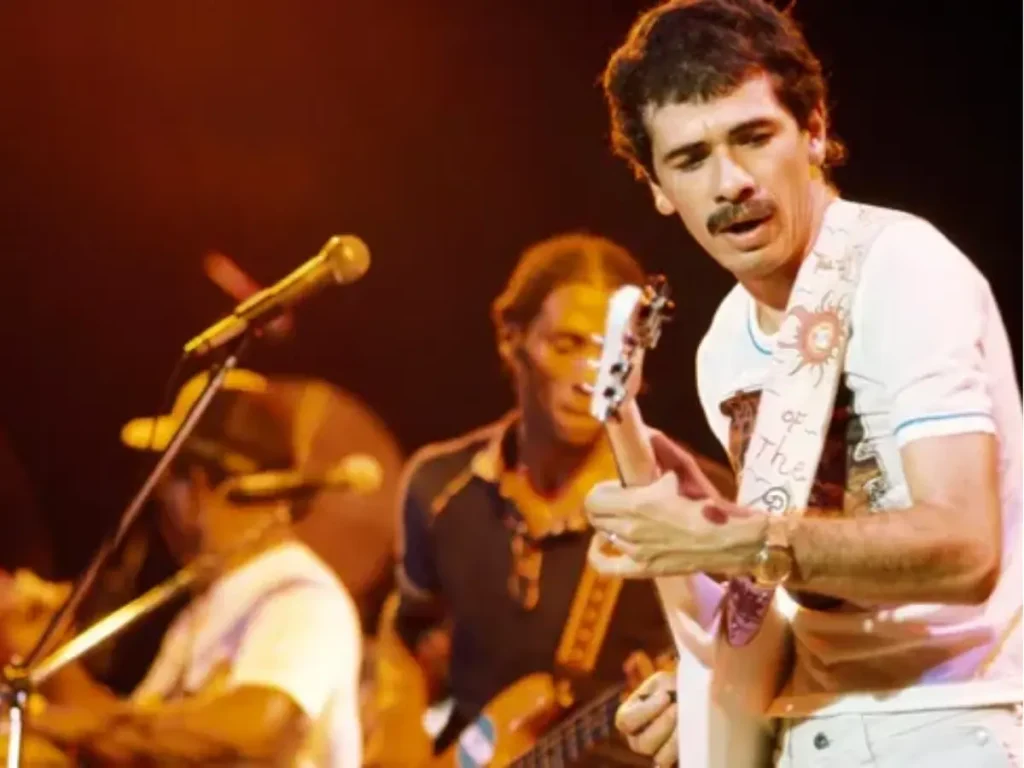
Carlos Santana has never been shy about naming names. In one breath he praises John Lee Hooker, Lightnin’ Hopkins, B.B. King and Little Richard. In the next he calmly says, “Elvis Presley would not” go into his body. For him, the best music is not what you play, but what plays you.
That sounds mystical, but it is really a brutally practical way of sorting music: does your body say yes or no. Once you understand how Santana uses that filter, his entire career – from Abraxas to spiritual jazz to African projects – suddenly snaps into focus.
The Abraxas mindset: stop thinking, let it play you
When Santana talks about the Abraxas period, he describes trying not to think onstage, a lesson he says he absorbed from Miles Davis. In his words, the best nights were when the band was so exhausted and jet-lagged that the mind went blank and the music “played” them instead of the other way around.he absorbed from Miles Davis.
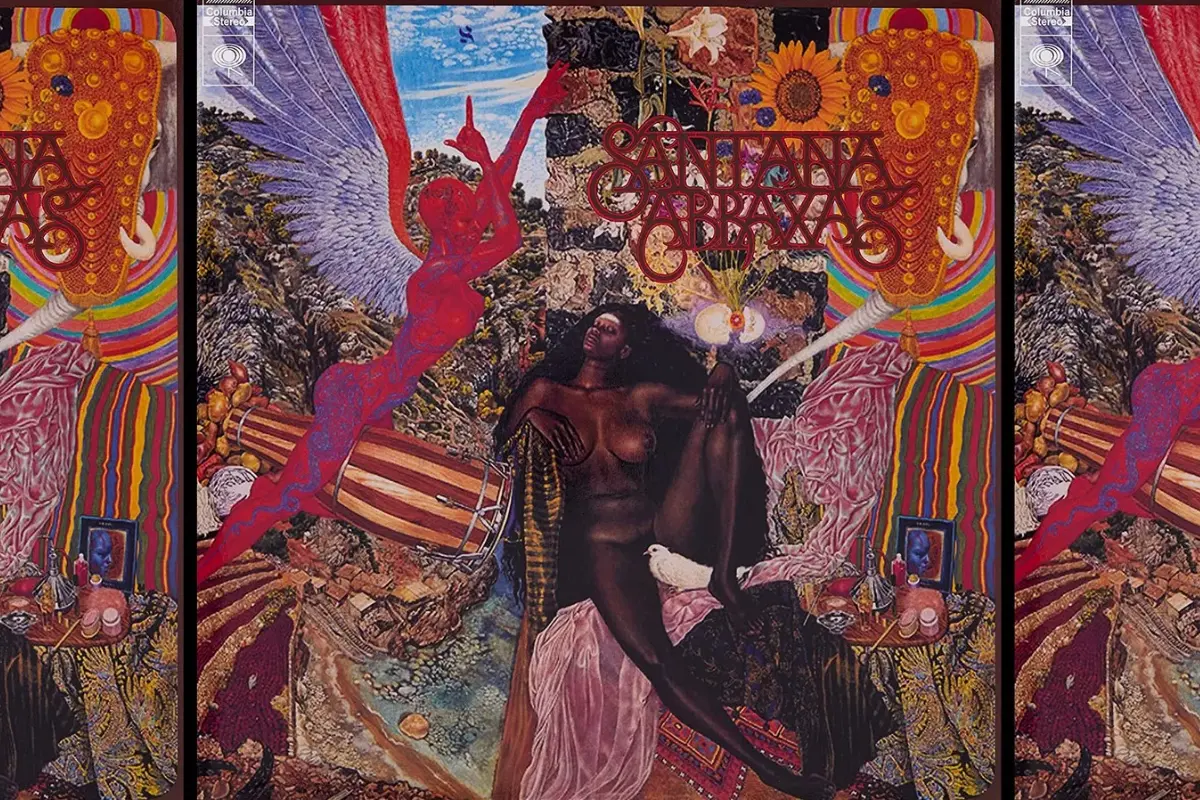
Listen to that record and you can hear why he links it to surrender. Abraxas, the band’s second studio album, takes Latin rock, blues, psychedelic rock and jazz fusion, and melts them into one continuous current. It topped the U.S. album chart and still shows up on lists of the greatest albums because it feels less like a set of songs and more like a weather system rolling over you.
Guitarists hear it in the way “Black Magic Woman” spills into “Gypsy Queen” and in the humid pulse of “Oye Como Va”. Critics have called the album “sacred and sexy” at the same time, noting how its Afro-Cuban rhythms and blues-rock guitar pushed Santana’s sound into new “exotic” territory for mainstream rock audiences.
That is what Santana means by not thinking: you stop micromanaging every bar and instead ride the storm of the groove. The danger is chaos, but the payoff is transcendence.
Becoming a “multi dimensional sponge”
Santana traces that surrender back to his teenage years in the late 1950s and early 1960s. In one interview he says he became a “multi-dimensional sponge” in those years, letting some sounds seep into his body while rejecting others. The test was simple: did the sound feel multi layered and rooted in Africa, or did it feel flat to his nervous system.
The artists that passed the test look like a short history of Black American music: John Lee Hooker, Lightnin’ Hopkins, Jimmy Reed, B.B. King, Little Richard, Chuck Berry. Their records were not just songs to him; they were vitamins, rhythmic nutrients.
To make sense of his comments, it helps to see who his body said yes to and who it quietly pushed away.
| Went “into” Santana’s body | Did not go in |
|---|---|
| John Lee Hooker – raw boogie, deep shuffle blues | Elvis Presley – early rock and roll filtered through country |
| Lightnin’ Hopkins, Jimmy Reed – hypnotic repeated riffs | Certain Nashville and pop sounds of the era |
| B.B. King – vocal, singing guitar lines | Anything he felt was rhythmically or emotionally “one dimensional” |
| Little Richard, Chuck Berry – feral, piano and guitar driven rock | Music that smoothed the edges off Black rhythm and blues |
He is careful to say it is not about the color of the performer, but about the sound. If it did not feel “multi dimensional via Africa” his body simply spat it out. This is not politeness; it is a musician trusting his nervous system as quality control.
So what about Elvis?
For many listeners, Elvis is the doorway into rock and roll. Santana’s claim that “Elvis would not” go into his body sounds almost sacrilegious. But listen closely and you realize he is attacking a particular aspect of the sound, not the man.
Early Elvis is a fusion of Black rhythm and blues with country balladry and white gospel. The rhythm guitar often sits squarely on the backbeat, with drums and bass playing a relatively straight pattern. For Santana, raised on Afro-Latin percussion and blues shuffles, that kind of beat can feel like a photograph of rhythm instead of the living thing.
Contrast that with the Cuban and Afro-Colombian grooves that underpin modern Latin pop. A track like “Despacito” works even on non Spanish speakers because the cumbia influenced rhythm in the drums and guitar hits your hips before your brain clocks the lyric. That is the kind of multidimensional, body first time feel Santana is talking about.
It is also why he can say in the same breath that he loves Willie Nelson, Merle Haggard and Chris Stapleton, yet still finds that certain Nashville flavors never quite register in his cells. Nelson’s own relationship with his scarred, nylon string guitar Trigger is a great example of country music at its most rhythmically alive and personal, more borderless than Nashville polish.
Miles Davis and the discipline of not thinking
None of this happened in a vacuum. Santana has often credited Miles Davis and John Coltrane with pulling him deeper into jazz harmony and open ended improvisation. Drummer Michael Shrieve fed him Coltrane and Miles records in the early 1970s, nudging the band toward the drifting, spiritual jazz textures of Caravanserai and beyond.
Miles’ famous instruction to “play what is not there” was not about being clever; it was about stripping away cliché. His later quintets ran on “controlled freedom” where players obeyed the form just enough to keep the ship afloat while improvising dangerously at the edges.“controlled freedom” Santana heard in that approach permission to leave more space and to let the rhythm section lead.
Decades later he would double down on his African orientation, recording a project explicitly built on “nothing but African music” in marathon sessions that yielded dozens of tracks in a matter of days. To him, Africa is not a marketing word; it is a description of the rhythmic and spiritual source he wants every note to point back to.

What this means for how we listen
Santana’s comments sound ruthless, but they are a useful antidote to the bland idea that we should like everything. If your body never rejects a record, you might not be listening closely enough.
For listeners raised on 1950s to 1990s music, that can mean giving yourself permission to say: “I respect Elvis, but these Lightnin’ Hopkins records do something to my spine that his never did.” Or the reverse. The point is not to follow the canon, but to notice which artists hijack your breathing, your shoulders, your gait.
It also means not confusing complexity with depth. Led Zeppelin’s “Black Dog” is famously knotty, with riffs that slip in and out of expected meter, yet the band still makes the groove swagger so hard that your head moves even while your brain counts. That is music that plays you and challenges you at the same time.
What this means for how we play
For musicians, Santana’s philosophy is even more radical. It suggests that the highest technical goal is to become empty headed on command, without losing control of your hands.
In practice, that looks like this:
- Over prepare in private, under think in public. Learn scales, chord changes and licks slowly, with a metronome. Onstage or in the studio, stop chasing licks and chase tone and time instead.
- Let the drummer and bass player own your body. If you cannot physically relax and sway with the rhythm section, your solos will never escape the cage of your own ideas.
- Limit your options. Put on a vamp in D minor, allow yourself only three or four notes, and see how much feeling you can squeeze out by changing rhythm, attack and dynamics.
- Record your “blank” takes. Play after a long day, when you are tired and slightly fed up. Often those takes feel more honest precisely because your ego is too worn out to show off.
Santana once described his own band as a “mutt” rather than a purebred, arguing that being a slave to tradition leads to rubber stamped music.”mutt” rather than a purebred Letting the music play you is how you avoid that trap; you stop trying to sound like a category and start following what your nervous system demands.
Letting music choose you in the streaming age
In a world where algorithms shove thousands of songs at you each week, Santana’s filter is refreshingly savage. If a track does not change your breathing within thirty seconds, skip it. If another one makes time disappear, put it on repeat and ask why.
Maybe it is the way the congas argue with the snare, or the way the singer bends into a note late. Maybe, as with so many great Latin and soul records, it is that faint sense of danger that the band might fly apart at any second. Whatever it is, notice it. Then go hunting for more of that, not more of what the playlist tells you was “also liked.”
Santana’s harshest line is not about Elvis at all. It is about his own responsibility: if the sound is not what he needs, his body will not allow it. That is not snobbery; it is a vow to protect the channel between groove and spirit from anything that dulls it.
Conclusion: your body is the real critic
When Carlos Santana says the best music is the one that plays you, he is not being poetic. He is describing a concrete test that has shaped every major decision of his musical life, from which heroes he copied to which legends he quietly left on the shelf.
You do not have to share his verdict on Elvis to adopt his method. Pay ruthless attention to which records rearrange your posture, your pulse, your sense of time. Let those be your teachers, regardless of era or genre. The rest can fall away without apology.
In the end, the music that matters most is not the song you can explain, but the one your body refuses to forget.


