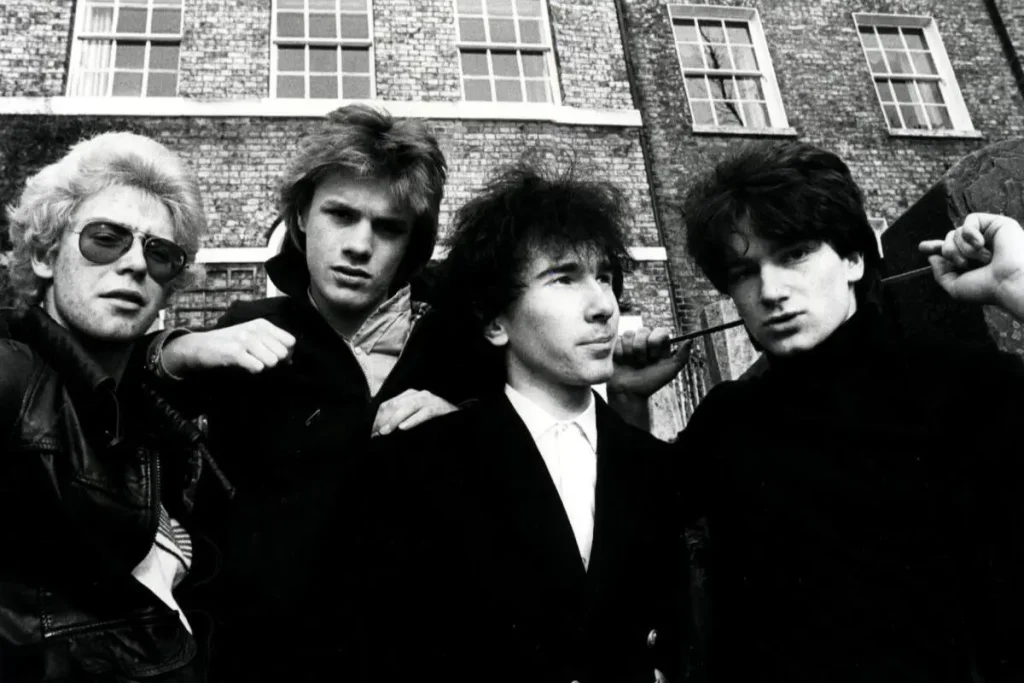
Most bands almost break up because of money, ego, or the drummer dating the singer’s ex. U2 very nearly broke up because of God.
In the band’s early Dublin years (roughly 1979-1981), Bono, The Edge, and Larry Mullen Jr. were involved with a Christian fellowship commonly referred to by fans and writers as “Shalom.” The spiritual intensity was real – and so was the suspicion that rock music was a spiritual trap.
“We were being told that rock and roll was of the devil.”
Bono, quoted in U2 by U2
This is the forgotten hinge point in the U2 story: the moment where they had to decide if the band was a temptation to escape or a calling to commit to. The choice they made did not just keep U2 alive – it shaped the band’s unusual relationship with faith for decades to come.
The Shalom Years: Dublin, Post-Punk, and a Very Serious Fellowship
Late-70s Dublin was not a glamorous launchpad. Punk and post-punk provided a permission slip for kids with more urgency than chops, but it did not solve the band’s private questions about purpose.
Shalom (as it is often labeled in U2 lore) was part of a wider current of charismatic, Bible-centered Christianity that appealed to young people looking for certainty. It offered community, rules, and a clean line between “holy” and “worldly.” That line ran straight through loud clubs and distorted guitars.
For U2, the tension was extra sharp because the band was not playing in a vacuum. Their earliest breakthrough material already carried a moral seriousness that made them stand out in a scene that often prized sneer over sincerity.
“Is This Compatible?”: The Crisis That Made U2 Consider Quitting
Accounts vary in detail, but the core story stays consistent across band histories: the spiritual demands of their fellowship clashed with the reality of being a young rock band. Rehearsals, gigs, travel, and the general nightlife orbit looked like spiritual compromise.
Within that context, the band (or at least key members) seriously asked whether continuing as U2 was compatible with faith. That is not a metaphorical “we had doubts” kind of moment – it was an actual fork in the road, where stepping away from the band felt like the “obedient” option.
Even their earliest recordings sit right on top of this conflict, which is why they feel unusually charged: the songs are not “about” belief in a tidy way. They sound like someone arguing with themselves at full volume.
The Re-Frame That Saved the Band: Music as Vocation, Not Vice
The most interesting part is what did not happen. U2 did not rebrand as a Christian rock act. They did not write altar-call choruses or retreat into safe messaging. Instead, they re-framed the band as a kind of vocation: a place to work out faith honestly, in public, without pretending to have the answers.
That decision created a template U2 would keep using: spiritual language, biblical imagery, and moral urgency – but delivered with ambiguity, doubt, and human mess. It is not “church music.” It is what faith sounds like when it has to live in the real world.
“I still haven’t found what I’m looking for.”
Bono (song lyric), as documented in official U2 discography references
That posture – yearning rather than triumph – is why U2’s spiritual songs can land with believers and skeptics alike.
How the Crisis Shows Up in the Music (Without Turning into Sermons)
If you want to hear the Shalom-era tension without reading a single biography, cue up the early run from Boy (1980) through October (1981). The sound is youthful, but the themes are heavy: innocence, loss, conscience, and transcendence.
“Gloria”: Latin, Psalms, and a Rock Song That Refuses to Behave
“Gloria” is the obvious headline because it is audacious: a post-punk band chanting Latin praise inside a song that still sweats and swings. The title and chorus nod to Christian liturgy, but the verses feel like obsession, longing, and disorientation rather than religious certainty.
U2 historians have long pointed out the track’s biblical echoes, including its connection to Psalms-inspired imagery, as part of the band’s early habit of using scripture as poetic vocabulary rather than as a doctrinal statement.
Even the way the song is built matters: it is not a “message” with a neat conclusion. It is a collision – faith vocabulary strapped to loud guitars, played like it might fall apart mid-chorus.
“October”: Quiet Faith in a Loud Band
The October album has a reputation: beloved by deep fans, often misunderstood by casual listeners, and occasionally dismissed as U2’s “religious” record. That label is too simple, because the album’s spirituality is not marketing – it is a diary.
Look at the track “October” itself: short, reflective, almost hymnal in mood. It is the sound of a band trying to keep its inner life intact while the outer life accelerates in the song’s recording-era context.
The record is not preachy. If anything, it documents the cost of taking belief seriously when you are also trying to become a professional band.
“40”: When a Gig Ends Like a Prayer
By 1983, “40” became famous for closing concerts with a communal singalong, often with the band leaving the stage while the audience kept singing. The lyric is adapted from Psalm language, which makes the ending feel less like a rock finale and more like a benediction rooted in U2’s documented faith-inflected identity.
This is one of U2’s key moves: bring ancient spiritual texts into a modern crowd setting, without demanding anyone sign a statement of belief at the door.
Why U2 Didn’t Become a “Christian Band” (and Why That Was the Point)
Here is a provocative claim that holds up: U2 survived the Shalom crisis because they refused to turn faith into a product. Many artists who lean religious either sanitize the art to fit church expectations or weaponize religion for controversy. U2 attempted a third way: spiritual honesty that could withstand rock’s volume and scrutiny.
That choice created friction from both sides. Secular rock culture tends to distrust belief as naivety or control. Religious subcultures often distrust rock as corrupting. U2 sat in the uncomfortable middle, which is exactly where their best early work lives.
Quick Listener’s Guide: Hear the Tension, Track by Track
| Song | Album / Era | What to Listen For |
|---|---|---|
| “I Will Follow” | Boy (1980) | Urgency and devotion language that can read as relational or spiritual in the band’s early-career overview. |
| “Gloria” | October (1981) | Liturgy meets post-punk drive; faith as desire, not arrival. |
| “October” | October (1981) | Intimacy and restraint; the band’s quiet side under pressure. |
| “Into the Heart” | Boy (1980) | Childhood and innocence themes that match the era’s spiritual seriousness. |
| “40” | War (1983) | Psalm-derived lyric and the famous “walk-off” concert ending ritual. |
What’s Credible, What’s Myth: Sorting the Shalom Story
Because U2’s early religious tension has been retold for decades, it attracts exaggeration. Two grounding points help keep it factual.
First, primary band accounts matter most. The band’s own recollections (especially when consistent across members) confirm the seriousness of the conflict and the sense that some believers around them viewed rock as spiritually dangerous.
Second, careful U2-focused reference sites have documented the period’s recordings and context, including material associated with those years, without turning it into folklore.
So What Changed After 1981?
U2 did not “leave faith behind.” What shifted was the band’s theology of work: music was no longer automatically suspect. It could be a vehicle for truth-telling, solidarity, and even worship, as long as it stayed honest.
That helps explain why U2’s later spiritual moments often show up inside songs about politics, grief, or violence. The band learned early that faith does not get its own sealed-off category; it leaks into everything.
It also explains why U2 could write songs that feel devotional without joining the Christian music industry. Their audience was the world, not a subculture.
Conclusion: The Almost-Breakup That Became the Blueprint
U2’s near-implosion over religion is not just a quirky origin story. It is the engine behind their early intensity and their long-term identity: a band willing to chase transcendence in the same breath as doubt, noise, and desire.
If you want a shorthand for the outcome, it is this: U2 did not choose between God and rock. They gambled that rock could be part of the conversation – and then they spent the next decades proving that gamble was worth it.