Bruce Springsteen’s fifth studio album, The River, arrived like a two-disc argument with itself: one side grabbing you by the collar, the other quietly breaking your heart. Released as a double LP, it marked a pivotal moment where Springsteen stopped writing only about escape and started writing about what happens after you don’t get out.
In popular memory, The River is the album of “Hungry Heart,” the first time The Boss cracked the US Top 10 singles chart and sounded like he might actually enjoy it. But the deeper story is messier and much more interesting: The River is the sound of a band trying to play in a studio without sanding off the splinters.
“I wanted a record that sounded like our live show.”
– Bruce Springsteen
From “bottle the live show” to “let the contradictions in”
Springsteen had already become a live phenomenon by the late 1970s, but translating that stage electricity into a controlled studio environment is notoriously hard. The loud, communal thing that makes a concert feel alive often disappears under headphones, click tracks, and the fear of making mistakes.
The River is Springsteen deciding that the “mistakes” might be the point. In Classic Rock writer Henry Yates’ framing, it began as a mission to “put more trash in our sound,” and you can hear that impulse in the record’s stomp-and-shout moments. Even when you can tell it’s carefully arranged, it pretends to be barely held together.
The split-personality double album (and why that’s the feature, not the bug)
Single albums can be tidy. Double albums can be indulgent. The River is neither tidy nor purely indulgent; it’s a deliberate act of emotional whiplash that mirrors adult life. You get a party, then a hangover. You get the wedding, then the bills.
Disc 1: a band that kicks in the door
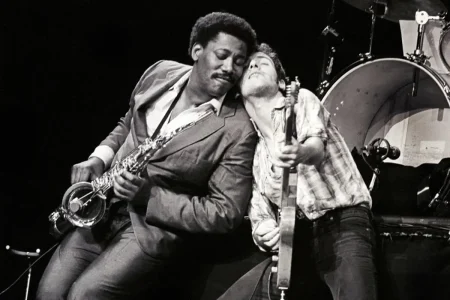
On the raunchier cuts, the E Street Band sound like they’re playing a bar, not a studio. The grooves are big-boot simple, the guitars are blunt instruments, and the saxophone is basically a second lead vocalist.
That’s where the “bar-room thunderers” live: “Cadillac Ranch,” “Ramrod,” and friends. They’re exciting, sometimes unsubtle, and that’s the charm. A lot of rock records try to convince you they’re dangerous; these tracks don’t try very hard because they don’t have to.
Disc 2: the reckoning
Then the album turns and shows its teeth. “Point Blank” is a standout example: a sad-eyed, jazz-leaning sweep where the rhythm feels like it’s moving through fog. It’s not merely “slow,” it’s narrative, like the song is walking you room to room through a relationship that’s coming apart.
This tension is what makes The River last. Plenty of Springsteen’s earlier work is about the romance of leaving. The River is about the consequences of staying, and the consequences of leaving too late.

Track types: what The River is actually made of
Instead of ranking songs (a trap), it’s more useful to understand the album as a toolkit of moods. Here’s a practical way to “hear” The River in categories, especially if you’re revisiting it after years away.
| Type of song | What it’s doing | Examples |
|---|---|---|
| Bar-band blowouts | Turns the E Street show into a three-minute shove | “Cadillac Ranch,” “Ramrod” |
| Pop with grit | Hooks big enough for radio, but still bruised around the edges | “Hungry Heart” |
| Working-life realism | Marriage, money, and regret, told without hero lighting | “The River” |
| Psychological ballads | Interior scenes, emotional aftermath, slow-motion collapse | “Point Blank” |
“Hungry Heart”: the hit that changed the audience
“Hungry Heart” matters because it’s where Springsteen’s street-level storytelling intersects with a chorus that practically demands mass singalong. It became his first US Top 10 single, and that success reshaped his career trajectory.
There’s also a useful songwriting lesson here: the lyric is restless and morally complicated, but the melody is direct and generous. A useful bit of lore is that “Hungry Heart” was originally written with the Ramones in mind, which helps explain why it moves like punk-pop in a leather jacket.
In the UK, “Hungry Heart” also placed strongly on the singles chart, underlining that this was not just a regional breakout. The chorus didn’t require you to understand New Jersey geography or American manufacturing decline; it just required you to have wanted something you couldn’t justify.
The River (song): the moment Springsteen stops myth-making
The title track is where the album’s “adult turn” becomes unavoidable. The narrator isn’t racing toward the horizon anymore; he’s looking back at the choice points that got him here. Its power is partly technical, too: the melody and chord movement are simple enough to feel inevitable, which is why so many players learn it early.
Even commercial sheet-music listings highlight how widely the song travels beyond rock audiences, into living rooms and lesson studios. That’s a quiet kind of canonization: not just “famous,” but played by ordinary musicians.
Why the double album worked: it’s a map of American emotion
The provocative claim: The River is Springsteen’s most honest album precisely because it refuses to pick a single “serious” tone. People don’t live as one mood. They joke, they flirt, they drink, they spiral, they get up for work anyway.
Some critics have called it messy. They’re not wrong, but they’re missing the point. The mess is the thesis: a life can be loud and fun and still end up cornering you at 2 a.m. with the truth.
Studio craft: making “togetherness” sound real
Rock fans love to talk about “raw” records as if raw means “accidental.” In reality, making a band sound like it’s about to fall over without actually falling over is an art. When you hear The River snap from chaos to tightness and back, you’re hearing arrangement choices, performance choices, and production choices acting as one machine.
Contemporary reviews captured that push-pull. The original Rolling Stone review recognized the album’s breadth and its attempt to present multiple sides of Springsteen’s writing and bandleading. Whether you agree with the verdict, it’s a valuable snapshot of how the record landed when it was new.
Reissues and “the work-in-progress” version of The River
One reason The River keeps generating debate is that its backstory includes alternate shapes: different track lineups, different sequencing, different emphases. That’s not unusual for major albums, but it’s especially relevant here because the released version is already a study in contrast.
Public radio retrospectives have leaned into this, arguing that its sprawl is central to its impact and to how it documents Springsteen’s transition into more complex character writing. If you’ve only ever heard the hits, the deeper cuts can feel like you’re hearing the artist grow in real time.
Listener’s guide: how to hear it like a musician (even if you’re not one)
For Know Your Instrument readers, The River is a masterclass in how arrangement changes meaning. Try this on your next listen:
- Focus on the snare drum. On the rockers, it’s a command; on the ballads, it’s restraint.
- Track the saxophone. Clarence Clemons doesn’t just solo; he comments, like a Greek chorus.
- Listen for ensemble “traffic.” The best moments feel like the band can’t get out of each other’s way, and that’s the illusion of a great live group.
If you want a data-driven angle, setlist archives show how frequently Springsteen has kept The River material in rotation across decades of touring. Longevity on stage is often the harshest test a song can face.
Numbers, context, and the cultural afterglow
Chart history is only part of the story, but it’s still useful context. In the UK, the album’s chart performance is documented in the Official Charts database, reinforcing how globally visible Springsteen became in this era.
Meanwhile, industry trade coverage from the time gives a window into how major releases were framed and marketed in the early 1980s music business. Reading those pages now can be sobering: the “product” language sits right next to art that’s plainly trying to outrun the box it’s sold in.

Conclusion: the album that taught The Boss to contradict himself
The River is the point where Springsteen stops pretending rock is only about freedom and starts admitting it’s also about responsibility, damage, desire, and plain bad timing. It’s raucous, tender, inconsistent, and human.
If you want a neat masterpiece, you’ll find tighter Springsteen records. If you want the one that feels like a life cracking open in stereo, you keep coming back to The River.
For a quick reference on track listing and release details as presented by Springsteen’s official site, start here.