Disclosure: We are a professional review site that receives compensation from the companies whose products we review. The opinions here are our own. As an Amazon Associate we earn from qualifying purchases.
Updated 22 November 2026 · By the KYI Team
Update, November 2026: Epiphone has renamed the Hummingbird Pro. It is now the Hummingbird Studio, with updated electronics, and sells for about $500. We have kept our review of the Pro below for anyone buying one used, noted where the Studio differs, and added the current Hummingbird range and prices.
When you first see the Hummingbird acoustic guitar, you get the feeling that you’ve seen it somewhere before. And you probably had, with the sheer number of celebrated music artists counting the Hummingbird as one of their favorites and using it for composing songs, recording music and performing live. Notable Hummingbird players include Keith Richards, Mick Jagger, Brian May, Chris Cornell, Sheryl Crow, Thom Yorke, Michelle Branch and Noel Gallagher.
Now, there are basically two kinds of Hummingbirds: one made by Gibson and another made by Epiphone. The two companies used to be fierce rivals until Epiphone became a Gibson subsidiary. Epiphone now has a reputation for producing Gibson-quality guitars at a not-so-Gibson price – like the Hummingbird, which was introduced in the ‘60s.
Got the gear sorted? Read Guitar Tricks, reviewed here before you decide how to learn.
Epiphone reintroduced its version of the Gibson Hummingbird in 2012, calling it the Hummingbird Pro. It’s what we reviewed because at less than $400 at the time, it was what most of us could actually afford at the beginning phases of our music career. Epiphone has since replaced it with the Hummingbird Studio, which sells for about $500. Check back again for a review of the Gibson when we’ve scrounged enough money from gigs for it (it can take a while, though).
| Status | The Hummingbird Pro name is discontinued. The same guitar is now sold as the Hummingbird Studio |
| Price | Hummingbird Studio about $500 new (£399 to £449 in the UK). A used Pro is around $350 |
| Top | Solid spruce on both |
| Back and sides | Laminated mahogany on both |
| Scale and nut | 24.75 inches, about 1.69 inches at the nut |
| Electronics | Pro: Shadow ePerformer preamp and NanoFlex pickup. Studio: Fishman Sonitone pickup with Presys VT controls |
| Best for | Players who want the classic Hummingbird look and a plug-in acoustic for about $500 |
| Pick something else if | Sound matters more than looks at this price (a Yamaha is the usual advice), or you want all-solid wood (the dearer Epiphone Hummingbird) |
Gibson dreams aside, we’re not regarding the Hummingbird Pro by Epiphone as a second placer. After all, comparing a high-end Gibson with a pocket-friendly Epiphone is hardly fair. So we’re taking a look at the qualities that make the Epiphone Hummingbird Pro acoustic-electric guitar great on its own. Let’s get started!

Hummingbird Pro vs Hummingbird Studio
The Studio is the Pro under a new name. Gibson’s own site describes it as “previously called Hummingbird Pro”, and the two are more alike than different.
| Hummingbird Pro | Hummingbird Studio | |
|---|---|---|
| Status | Discontinued | Current |
| Top | Solid spruce | Solid spruce |
| Back and sides | Laminated mahogany | Laminated mahogany |
| Fingerboard and bridge | Rosewood | Pau ferro |
| Scale length | 24.75 inches | 24.75 inches |
| Tuners | Grover | Grover Rotomatic |
| Electronics | Shadow ePerformer preamp, NanoFlex pickup | Fishman Sonitone pickup with Presys VT controls |
| Included | Varies by seller | Gig bag |
| Price | Around $350, used | About $500 new |
If you are buying new, the Studio is the one. See the Hummingbird Studio on Amazon. If you find a clean used Pro for well under the Studio’s price, you are getting essentially the same guitar with older electronics.
Specs and Features
The Epiphone Hummingbird Pro went through a number of improvements over the years. The last upgrades to the square-shouldered dreadnought guitar included the Shadow ePerformer preamp and the Shadow NanoFlex pickup system for better performance on and off the stage. The Hummingbird Studio that replaced it uses a Fishman pickup and preamp.
The top of the Epiphone Hummingbird Pro is made of solid spruce while the neck, back and sides sport laminated select mahogany wood. The solid spruce top improves with age – with some proper TLC of course – so you can be sure it sounds as good as it looks.
The neck has a SlimTaper profile with a comfortably playable D shape. This neck profile became famous during the Sixties and is meant to promote speed and reduce fatigue when playing.
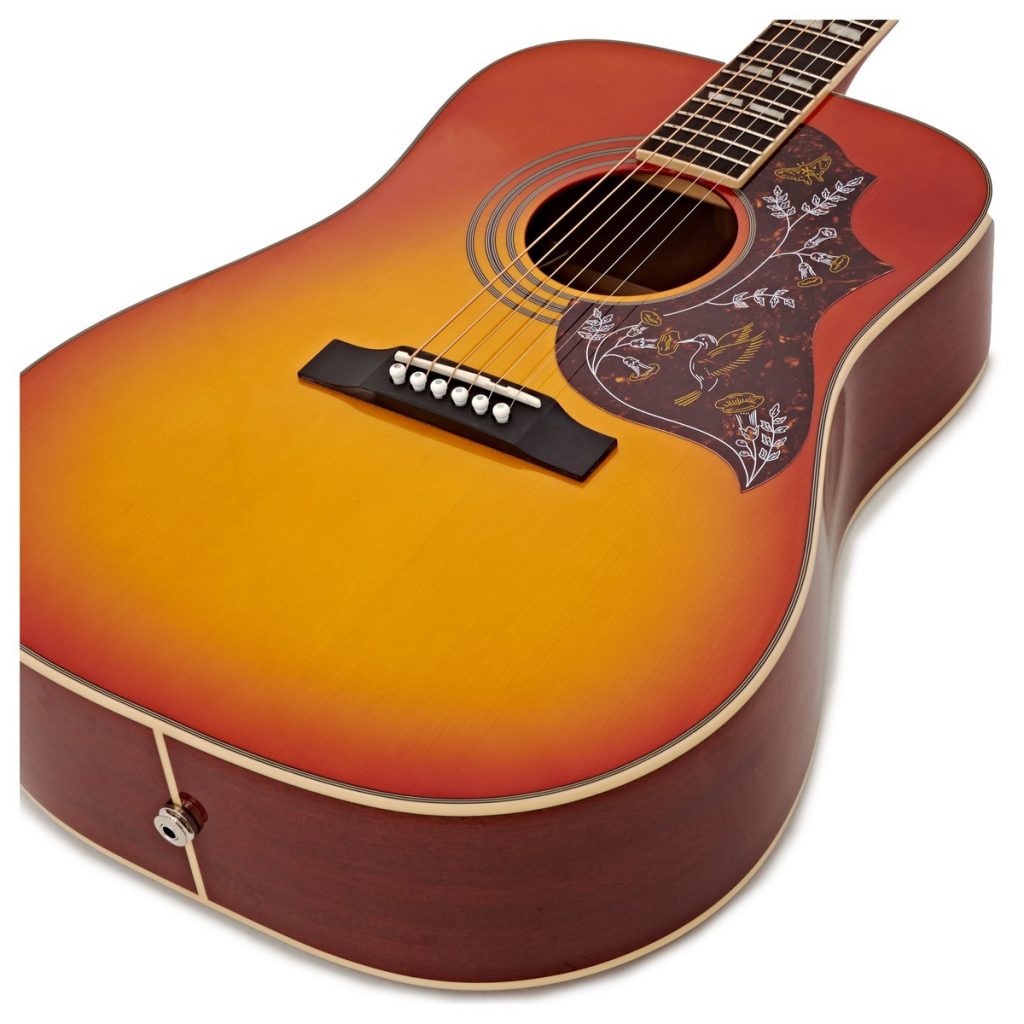
The top of the guitar sports a 5-ply black and white binding, while the back and the fingerboard have a single-ply white binding. The Epiphone Hummingbird Pro came in a striking Faded Cherry Burst finish, and the Studio keeps it.
Pearloid parallelograms serve as markers on the rosewood fretboard. The guitar inlays are effective as a visual aid so you can easily guide your fretting hand to the notes you want to play. With the pearloid inlays, you can more quickly tell which fret you are playing when looking down the guitar neck.
The scale length of the Epiphone Hummingbird Pro is at 24.75 inches and the nut width measures 1.68 inches. The guitar has a rosewood reverse belly bridge with a compensated imitation bone saddle, sturdy Grover tuning machine heads, adjustable truss rod and an imitation tortoiseshell pickguard.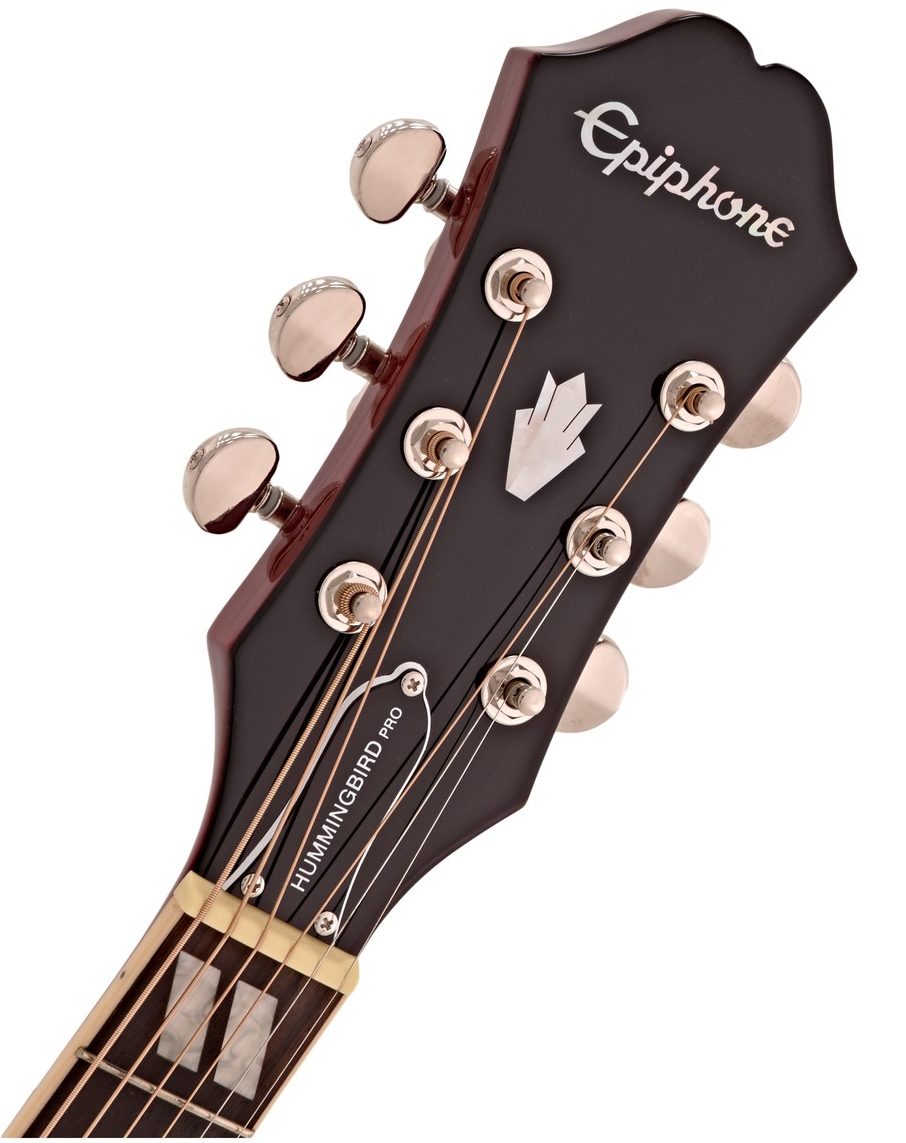
And of course, it wouldn’t be a Hummingbird guitar without the traditional hummingbird-and-flowers artwork, which very nicely stands out amid the dark pickguard. The guitar also has the trademark sloped dovewing headstock, which bears the Epiphone logo in white letters.
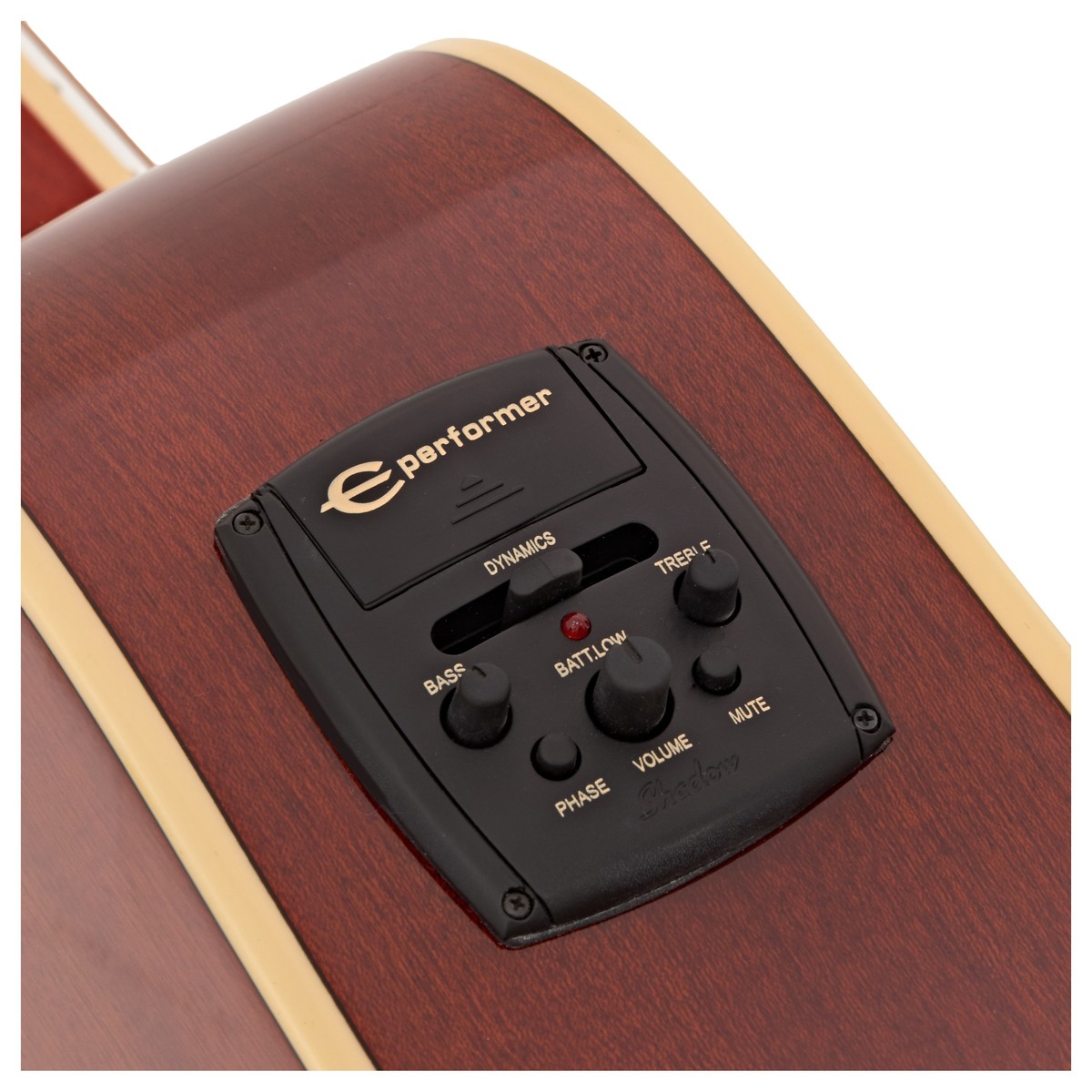
As for the onboard electronics, the controls for the preamp are located on the upper bout. Aside from a low battery indicator, there are controls for Master Volume, Mute and Treble and Bass EQ. There is also a Dynamics control slider. The pickup system, hidden away inside the soundhole just under the saddle, picks up the vibration of the strings with no problems at all.
What’s missing in the system is a built-in tuner. On the bright side, this means you have a choice of using your preferred tuner.
The overall build quality is impressive. It shows fine attention to detail and good craftsmanship. It’s easy and comfortable to play, and with its vintage appeal, you’ll find it hard to look away.
Sound Quality
The tonewoods give the Epiphone Hummingbird Pro an amazing sound quality. The solid spruce top gives the guitar plenty of resonance, making it sound big indeed. The guitar’s tone is bright, warm and rich, with a good balance across the registers.
This versatile guitar does well when playing different music genres, from rock to blues and jazz. There’s enough low-end heft for heavy strums and rock riffs. Notes are crisp and clear for fingerstyle playing and flatpicking.
Now, let’s take a moment to dig a little deeper into the Hummingbird Pro’s electronics. According to Epiphone, it has been working with Germany-based electronics company Shadow for more than a decade, looking for ways to amplify an acoustic guitar without it losing its acoustic sound. This partnership resulted in the development of the NanoFlex pickup and ePerformer Preamp.
The preamp does very well in amplifying the acoustic sound naturally. When the guitar is plugged in, bright tones sound brighter and the lows sound deeper without taking away the acoustic-ness. The controls are also pretty straightforward so you can easily tweak the output to come up with the sound you’re going for.
All in all, the Epiphone Hummingbird Pro sounds perfectly good, especially for its price.
The Epiphone Hummingbird range in 2026
- Hummingbird Studio (about $500). The Pro under its new name. Solid spruce top, mahogany back and sides, Fishman electronics, gig bag. There is also a cutaway version, the Studio EC.
- Hummingbird, Inspired by Gibson (about $750 to $900). The step up, built closer to the Gibson, which owners describe as all solid wood.
- Hummingbird Deluxe EC and the 1960 Hummingbird reissue (about $1,300). The top of Epiphone’s range.
- Gibson Hummingbird (roughly $3,500 to $4,500). The original, made in the USA.
What owners say
In November 2026 we read 16 threads and about 250 owner comments about Epiphone’s Hummingbirds on Reddit, in r/AcousticGuitar, r/Guitar and r/guitars, written between 2014 and 2026. Most recent threads are about the Studio and the Inspired by Gibson model, because the Pro is no longer sold.
What owners like most:
- The look. Epiphone gets the Hummingbird’s pickguard, color and shape right, and owners say it looks better in person than in photos.
- The Inspired by Gibson model. Owners who have played it beside a Gibson Hummingbird say the two are very close.
- Comfort. The short scale and slim neck suit long practice sessions.
What owners point out:
- At the Studio’s price, the standard advice on Reddit is to buy a Yamaha for sound and build. The Hummingbird wins on looks and feel.
- Acoustic guitars vary from one to the next, and Epiphones more than most. Several owners say to play the actual guitar before you buy.
Buying a used Hummingbird Pro
Used Pros sell for around $350. Before you pay, check that the neck is straight and the strings are not high at the 12th fret, look for the bridge lifting off the top, and plug the guitar in to make sure the Shadow preamp works, because replacement parts for it are harder to find than for the Fishman system on the Studio.
Alternatives at this price
- Fender CD-140SCE (about $450). Solid spruce top, a pickup with a tuner, and a hardshell case included.
- Epiphone J-45 EC Studio (about $360 to $400). Epiphone’s take on the other famous Gibson acoustic, with rounder shoulders.
- Guild D-240E (about $500 to $550). A plainer-looking dreadnought with a solid top and a pickup.
- Yamaha FG830 (about $420, no pickup) or the FGX830C (about $680, with one). The choice if sound comes first.
How we tested: Our reviewer played the Hummingbird Pro for the original review. For this update we checked the Hummingbird Studio’s specifications on Gibson’s own site on 22 November 2026, checked prices at Musician’s Friend and Andertons, and read owner comments on Reddit.
Frequently asked questions
Is the Epiphone Hummingbird Pro discontinued?
The name is. Epiphone now sells the same guitar as the Hummingbird Studio, which keeps the solid spruce top and mahogany body and swaps the Shadow electronics for a Fishman system. Guitars badged Hummingbird Pro are only available used.
What is the difference between the Epiphone Hummingbird and the Hummingbird Pro?
The Hummingbird Pro was Epiphone’s affordable Hummingbird from 2012, with a solid spruce top, laminated mahogany back and sides and a pickup. The Hummingbird Studio replaced it. The dearer Epiphone Hummingbird, in the Inspired by Gibson range, sits above both at about $750 to $900 and is the closest to the Gibson original.
What is the price of the Epiphone Hummingbird Pro?
It cost a little under $400 when it was on sale. Now you can only buy one used, for around $350. The Hummingbird Studio that replaced it sells for about $500 new.
Does the Epiphone Hummingbird Pro have a tuner?
No. Its Shadow ePerformer preamp has volume, bass, treble, mute and a dynamics slider, but no tuner.
Which is better, the Epiphone Dove or the Hummingbird?
They are close relatives with the same body shape. The Dove has maple back and sides and a brighter sound. The Hummingbird has mahogany and a warmer one. Choose on sound and looks.
How does the Epiphone Hummingbird compare with the Gibson Hummingbird?
The Gibson is built in the USA from solid woods and costs roughly $3,500 to $4,500. The Epiphone versions follow the same look and shape with cheaper materials. Owners of the Inspired by Gibson model say it gets surprisingly close.
Is the Epiphone Hummingbird good for beginners?
Yes. The short 24.75-inch scale and slim neck make it comfortable, and the looks make you want to pick it up. Players on Reddit point out that a Yamaha at the same price is the safer buy for sound alone, so try both if you can.
Why buy the Epiphone Hummingbird Pro?
The Hummingbird is a classic guitar trusted by a multitude of musicians the world over. The Epiphone Hummingbird Pro is a great modern version of this legendary instrument, and it’s something you’ll be proud to have as a musician whether you’re a beginner or a seasoned pro.
Is it worth the buy for beginners?
Well, yes. It’s a beautiful guitar you may not even want to put down – which is good for those who may need the motivation to practice every day. It’s comfortable and fun to play, equipped with good-quality electronics and built to last. It’s something you won’t be embarrassed to take out of the house for lessons, jamming sessions or a couple of hours of practice in the park.
If you have about $500 to spend on a guitar, the Hummingbird Studio is one of the best-looking models you can buy, and a used Hummingbird Pro costs less.