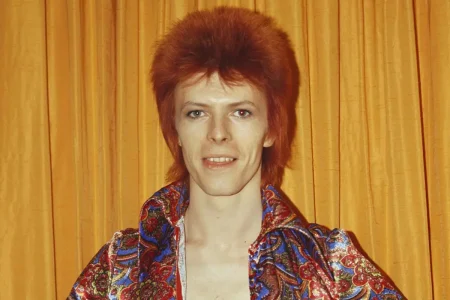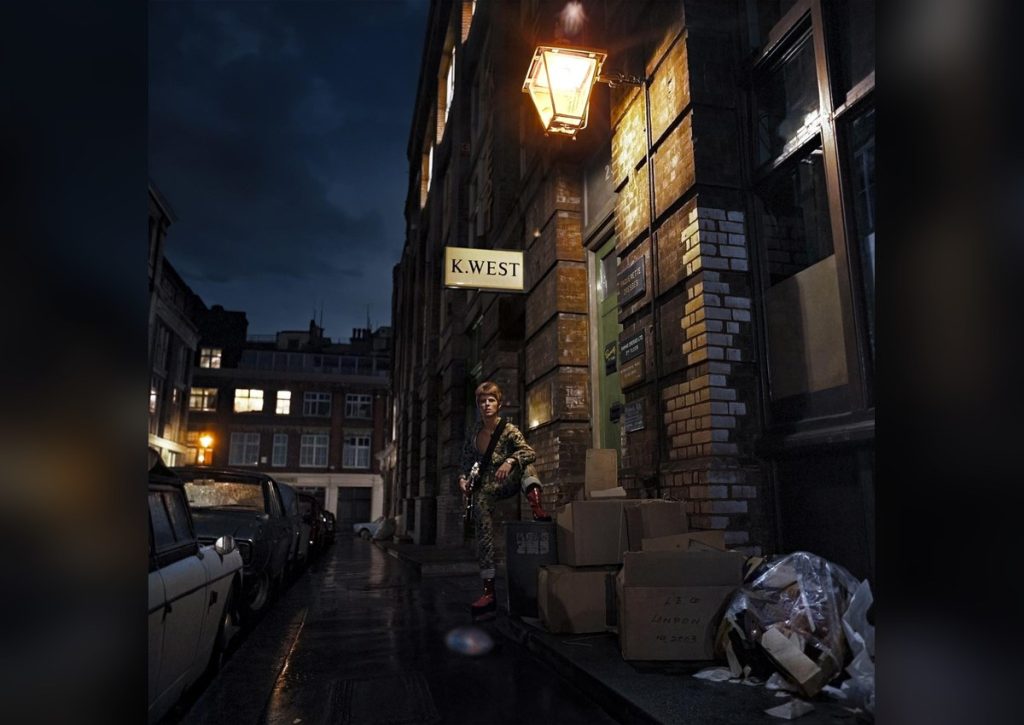
The most famous alien arrival in rock history happened in a dim London side street on a freezing January night, witnessed by nobody. The cover of The Rise and Fall of Ziggy Stardust and the Spiders from Mars — Bowie in a jumpsuit, guitar-less and luminous, boot on a bin ledge beneath a glowing “K. WEST” sign — was shot at 23 Heddon Street, a cul-de-sac off Regent Street, in January 1972. Fifty years on, the alley is a place of pilgrimage, the sign is a stolen relic, and the photograph is studied like scripture. Not bad for a quick session nobody thought twice about.
One cold night in W1
The circumstances were gloriously unglamorous. Photographer Brian Ward had a studio in the street and suggested shooting outside; the January night was so bitter that the rest of the Spiders declined to leave the warm studio, which is why the album’s mythology stars one man alone in the lamplight rather than a band. Bowie posed in the cold, in a jumpsuit, for a handful of frames. The shot chosen for the sleeve was hand-tinted into the unearthly colour of legend — turning a damp Mayfair service alley into what fans have read, ever since, as the landing site of an alien messiah.
That’s the part worth savouring: the transformation was entirely conceptual. Nothing about the location was art-directed. The gas lamps, the stacked boxes, the furrier’s sign — it was simply what was there. Bowie’s genius was understanding that a myth doesn’t need a set; it needs a figure the eye can’t explain, placed somewhere the eye knows too well.
The session produced a second landmark almost as an afterthought. Around the corner from the main shot, Ward photographed Bowie inside a red telephone box — the frame that became the album’s rear cover, and turned an ordinary K2 kiosk into the most re-enacted phone call in London. And the transformation of the front cover happened after the fact: the photographs were taken in black and white, then hand-coloured by artist Terry Pastor, whose tinting supplied the eerie, not-quite-real palette that makes the night look like no night on Earth. Ziggy’s otherworldliness, in other words, was applied by brush.
The riddle of K. WEST
The glowing sign above him belonged to K. West, a furrier occupying part of the building — as prosaic a business as London offered. Fans refused the prose. For decades, believers parsed the sign as “quest”, a planted mystical clue to Ziggy’s mission, and Bowie was asked about it enough times that he took to marvelling, with visible delight, at the meanings people had built from a fur shop’s nameplate.
The sign’s own fate completed the legend: it vanished in 1982, reportedly removed by an enthusiastic fan as the premises changed hands, making it one of rock’s great missing artefacts. The quest, as it were, continues.
The plaque
London eventually made it official. On 27 March 2012 — the album’s fortieth-anniversary year — the Crown Estate unveiled a commemorative plaque at No. 23, with Spandau Ballet’s Gary Kemp, superfan and scene descendant, doing the honours. The plaque has two lovely quirks. Installed privately rather than by English Heritage, it’s black instead of the traditional blue — fittingly off-format for its subject — and it commemorates not David Bowie but “Ziggy Stardust 1972”, making it one of the only official London plaques dedicated to a fictional being.
That inversion would have pleased its creator. The character got the plaque; the man got the alley. Fans arrive daily to recreate the pose — boot up, chin lifted — in a street that now hosts restaurant terraces where the bins stood, the Ziggy look itself having long since passed into design history.
Why the alley matters
Album-cover locations are usually trivia. Heddon Street is something more, because the image did real narrative work: it introduced Ziggy as a physical fact in a real city, standing in the London drizzle like a visitor who’d just stepped out of somewhere better. Bowie had form here — he’d launched his first great character into the space age three years earlier — but Ziggy needed the opposite of space: he needed a street, and the street needed to be ordinary.
The street itself has gentrified around its ghost — the loading bays replaced by restaurant terraces, heaters and awnings where the bins stood — and the contrast only sharpens the pilgrimage. Visitors stand in a pleasant Mayfair dining mews holding up the album sleeve, triangulating lamp and doorway, trying to see the cold, shabby 1972 alley underneath. It’s there if you look: same bricks, same lamp, same doorway arithmetic.
Every city has a thousand alleys like it. Only one has a black plaque for a Martian. The distance between those two sentences is, more or less, the size of David Bowie’s imagination — and it’s measurable, on foot, just off Regent Street, where the lamp still glows and the quest never quite ends.