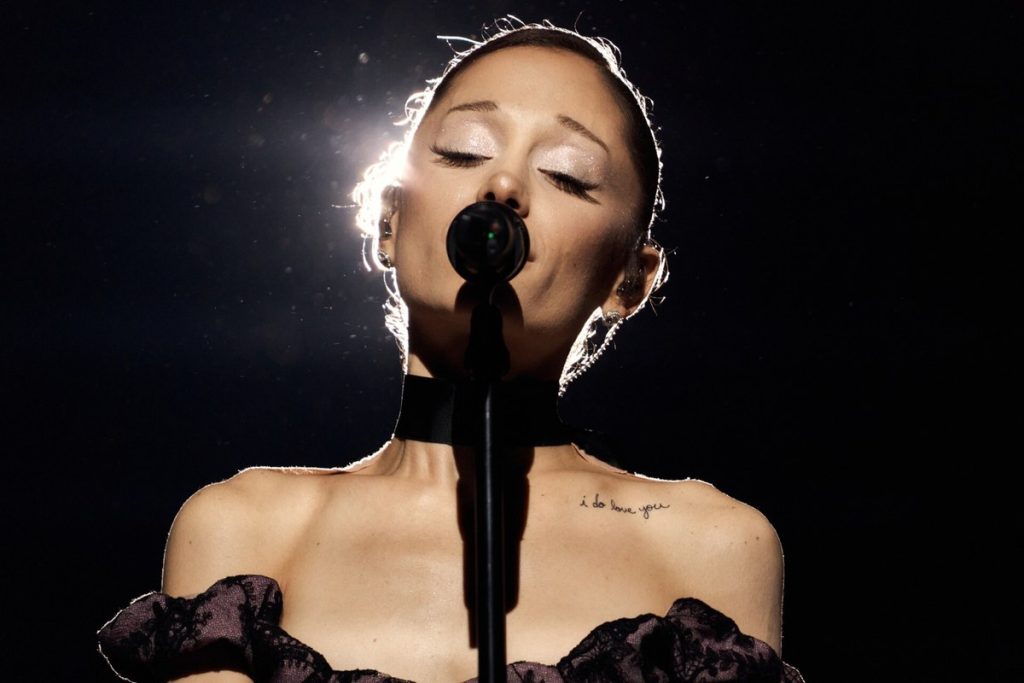
Ariana Grande has told Donald Trump’s campaign account to stop using her music, after a TikTok post set her 2024 single “We Can’t Be Friends (Wait For Your Love)” against on-screen messaging about transgender athletes. Her reply, left in the comment section of the post itself, ran to nine words: “Never use my music again. Also, your truth is false.”
It is the second time in roughly two months that Grande has publicly objected to her catalog being used this way, and the latest entry in a run of similar disputes that has drawn in a long list of American pop’s biggest names.
What the post said, and what came before it
The video went up on Thursday. Rolling Stone reported that it came from the Team Trump account, which was created during the 2024 presidential campaign. It showed the president walking toward a podium while text appeared on screen reading: “Me and my truth we sit in silence… Men can’t have babies and should never compete in women’s sports.”
The opening line is lifted straight from Grande’s lyric. The caption read: “This shouldn’t be controversial! #trump #arianagrande #maga.”
Accounts differ slightly on the clip’s origin, and the difference is worth noting. TheWrap reported that a source with knowledge of the matter stressed that neither the White House nor the president’s own account had posted the video — a distinction that carries weight, because Grande’s previous complaint in June was aimed at an official White House post. TMZ described it more loosely as a rally video posted by Trump’s team. TheWrap said the White House did not immediately respond to its request for comment.
A source told TMZ that Grande’s label is working to have the audio stripped from the post. At the time TheWrap published, the song was still attached to it.
In June, the White House posted a TikTok showing Immigration and Customs Enforcement agents arresting and handcuffing people, soundtracked by Grande’s 2024 song “Bye.” She answered in the comments, and Reuters reported her wording: “Please do not ever use my music in relation to this barbaric, inhumane, heinous nonsense.”
That one drew a direct response. White House spokesperson Abigail Jackson told Rolling Stone at the time: “We’ll say this one last time: what’s actually barbaric, inhumane, and heinous are the criminal illegal aliens who have injured and murdered innocent American citizens.”
The exchange had a precedent of its own. In September 2025, Grande re-shared an Instagram post by the writer Matt Bernstein that criticized the administration over immigration enforcement and its rhetoric about trans people. Deputy Press Secretary Kush Desai replied through Entertainment Weekly with a line built out of one of her own song titles: “Save your tears, Ariana.”
What is different this time is the specific song. “We Can’t Be Friends (Wait For Your Love)” is not an incidental piece of backing music in the new post — its lyric is quoted on screen as the setup for the political message that follows. That is a good deal harder to characterize as background scoring, and it is the part Grande responded to.
A pattern, not an isolated row
Grande is one name on a lengthening list. TheWrap noted that Taylor Swift had her song “August” removed from a Trump TikTok earlier this month, and that Noah Kahan, Sabrina Carpenter, Katy Perry, Olivia Rodrigo and Bad Bunny have all pushed back during 2026 over music used without their permission. TMZ’s own tally adds Beyoncé, Celine Dion and Rihanna.
The complaints are not new either. Rolling Stone pointed out that during the 2024 campaign the objections ranged from public statements to formal cease-and-desist letters, with the family of soul singer Isaac Hayes taking the legal route.
The practical response has been remarkably consistent, and it says something about where the leverage actually sits. Artists rarely get an instant remedy. What tends to happen instead, as reporting on both the Grande posts describes, is a public statement followed by the artist’s label approaching the platform to have the audio removed from the specific video. That worked for Swift this month. Whether it works here is still open — and it is worth noting that when Swift’s audio was pulled, TMZ reported that the campaign’s TikTok account responded by mocking her rather than backing off.
Where it leaves her
Grande is in the closing stretch of a year that she has framed as an exception rather than a new normal. She is midway through a ten-night residency at London’s O2, the final stop on the Eternal Sunshine Tour, with the run finishing on September 1. It is her first major touring outing since the Sweetener World Tour wrapped in 2019, and she has been plain that she does not expect to do it again soon.
“I’m very excited to do this small tour,” she said on Amy Poehler’s Good Hang podcast in November, in comments reported by Consequence. “I’m going to give it my all, and it’s going to be beautiful, and I’m so grateful. I think that’s why I’m doing it. Because I’m like, ‘One last hurrah.’ For now.”
“We Can’t Be Friends” sits near the end of that setlist, second to last, every night. For the next fortnight she will be singing it to twenty thousand people at a time, which is rather more control over the song’s context than a comment box affords.