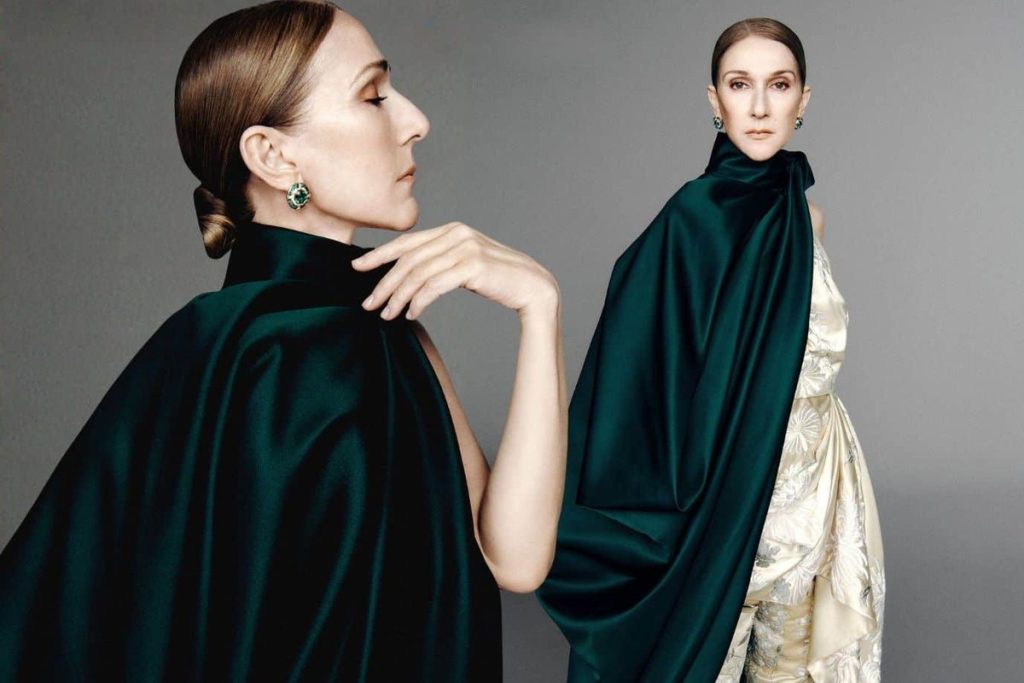
Céline Dion has spent nearly four years telling the world what stiff-person syndrome has done to her body. In a new cover profile for Harper’s Bazaar’s September ICONS issue, published Tuesday, she explains why she keeps doing it — and how close she now is to standing in front of an audience again.
“They paid for tickets. They bought my records. They gave me that luxury,” she told Harper’s Bazaar of her fans. “So the least I can do is tell them that I’m alive.”
The profile, written by Jazmine Hughes and photographed by Robin Galiegue in Las Vegas — the city where Dion’s record-breaking residencies made her name a fixture on the Strip — lands only weeks before her return to the stage in Paris. It is the fullest account she has given of her condition since her 2024 documentary, and the first in which the comeback is a booked, ticketed fact rather than a hope.
Seventeen years before anyone named it
Dion went public with her diagnosis in December 2022, in a video message that canceled a Las Vegas residency and, before long, a world tour. What the Bazaar piece makes plain is how long the illness went unidentified. She had been living with symptoms for roughly 17 years before doctors settled on stiff-person syndrome, a rare autoimmune neurological disorder that causes muscle rigidity and spasms severe enough to change how a person walks, breathes and sings.
At its worst, according to the profile, the pain was bad enough that she could barely walk, and there were days she needed a high dose of Valium simply to function.
She is particular about the vocabulary. “It is a progressive condition. I don’t like to say ‘disease,'” she said, scrunching her nose at the word and mock-scolding an imaginary Kevin for being one. It reads as a joke, but it is also a distinction she has held to consistently: the thing is ongoing and it is being managed, and she declines to let a noun turn her into a patient.
Since the diagnosis she has worked through physical therapy, vocal therapy and immunotherapy, and added new medication to her daily routine. Her first performance after going public came at the opening ceremony of the 2024 Paris Olympics, singing from the Eiffel Tower — a single, extraordinary night rather than a return to working life. This autumn is the return to working life.
What the Paris shows actually are
Accounts differ slightly on the shape of the run. HELLO! and the Daily Front Row both describe a five-week residency this fall followed by a three-week block in May 2027, while LaineyGossip counts 16 shows across September and October with ten more dates added for next May. Every version agrees on the reason for the second block: the first sold out fast enough that more dates went up almost immediately. The shows are set for Paris La Défense Arena, beginning in September.
“It’s been so long, I would like to offer them something to show how I’ve missed them,” Dion said of the fans who bought them.
Annie Horth, her head of wardrobe and creative adviser, told the magazine to expect something “grandiose,” built to accommodate the full range of what Dion does on a stage. “She goes from intimate and romantic to a vocal powerhouse, so we are creating something where she navigates that,” Horth said.
The preparation is relentlessly physical. Dion is doing 90-minute Pilates sessions three times a week and ballet classes on two of the remaining days, working with weights, a treadmill and a reformer, and spending spare time at a barre in her home gym. For a singer whose condition attacks the muscles that control breath and posture, conditioning is not vanity — it is the mechanism by which a two-hour show becomes possible at all.
The part that isn’t about illness
For all that, the profile is not a medical bulletin, and its best passages have nothing to do with her diagnosis. Mid-interview, describing her love of climbing trees — “I’m a monkey” — Dion scampers four feet up the scaffolding on a wall and extends an arm toward Hughes, as Hughes puts it, “like God did to Adam.” She remembers being allowed to sing a song or two in her family’s piano bar as a child before being sent home. “Ten years old and I’m in a bar. I could’ve been arrested,” she said. “But you know what? The police officers joined and sang with us. There was not a lot of crime then.”
She describes the years away through an image of an apple tree: herself trying to disappear behind the leaves, the leaves falling, everyone able to see her standing there with nothing left to give. “I was trying to tell them, I’m sorry, I don’t have any apples to give you anymore.” Then, she said, she heard a voice answer: “But we did not come for the apples; we came for the tree.”
Hughes’s summary of why any of this connects is the sharpest line in the piece: “But this is who she’s always been, earnest and strange, in a way that allows people to access their emotions. She is so deeply herself that it’s contagious.”
Dion’s own version is blunter, and closes the interview on the note her fans have been waiting four years to hear. “I’m honest, and it’s not always pretty,” she said. “Sometimes it’s happy things, sometimes it’s sad, but it’s called life. Instead of questioning life, can you live life? So I’m living my life, girl. I’m living the life.”